Showing posts with label Gaza. Show all posts

Tuesday, 14 June 2016

Analysing Trends in Mainstream Media Bias: RTE’s October Coverage of the 2015 Quasi-Intifada – Part One

Introduction

Section 39/1, of Ireland’s 2009 Broadcasting Act, obliges broadcasters to ensure that news reports are “presented in an objective and impartial manner and without any expression of the broadcaster’s own views.” However, RTE (Ireland’s public service broadcaster) was criticised repeatedly by an Irish pro-Israel advocacy group in its online postings, for the quality of its reportage of the onset of intensive violence during the Autumn period, which commentators often described as a prospective ‘Third Intifada’ due to the sharp rise in Arab-Palestinian attacks (stabbings, shootings and car-rammings) against Israeli civilians and security personnel. The period was also noted for an increase in protracted clashes or riotous Arab-Palestinian protests, which typically confronted Israeli forces.

While advocacy groups might be expected to be critical of news coverage that is not compatible with their views of a given issue that they represent, RTE’s news reporting on contentious issues has long been criticised by a variety of independent sources, as inaccurate, misleading, and selective in terms of the stories the Broadcaster chooses to feature. Some commentators have noted an anti-US, anti-Israel, anti-conservative slant in RTE’s coverage, which supports liberal-left stances and political parties, although hard-left political activists have argued that RTE is conservative. A senior member of the Irish Palestinian Solidarity Campaign also criticised RTE’s coverage as being racially prejudiced against Arab-Palestinians. That complaint is addressed in Part Two, in the section “Pro-Israel bias?”

This article discusses a quite large, albeit select, number of problematic examples of RTE’s television news coverage during October 2015, when coverage of the conflict was most prevalent, to attempt to represent the overall tone of coverage. Some brief examples of coverage from the middle of September to the end of November are also included. July-August 2015 coverage is also referenced to note trends in news reporting. With respect to journalistic practice, broad ethical problems concerning the conflict are also addressed. A concluding part of this series focuses in detail on two specific RTE reports, which are not discussed in Part One. RTE Player links of the principle daily television news programmes (Lunchtime News, 6.1 (6 O’clock) News, and 9 O’clock News) are only made available by the broadcaster for a limited period of time.

Background on the quasi-Intifada

While the region continued to experience significant levels of Arab-Palestinian violence, the onset of the Autumn 2015 period of intensified conflict is usually dated to the 13th of September, when Israeli security forces intervened at the al-Aqsa Mosque, to prevent an attack upon nearby Jewish worshippers closely adjacent to the Temple Mount/Haram al-Sharif compound, at the Western/Wailing Wall. Tensions grew during 2014/15 after certain Jewish activists sought changes to improve Jewish access, but Israel’s government refused to change the status quo, due to the fear that it would cause an Intifada.

The planned Arab-Palestinian attack at the Temple Mount coincided with Rosh Hashanah, the Jewish New Year, and was also a likely reaction to a policy move by former Defense Minister of Israel, Moshe Ya’alon, because he outlawed the Mourabitoun and Mourabitat Muslim groups, which were instituted to persistently harass Jewish people visiting the Temple Mount, as well as the Wailing Wall. Israel’s intervention was seen as validating Palestinian Authority President Mahmoud Abbas’ repeated claims that the Mosque was under threat. Alexander Levlovich, was perhaps the first fatality, killed in a stoning attack the following day by an Arab-Palestinian gang, when driving through East Jerusalem.

The quasi-Intifada resulted in approximately fourteen-hundred recorded attacks of Arab-Palestinian origin between the months of September and December 2015. Attacks decreased in January 2016, with 169 recorded attacks, largely matching the rate of August 2015, in which there were 171 recorded attacks. October 2015 saw the peak of this wave of terrorism, with 620 attacks.

Inconsistent news coverage

RTE’s early reportage of the renewed violence in the region was highly partial. When RTE news editors chose to report on the heightened violence, news coverage consistently highlighted Arab-Palestinian victims, albeit with the exception of one news bulletin. Four Israeli civilians were killed, and several others seriously injured, in numerous stabbing attacks, from Thursday the 1st to Friday the 2nd of October. These attacks were newsworthy because their frequency represented a stark indicator of renewed societal conflict. However, RTE’s TV news team only afforded one brief and rather belated mention, in a single Saturday the 3rd morning news bulletin, without an accompanying news report.

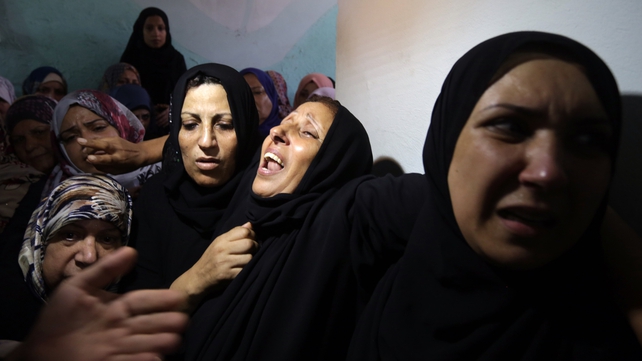
RTE’s 9th October Lunchtime television news report similarly failed to mention the high frequency of anti-Jewish violence occurring in Israel during the prior 24 hours. Instead RTE continued a trend of leading reports on Israeli/Jewish violence visited on Arab-Palestinians, with what was a probable revenge attack, which lightly-to-moderately injured four Arab men in Dimona, Southern Israel, although the Israel Security Agency (ISA) later noted that the injury to one victim was severe, with another moderately wounded, and two others injured slightly. The report included footage of grief stricken women, who were identifiably Arab-Palestinian due to their garb. The inclusion of such footage would have led viewers to the impression that the men were battling for their lives.

Whilst it was newsworthy to report on one of the rare instances of violence perpetuated by a Jewish civilian on several Arab men uninvolved in the conflict, the failure to report on anti-Jewish attacks was particularly notable since a numerically similar attack also occurred on October the 8th, which resulted in the injury of four Jewish people.

RTE’s reportage of the violent upsurge is consistent with coverage of the conflict in preceding months.

The last major international news event to come out of Israel, and the disputed territory of Judea and Samaria/West Bank, was perhaps the July 31st Duma arson attack on the Dawabshe family home. RTE’s TV coverage of the Duma attack was substantial and highly problematic. RTE reporter Carol Coleman misrepresented the reasons for Arab-Palestinian violence in the aftermath of the attack, which had a distinctly sectarian-religious (Islamist) dimension associated with the Temple Mount/Haram al Sharif. Coleman also failed to mention the associated incitement by the Palestinian Authority that often motivates such religious-sectarian violence, and presented reasonable security measures by the Israeli authorities as either a reprisal, or inciting a chain of escalating conflict.

The Broadcaster followed up on the Duma attack with reports on the death of the Dawabshe family’s father (8th August), and the death of the mother (7th September), both from burn injuries in the aftermath of the tragic arson attack. However, RTE’s television news department did not report on any of the attacks by Arab-Palestinians upon Israelis during the same period. Besides a failure to report on post-Duma Arab-Palestinian reprisals against Israelis, there was just one report on growing violence at the Temple Mount (13th September), which led with the Israeli intervention at the al-Aqsa Mosque.

RTE-Player screen-grab of revolving news text,
RTE News Now channel, Oct 15, 2015

Conflating aggressors with victims

News-presenter introductory comments for reports, typically described the growing death tolls, with numerical comparison between Arab-Palestinian deaths and Jewish-Israeli fatalities. However, such comparisons usually failed to note the widely divergent circumstances in which these deaths took place, with Arab-Palestinian deaths typically occurring in violent confrontations with army and security personnel, or during terrorist incidents. Sometimes the follow-on reports would clarify the preliminary remarks by the news-presenters but more often they did not. Such conflation is misleading at a most fundamental level because the resurgent violence relates to the matter of who is doing what to whom, e.g. an October 20th 6.1 News report mingled aggressors with victims:
Presenter Sharon Ní Bheoláin: “The UN Secretary General, Ban Ki-moon has said his trip to the Middle-East today reflects the global alarm over the escalation of violence between Israelis and Palestinians.”
Carole Coleman [voice-over of video featuring rioting youths]: “As the frustration felt by Palestinians continues to spill over into the streets, UN Secretary General Ban Ki-moon had this message for the young people…”
RTE-Player screen-grab, RTE 6.1 News, 20-October-2015, Carol Coleman report,
with captioning: "As the frustration felt by Palestinians..."


RTE would continue to lead news stories with the death and injury of Arab-Palestinians individuals, through the latter part of the period of violent escalation in November, and the nature of the fatalities would still be conflated. For example, news-presenter Eileen Dunne stated that “a surge in violence has resulted in the deaths of Israelis and Palestinians”, in the 23rd November 9 O’clock news programme.

RTE described violent riots, which have the explicit intent of clashing with police and soldiers, as “protests”. Protests are commonly understood to be largely peaceful events, which are usually borne of moral concern. The use, by the media, of such a term was especially unjust when there was a growing awareness that this episode could have represented the onset of a new Intifada, which was driven across Arab-Palestinian society by a wave of religious intolerance, with substantively anti-Semitic overtones.

RTE’s 10th October morning news text reported that the “IDF shot dead six Palestinians at the border of the Gaza Strip”. That morning’s news bulletins stated that “Protests have spread across the Israeli-occupied West Bank and Northern Israel after a day where six Palestinians were killed at the border of the Gaza strip…” The segment was short, at no more than 30 seconds, so it is unfair to expect it to be comprehensive, but it nonetheless misled with profound omissions in the description of the violence.

The segment failed to mention that the violence was initiated by Arab-Palestinians, and that further stabbing attacks in Jerusalem were committed against Jewish civilians. RTE also failed to mention that the Arab-Palestinians at the Gaza border were engaged in violence directed at a heavily armed military zone, that they were affiliated with both Hamas and Islamic Jihad, and that this riotous event was linked with Ismail Haniyeh, Hamas’ Gazan leader, who declared a new ‘Intifada’ shortly before the clash.

On the 11th October, the text-based news highlights on RTE’s ‘News Now’ channel, featured an image of grief-stricken Arab-Palestinian women, also found on the RTE website, with the accompanying words: “France has said the escalation of violence in the Palestinian territories and Jerusalem was ‘extremely worrying and dangerous’”. The use of such an emotive image, with the accompanying text, places indirect blame on the Israeli authorities for the rise in Arab-Palestinian fatalities. The image inevitably carries with it an inference that those killed were substantively innocent, when many of the fatalities targeted, and sometimes murdered, Jewish civilians.

RTE did not qualify which grouping was initiating violence against the other, even of the past events that led to the 2014 Gaza war, Operation Pillar of Cloud. The November 30th morning ‘News Now’ bulletins reported that Mohammad Abu Khdeir’s “killing was part of a cycle of violence that led to war between Israel and militants in Gaza.” RTE failed to address which group initiated the sequence of events, despite 16 months passing, and misrepresented the character of those events. The brutal murder of Abu Khadir on July 2nd 2014 was likely a reaction to Hamas’ kidnapping and murder of three Jewish teenagers in Judea and Samaria (West Bank), but war in Gaza developed as a consequence of increased rocket attacks. Some believe the attacks from Gaza increased as a result of the mass arrest of Hamas’ operatives in Judea and Samaria, but a programme of mass arrest to save three teenagers does not correspond with a “cycle of violence”. Neither can Abu Khdeir’s death be thought of as a major event leading to eventual war since the particular warring groups were not involved, and the Hamas-sanctioned rocket escalation had already begun before the 2nd July date of murder.

A notable departure

RTE’s television news department first acknowledged that Arab-Palestinians were targeting Jews in a spate of stabbing and other attacks, two weeks after the dramatic intensification, in a brief October 12th Lunchtime News report (“Palestinian man shot dead by security forces in Israel”), which stated:
“A Palestinian man suspected of attempting to stab a police officer in Jerusalem has been shot dead by security forces. It was the latest in a series of knife attacks in the past fortnight, mainly by Palestinians targeting Jews. Police said the officer was unhurt as he had been wearing a protective vest. On Friday, four people – two Israeli-Arabs and two Palestinians were injured in an apparent revenge attack.”
Oddly, the RTE report again referenced the several days-old stabbing of four Arabs, which, according to reports, largely resulted in moderate injuries. By contrast, RTE never displayed an impetus to balance reports of Jewish violence with reference to the Arab-Palestinian equivalent. Instead, it downplayed the latter.

For example, RTE’s Lunchtime, 6.1 and 9 o’clock news broadcasts (11th Oct, 10 mins) solely reported on the deaths of Arab-Palestinians:
“An Israeli airstrike on a Hamas target in the Gaza Strip hit a nearby house, killing a Palestinian woman and her daughter. This marks an escalation in recent violence, which has seen several Israelis killed and a growing number of Palestinian deaths. The increase in violence has increased fears of a new Palestinian uprising.”
There was no mention of the other attacks during the 11th of October, where, for example, an Arab-Israeli man injured four Israelis in a combined car and stabbing assault. RTE also failed to report the attempted suicide bombing by an Arab-Palestinian woman, which was disrupted by Israeli security personnel, despite the fact that the story garnered significant attention due to its circumstance.

Passive voice

RTE reports typically led with descriptions of Israeli security forces shooting dead Arab-Palestinian aggressors, or of Israeli security measures in reaction to the intensification of violence.

At times, a variant of grammatical passive voice was used in the construction of sentences for RTE’s descriptions. Such sentence structure often occurs in mainstream media reportage of the Israeli conflict. Passive voice allows authors more control over narratives, whereby the responsibility of any agent for instigating events can be obfuscated. With passive voice, the instigating group of a conflict situation can be presented as having been subjected to the actions of other parties to that conflict. It is objectionable, for confusing which side is responsible for the broad-spectrum violence, and for directing blame at those attempting to reduce the effects of the destructive acts. For example, news-presenter Brian Finnerty, Lunchtime News, 16th October reported:
“In the past month, the violence has claimed the lives of eight Israelis and more than thirty Palestinians, some of them suspected of carrying out attacks, have been killed by Israeli security forces.”
Undue skepticism

Statements, such as the above, present a double-standard, where murders, or attempted murders, were treated with scepticism, but not the reactions by the authorities. An element of scepticism is appropriate when dealing with claims made by different groupings in a state of conflict, and media reports correctly use the terms ‘alleged’ or ‘suspected’ when addressing criminal acts by individuals/groups that are not yet affirmed through legal process. Nonetheless, journalists commonly make legitimate determinations of fact, based on the security of accessible evidentiary material, and on very high probabilities, where, for example, clear intent can be ascribed to violent/criminal events. It had been firmly ascertained that a significant number of Arab-Palestinians were killed by Israel’s security forces, but it has also been ascertained that a substantive proportion of those killings were in immediate reaction to terror attacks, as the toll of Jewish casualties, and available video material to a number of the attacks, demonstrates.

With further scepticism, Carole Coleman’s October 20th Lunchtime News report describes a house demolition as “Israeli soldiers dismantling a Palestinian home in the West Bank. The army claims it’s the home of a militant who carried out a stabbing a year ago killing a woman.”

The report refers to the demolition of Maher al-Hashlamoun’s house. Al-Hashlamoun is in actual fact is a member of Islamic Jihad who was found guilty of committing several terrorist attacks, one of which led to the murder of a twenty-six year old Israeli woman. By convention, RTE attribute crimes to individuals who have been found guilty of such acts by courts of law. However, Coleman’s report would lead the viewer to suspect that the demolition is undeserved in some way, because al-Hashlamoun is supposedly innocent, or that his crimes have been insufficiently ascertained.

Notable omissions

The attacks during this period were never described as having a terrorist intent. Yet RTE is not adverse to using the term in relation to similar attacks in the West, most recently with the Belgium attacks.

RTE’s 16th November morning and Noon ‘News Now’ bulletins reported on a gun attack against Israeli troops, when the home of terrorist Mohammad abu Shahin (alternatively spelt ‘Shaheen’) was demolished in response to the murder of Danny Gonen, a Jewish hiker, during the month of June. The news-presenter stated:
“Palestinian medical sources have said Israeli troops shot dead at least two Palestinians during a gun battle in the Occupied West Bank. The Israeli military said in a statement that troops had come under attack during the operation to destroy the home of Mohammad abu Shahin… Some twenty other Palestinians were wounded in the incident as troops demolished the home of a militant whom Israel had said had killed an Israeli man in June.”
The report did not note that Shahin (Shaheen) had previously been found guilty of conspiring to commit a terror attack for which he was imprisoned between 2006 and 2008, and had more recently confessed to committing numerous other attacks. He is a member of the Fatah/Tanzim Force 17 elite terror unit. Israel’s Supreme Court issued a stay of demolition in October to evaluate the case, which was subsequently passed, while another demolition application was rejected.

Abbas’ incitement misrepresented

A 14th October 9 O’clock news report by Carole Coleman (“Two Palestinians shot dead in latest spate of attacks in Israel”) led with the deaths of Arab-Palestinians involved in a terror attack, and used material from her earlier reports that day, analysed in part two of this article. Coleman added:
“This evening Palestinian president Mahmoud Abbas held firm, saying that Palestinians would continue to struggle for the project of nation or state-hood. He spoke of the right to self defence but called for non-violent resistance.”
This is an inaccurate representation of Abbas’ speech, which did not in fact call for a de-escalation of violence. The speech endorsed the ongoing Arab-Palestinian violence, which he characterised as a defensive measure, and presented solely as a reaction to supposed Israeli aggression, particularly against the al-Aqsa Mosque. Abbas attempted to present an Arab-Palestinian teen, who engaged in a stabbing attack, as a martyr akin to Mohammad al-Dura, a story that has been utilised as a widespread source of incitement in the Arab world. Coleman’s description may have been based on the inaccurate accounts provided by a number of news-wire services. The article ‘He Said/They Said: Mahmoud Abbas October 14th speech, and the Mainstream Media’ provides a detailed account of the speech.

The speech was in keeping with the Fatah Party’s production of a substantive amount of material encouraging violence, while demonising Israeli soldiers. Coverage of trenchant PA/Fatah incitement, and associated conspiracism involving the Temple Mount/Haram al-Sharif, was entirely absent however.

By contrast, RTE’s coverage of a speech by Israeli prime-minister Benjamin Netanyahu, on October 21st, was very negative. The speech garnered international attention because Netanyahu asserted Grand Mufti Haj Amin al-Husseini had a principle role in encouraging Hitler to wholly adopt a programme of extermination against Europe’s Jewish people but soon clarified that he had no intention of exonerating Hitler. Some of RTE’s reports did include that clarification, whilst other reports did not. The revolving text on the ‘News Now’ channel stated: “Netanyahu provokes holocaust row” — a title also applied to RTE’s syndicated website coverage of the controversy. The article ‘Mufti Haj Amin al-Husseini’s Initiatory Role in the Extermination of European Jewry’ provides a detailed account of the way in which the international media misrepresented history to criticise the PM.

Obfuscation of identity

The 13th of October may be remembered as a peak in the anti-Jewish violence of the period, due to the high number of civilian casualties. The varying identities of attackers, and their victims, is of crucial importance in reports of sectarian strife, but the atypical wording of RTE coverage suggests there may have been attempts to confuse the issue. Morning and Noon news-bulletin reports, on the 13th, stated:
“In Israel at least two passengers have been killed in separate attacks on buses in Jerusalem. The first person died in a gun and knife attack on a bus in the East of the City. Police later shot him [indistinct word]. In the second, a man drove a car into a bus and then started stabbing passengers.”
These reports were peculiar for avoiding the use of identifying words like ‘Jew’. ‘Israeli’, ‘Arab’, and ‘Palestinian’, etc., even though early reports from Israel clearly delineated the identities of the attackers and their victims.

Michelle McCaughren’s October 13th Lunchtime News report differed by expressing notable sympathy for the victims. The victims of the bus attack are described as “terrified passengers who had no means of escape”. However, she continued to use impersonal descriptions like “attackers”, “men”/“man”, and “pedestrians”. She suggested one attack, involving the car-ramming of pedestrians, was indiscriminate, where the assailant got out and supposedly stabbed “anyone” who was nearby. Although McCaughren did mention that the attack took place in an Ultra-Orthodox neighbourhood, she did not clearly address the fact that Jews were targeted, including a Jewish Rabbi, who would be visibly Jewish, and that the assailants were Arab-Palestinians. Attempts to obfuscate certain identities is common in the mainstream media. The appendix has a full transcript of the report.

McCaughren’s report spent almost as much time on one of the Arab-Palestinian attackers as that of the many victims, by featuring police video of a crowd apparently kicking a would-be attacker at a Tel Aviv bus stop. The report included an extract of a speech by the Mayor of Jerusalem, Nir Barkat, telling Israeli citizens to calm down. The selection of such content suggested that the fears of the Jewish citizenry was unjustified, and/or that they were over-reacting. The report did not mention that the mayor explicitly blamed Arab-Palestinian incitement for the murders, earlier that day.

Carole Coleman’s October 19th Lunchtime News report (“Israeli forces impose tighter restrictions in Jerusalem and West Bank”) also focused to a lengthy extent on the fact that some Israelis, who had just witnessed a terrorist incident at a bus station, then attacked another suspected attacker who would later be found to have been uninvolved. While the reprisal is worthy of comment, far greater attention was paid to this incident than the terrorist attack that initiated the subsequent event.

“Palestinian territories”?

RTE (and other media outlets) typically use the terms “occupied Palestinian territories” or “Palestinian territories” for Judea and Samaria/West Bank, and “Palestinian areas of Jerusalem” for East Jerusalem, etc. For example, the RTE ‘News Now’ screen-text (‘News’ section, October 19th), stated “The Israeli government has announced tougher security measures to tackle unrest in Israel and the Palestinian territories”, while Coleman’s October 14th Lunchtime News report referred to “Palestinian areas of East Jerusalem”. It is markedly different to the term “Arab East Jerusalem”, which does not infer an expected or legally/morally justified national identity. The term is prejudicial however much it may be used by the United Nations.

The areas of East Jerusalem, and Judea and Samaria/West Bank, are politically contested territories, which have largely been ruled by empires for millennia. There has been no legitimate prior sovereign in these regions since the defeat of the Jewish Bar Kokhba Revolt against the Roman Empire, in 135 AD. Many do consider the territories to be occupied. However, the British Mandatory text defines all territory West of the Jordan river as necessarily being designated for “the Jewish National Home”, with only territory East of the Jordan river having the option of alternate applications (Article 25), with good reason since the contested territories represent the cultural and religious core of the Jewish homeland, constituting the first and second cities of Judaism (Old (East) Jerusalem and Hebron), along with its holiest of shrines and places of worship.

Some experts effectively treat Jordan as having held legitimate title but the State waged an unprovoked war of aggression against Israel, when the Jewish State first declared independence in 1948. Thus, it is clear that Jordan illegitimately occupied these territories, and so such an act cannot be a basis for valid territorial claims against another so aggressed. Moreover, the entire thrust for peace, with UN Security Council Resolution 242, the final status talks of the Oslo Accords, etc., make it clear that negotiations with the interested parties are to be the basis for a peace settlement. To describe these territories as entirely “Palestinian”, and as “occupied”, without qualification, pre-empts such a process.


Appendix

An example of language usage — transcript of the 13th of October 2015 RTE Lunchtime News report:
John Finnerty: “In Israel at least three people have been killed and thirty others wounded in a series of knife and gun attacks. It comes on a day of rage declared by Palestinian groups. The Israeli prime minister, Benjamin Netanyahu, will convene an emergency session of the security cabinet later today to discuss the recent surge in violence.”
Michelle McCaughren [reporting]: “The attacks took place as early morning commuters made their way to work. The assailants used guns and knives, and in one instance drove a car into a group of pedestrians in an ultra orthodox neighbourhood of East Jerusalem. The driver then got out, and wielding a knife, attempted to stab anyone standing nearby. The most serious incident took place earlier in the capital when two men stormed a bus. One opened fire and the other used a knife on terrified passengers who had no means of escape. It resulted in multiple casualties. One of the attackers was shot dead by police. The other was seriously injured.
In a suburb of Tel Aviv an angry crowd gather around a man suspected of trying to stab another man at a bus stop. A video distributed by the police shows him being kicked and beaten as he lies on the ground. Calling for greater security measures, the mayor of Jerusalem, Nir Barkat, appealed for calm. He said all citizens must know that they cannot take the law into their own hands. The public must calm down and let the security forces do their job.
These types of incidents have increased in frequency in recent weeks and appear to be random and sporadic. The security forces say they are difficult to predict and even more difficult to bring under control.”


Published at Crethi Plethi.

Tuesday, 26 May 2015

An Analysis of Media Narratives on Present Circumstances in Gaza

Robert Shortt, Gaza, Prime Time, May 7, 2015 (RTE Screen-grab).

Ireland’s principle broadcasting institution, RTE, ran a series of news reports by journalist Robert Shortt, which are concerned with the current troubles that the people of Gaza face, in the aftermath of ‘Operation Protective Edge’, last year’s war between Israel and several terrorist groups based in Gaza.

Shortt’s reportage echoes many of the recent accounts of the situation in Gaza found in the mainstream media. His reports form the basis of this article’s broader thematic rebuttal of current media coverage.

The most substantive report, ‘Inside Gaza’, was broadcast on ‘Prime Time’, RTE’s premium current affairs programme, on May 7th 2015 (RTE incorrectly posts the date as May 8th). The segment begins at 9:57 in RTE’s Internet Player.

An article, titled ‘RTE’s Gaza news coverage sponsored by Irish Aid’s pro-Palestinian proxy’ details possible breaches of broadcasting code in Shortt’s reports.

The report is introduced by David McCullagh, who accepted United Nations “estimates” of the civilian death toll, without mention of their true source — Hamas, which often used distorted figures for propaganda in the past.
“Last year Hamas and Israel fought a 50 day war in the Gaza strip. It was the third conflict in six years and the deadliest. The UN estimates that on the Israeli side 67 soldiers and four civilians were killed. On the Palestinian side, over 2,200 people were killed, including over 1,500 civilians, of whom 551 were children. Now many are warning that tensions are rising once again.”
Zaitoun Elementary School, 'New Crisis in Gaza', RTE News, May 9, 2015 (Screen-grab)

On the UN report: ‘attacking’ schools?

Shortt’s 11 and a half minute report highlights the suffering of children during and after the 2014 conflict. For example, he stated:
“Last July, Mara, her ten siblings, father, and mother, then heavily pregnant, fled the bombing of their home to find shelter in this UN school. Over a thousand people are still crammed into the classrooms of Zeitoun Elementary. Seven such centres were attacked by Israeli forces during the war causing 44 deaths, and 227 injuries.”
Shortt’s claim relates to the damage of seven schools studied in a UN Board of Inquiry report — its summary findings were issued on the 27th April. Shortt’s claim that Israel “attacked” seven UN schools is not credible. The report notes that one school (appertaining to ‘Incident (g)’ in the study) was not being used as a shelter, and the road outside another school (‘Incident (f)’) was struck, rather than the school itself. Moreover, the word ‘attack’ suggests an overt intentional wish to strike these UN civilian installations, which the UN report, although prejudicial in its own right, does not itself ascribe to Israeli actions.

Despite the specificity of the report, Shortt failed to properly identify the school in question. It may be an ‘United Nations Relief and Works Agency for Palestine Refugees in the Near East’ (UNRWA) school in Zeitoun (also spelt Zaitoun), called the ‘Shahada Al-Manar Elementary’, a site from which Hamas was identified to have fired weaponry, or ‘Zeitoun Preparatory Girls “B” School’. The UN report blames the IDF for a stray “projectile” striking the roof of the latter school, whilst stating that “militant activity was also noted” (Point D, 35) some hours earlier in the area, and that no IDF activity can be explicitly tied to the single strike. Therefore, to describe the school as having been “attacked” is misleading.

Shortt’s subsequent news report, discussed below, appears to reference the same building visually, but a sign identifies it as “Zaitoun Elementary Boys “B” School”, which was not one of the schools featured in the UN report, albeit related to the girls school of the same name. Shortt further remarks:
“Last week the UN dismissed Israeli claims that Hamas rockets were found in schools used as shelters but it admitted rockets were found in empty schools.”
Israel did not claim rockets had been found in schools actively used as shelters. Broad Israeli claims related to the use of active school shelters by terrorist groups, to launch attacks. Such claims were latterly disputed by witness testimony in the report but the conditions of the testimony can be deemed problematic with some justification, given potential conflicts of interest with the parties collecting it. Moreover, the word ‘dismissal’ is an undue and misleading description of the UN report’s findings. The UN report looked specifically at a small number of instances, namely those that involved UNRWA property (see Point 5 of the report), rather than provide an actual overview of the conflict:
“In its report, the Board noted that it was not within its terms of reference to address the wider aspects of the conflict in Gaza, its causes or the situation affecting the civilian populations of Gaza and Israel in the period before “Operation Protective Edge” was launched. Its task was limited to considering the ten incidents identified in its terms of reference.”
Furthermore it should be noted that inactive schools were not merely acknowledged to have been used for the storage of weaponry. Two of the three referenced sites were also used to fire against the IDF. Shortt’s report focuses on the area of Jabalia. The UN report notes an interesting event in relation to one of the area's local schools: it “was highly likely that an unidentified Palestinian armed group could have used the school premises to launch attacks on or around 14 July” (point 70) but Shortt does not appear to deem it necessary to mention such mitigating circumstance.

Shortt makes similarly misleading claims in an article on RTE’s site, which comes across as an apologia for the use of schools:
“Israel claims Hamas used school shelters to store rockets. But a report last week from the UN found the schools where rockets were located were empty and not the shelters where hundreds gathered only to come under attack once more.”
The UN report noted that the three schools in question were at summer recess so it is possible they could have been used if the war began at a slightly earlier date. They are designated civilian structures, so it is still a highly problematic matter to use them in war. Shortt et al. wish to dismiss the import of such unprecedented findings but they represent just a surface glimpse of long-established behaviour, e.g. from 2009:
‘United Nations Humanitarian Affairs Chief John Holmes told the UN Security Council, “The reckless and cynical use of civilian installations by Hamas and indiscriminate firing of rockets against civilian populations are clear violations of international humanitarian law.”’
The UN report’s findings add further credence to the long-expressed view that terror groups use human shields in civilian areas. The report only addressed three structures. An increasing number of international journalists have acknowledged that Hamas use human shields, while Ghazi Hamad, a representative of Hamas, grudgingly admitted they fired from civilian areas during the war, while civilians would have been resident.

It is time for the likes of Shortt, et al, to stop making excuses, whilst subtly inferring that Israel targets civilians intentionally, as per his claim (quoted above) that civilians were twice attacked by Israel.

Gaza’s embargo

The report mentions the failure of promised donations to materialise, but fundamentally blames the present problems on the blockade, with Siobhan Powell, of (UNRWA) echoing the notion. Shortt says:
“Israel imposed a blockade on Gaza after a violent split between Palestinians in 2007. Hamas has ruled Gaza since.”
It is not wholly accurate to describe Israel’s action as a ‘blockade’, other than with respect to its maritime activity, which cut off access to the sea beyond a six nautical mile zone, due to efforts to smuggle weaponry into Gaza. A blockade tends to be defined as “The isolation of a nation, area, city, or harbor by hostile ships or forces in order to prevent the entrance and exit of traffic and commerce.” UNRWA however notes that “Israel allows most goods into the Gaza Strip except for items it defines as “dual-use” materials which could have a military purpose.”

Israel allows some Gazan produce to be exported internationally, through its borders, and has assisted farmers in recent years with a variety of projects. Export levels remain small but have shown signs of increasing in the aftermath of the 2014 war, a situation that looks set to continue by addressing security issues.

Israel’s actions over land would be more correctly defined as a partial type of ‘embargo’, a forceful diplomatic measure adopted by some nations to limit its interaction with a given territory. Israel and the Palestinian Authority signed the Agreement on Movement & Access, allowing for free access of people and goods into Israel. However, after the 2006 elections, Hamas refused to recognise Israel’s right to exist or to curtail its violence, which led to the EU and the Quartet suspending assistance arrangements in Gaza. Hamas would then enter into a state of revolt by violently throwing off the legal structures of the Palestinian Authority in 2007, the interim arrangement toward forging of a new Arab state, with it concomitant security arrangements.

With Hamas instigating further belligerent acts, a maritime blockade was formally announced in June 2008
“In accordance with the agreements between Israel and the Palestinian Authority, entry by foreign vessels to this zone is prohibited. Israeli Notice 6/2008”
The embargo and naval blockade grew out of a worsening scenario with a belligerent seizing absolute control in a coup. As such it was and continues to be a justified measure, as the Palmer Report accepts.


Shortt on steel and cement

The limited reconstruction of Gaza should be blamed on Hamas and the international community for not ensuring that construction materials are utilised for their intended purpose. Shortt thinks differently:
“Rebuilding after a war is a huge task. Rebuilding after three wars in six years is a monumental task. Add to that a blockade and a temporary cease-fire, and it’s leading to frustration and a simmering sense of anger, which is stretching hope of return to any sort of a normal life here in Gaza to its limits.”
The destruction to some neighbourhoods nearer the Gaza border with Israel is considerable. The zones of conflict were limited however, so it is somewhat misleading to present all of Gaza as being in a near-complete state of destruction, and to present the entire enclave as being in need of reconstruction thrice-over, when there were substantive efforts to rebuild previously. In 2010 Israel significantly eased the embargo, allowing Gaza’s infrastructure to be improved, yielding results that were at times unexpected, given common perceptions of quality of life in the Strip. In 2013 Israel further eased restrictions on construction materials, until these materials were repeatedly found to have been exploited by Hamas for building terror-tunnels into Israel itself.

Shortt then presents, as an unsubstantiated claim, the notion that Hamas is using building materials to construct new tunnels to conduct assaults, when it is in fact rather more than just a mere accusation:
“Israel accuses it [Hamas] of continuing to use cement and steel to rebuild tunnels to launch attacks into its territory.”
The programme segment then leads to an apologia from a representative of Hamas. Dr. Hamad Ghazy, Hamas’ Deputy Foreign Minister, who, after indirectly justifying such acts as a defence, stated:
“We want to take precautions to prevent any possible aggression against our people, but ah we gave promises that all the building materials that come to Gaza go to people who need it. Hamas will not interfere.”
Despite the contradictory message, purposefully aimed at Western audiences, Hamas’ leaders have loudly pledged Hamas’ wish to build new tunnels, and rearm. Recent reports attest to an unpleasant reality that Hamas is intensifying its tunnel-building efforts, with the use of greater mechanisation.

Dual-use cement imports had been curtailed, due to its military usage. However, tens of thousands of tons of other building materials had been transported into the Gaza Strip since the end of the 2014 war, and Israel has in another respect liberalised the import of cement. UNRWA itself notes:
“Construction materials defined as dual-use are only permitted to enter for approved projects by international organizations and, since mid-October 2014, under the Gaza Reconstruction Mechanism (GRM), an agreement between the governments of Israel and Palestine, for private sector use. The GRM, to which UNRWA is not a party, allows for private sector imports, and hence for shelter self-help for large scale reconstruction which was not possible prior to the establishment of the GRM”
The Jewish State had restricted the import of cement due to Hamas’ efforts to obtain such materials, often via the black market, but has since lifted its restrictions.

In another news report, entitled ‘New Crisis in Gaza’, broadcast on the RTE’s 6.1 (6 o’clock) and 9 PM news programmes, and otherwise repeated cyclically on the broadcaster’s ‘News Now’ channel, Robert Shortt states:
“In Gaza they call concrete ‘grey gold’. Building materials are in such short supply that people are literally taking sledge hammers to the remnants of buildings here, to extract the steel rods and break down the concrete rubble, in order to use it again.”
Similarly, Shortt wrote:
“The dull thud of sledgehammers can be heard as people break up collapsed concrete floors. Donkeys pull carts piled with twisted steel rods literally torn from the wreckage. Such is the shortage of building materials, Gazans are recycling everything they can use.”

Cement factory representative, 'New Crisis in Gaza', RTE News, May 9, 2015 (Screen-grab)

Shortt presents this story as if individual Arab-Palestinians are remoulding rubble with their bare hands. However, there is in fact an established localised industry recycling steel bars and concrete. Shortt indeed does mention a “concrete factory was destroyed during the war and rebuilt at a cost of four million Euro” but does not tie the point to the recycling of concrete.

To quote one pro-Palestinian source critical of Israel:
“Abu Ali Daloul is one of the main traders of recycled iron bars in Gaza. He bought tons of the iron bars removed from the rubble of the recent war. He fixes the bars and prepares them to be used again for construction purposes.

The concrete rubble are transported to stone breaking workshops in order to be turned into pebbles for use on road paving projects. Abu Lebda is a stone breading [sic] workshop which recycles concrete rubble and provides brick manufacturers with pebbles to make bricks with

Malaka concrete bricks factory brings the pebbles from Abu Lebda’s stone breaking workshop and puts the amounts in its stores hoping the cement to pass through the crossings to be able to produce bricks suffecient to rebuild Gaza.”
Moreover, the recycling of steel and concrete building materials has become commonplace the world over, for environmental reasons. Shortt, however, would sooner have the viewer believe that this is a remarkable, near-unprecedented phenomenon!

An anti-Israel NGO, called Gisha, reported in January that quite substantive amounts of concrete had entered Gaza since the end of Operation Protective Edge, but very little has been used to rebuild Gazan homes, despite the fact that Gaza’s residents are entitled to free building materials if their homes are damaged. The materials were in fact sold to Hamas, and requisitioned by Hamas.


Dr. Mona el-Farra

In the Prime Time report, Shortt proceeds to discuss the more personal effects of the embargo upon Dr. Mona el-Farra, a leading member of a highly partisan NGO called the ‘Middle East Children’s Alliance’ (MECA):
“But the blockade goes deeper. Gazans cannot travel freely across their borders. Dr. Mona el-Farra was prevented from travelling to Ireland in March to speak at a conference.”
The conference in question was organised by SIPTU in Dublin. SIPTU, Ireland’s largest trade union, has long pushed for a strong anti-Israel agenda, and supports a boycott. Some made a fuss of her non-attendance at the time. Sinn Féin-IRA leader, Gerry Adams, took up el-Farra’s cause with the Minister for Foreign Affairs, Charlie Flanagan, but the conference, far from advocating a fair just solution to the Arab-Israeli conflict, actually promoted a boycott of Israel, and a one-state solution, which would destroy the self-determination of the Jewish People, in a region that is otherwise Judenrein.

Therefore, it was no surprise that el-Farra proceeded to blame Israel for not letting her travel through its borders. She suggested it was because her voice is ‘loud’. However, neither she nor the programme makers noted that both Egypt and Israel denied her passage from Gaza, nor that both states have a right to control their borders, particularly when belligerent groups lie in wait beyond these barriers!

It should be noted that the Palestinian Authority constitutes the body responsible for the issuance of Gaza’s passports, as established in the Interim agreement with Israel. It is left unsaid in Shortt’s report, but Hamas has accused its Fatah/PLO rivals of frustrating the efforts of academics and campaigners to travel from the Gaza Strip, since 2008.


For the children?

Notably, Robert Shortt’s reports focused to a significant extent on the welfare of children. He states:
“Its against this backdrop of continuing violence and confrontational politics that children like Mara attempt to grow up.”

Like many Gazan children, she has seen the horrors of war. Psychological support has helped her re-adjust.”
Similarly, to quote a promotional webpage:
“Dr El Farra was prevented from travelling to Ireland in March to speak at a conference on Gaza. Her main concern is the impact of the conflict on the children of Gaza.”
Dr. el-Farra comments further on the predicament of Gaza’s children, who suffer the effects of war:
“The direct impact is the children don’t sleep well at night, having nightmares. Different sorts of phobias. Some of them lost speech. Some of them are afraid of dark nights or back to bedwetting again.

Some cannot focus at school. They became very irritable and they cannot focus at school. And this of course has another effect which is social problems. Have restless children, quarrelous, aggressive children.

There’s no life at the moment in Gaza. You are coming as visitor but I live here, and I go everyday to the refugee camp areas, and I can see the frustration on peoples faces and souls and minds.

My concern is the youth. They will start looking for radical solutions, getting involved with more radical Islamist groups like ISIS”
In this context, Israel’s influence on Gaza, through embargo and war, is blamed for these disturbing behavioural traits. Oddly however, neither el-Farra, or the programme makers, mentioned the extent to which Hamas radicalises Gaza’s children, with thousands of youngsters going to training camps. Even some Gaza-based anti-Israel NGOs are objecting to Hamas’ use of children in this way:
“local human rights groups are accusing Hamas of exploiting children for political purposes.

“We are not disputing the right of an occupied people to resist, but it must be done by adults, not children,” one human rights activist told AFP, speaking on condition of anonymity.

“The camps are making young people aggressive instead of educating them and teaching them to abide by the law,” the activist said.”
Thus, problematic unsocial behaviour in children can equally be attributed to radicalisation. Hamas and other Arab-Palestinian factions have engaged in such behaviour, which is illegal under international law. The issue is far from recent, e.g. with the use of children in the First Arab Revolt of 1936.

Despite el-Farra’s/MECA’s professed wish to see the welfare of Arab-Palestinian children improve, the vocal defence of terrorism, and use of children for emotive conflict propaganda, may explain why they turn a blind eye to the abuse of children on their very doorstep, an abuse that even has expression in Gaza’s media. “Every Muslim mother must nurse her children on hatred of the sons of Zion” is one of Hamas’ many statements on the desired outcome of parenting.

Schools have long been a source of radicalisation in the Arab-Palestinian territories. Even children attending UNRWA’s own putatively civilian schools can experience the force of radicalisation. The headmaster of Zeitoun Elementary Boys school openly celebrates genocide and massacre. Shortt visited the school but seemingly such behaviour didn’t deserve mention!

El-Farra frets about the possibility of Islamic State becoming popular in Gaza. While the Western media presents ISIS in justifiably strong terms, due to its extraordinary bloodlust, Hamas’ speech is notably more extreme with respect to its advocacy of the genocide of all Jews, leading to the distinct possibility that the Sunni group’s bloodlust is only impeded by arguably the most sophisticated counter-terror force in the world.


Does responsibility lie with Arab-Palestinian rule?

Shortt’s coverage suggests Israel treats Gazans worse today than say a year ago. Arguably the opposite is the case. Shortt failed to report on various developments. For example, Israel facilitates the mass transit of construction materials into Gaza. Israel is doubling the water delivery to Gaza, after a crisis due to illegal drilling in the Strip’s coastal aquifer. Israel is also helping to increase the supply of electricity in the region, and may have indirectly engaged in discussions with Hamas, to construct a pipeline going from the Jewish State to Gaza to reinforce the electricity supply.

It is of course stating the obvious to say there are very limited opportunities for the people of Gaza, and that many are likely to feel a deep sense of despair. However, although conditions are extremely challenging after the damage caused by war, further Israeli initiatives, for business and reconstruction, were initiated during the latter months of 2014.

Shortt focuses on Israel’s blameworthiness for the present circumstances blighting the Gaza Strip, but what of Hamas and the Palestinian Authority themselves? The viewer only hears mention of “dysfunctional Palestinian politics”. Perhaps he hints at a topic that goes beyond Hamas’ rejectionist stances. He may refer to factionalism and corruption but viewers are not advised even though it relates strongly to the topic at hand. Is blameworthiness attributable to non-Jews of less interest to the viewer?

It is acknowledged that political factionalism has played abidingly negative role on conditions in Gaza from the very outset.

Other than previously mentioned issues, such as the dispute over passport issuance, there have been continued disagreements between Hamas and the Palestinian Authority over the payment of trans-state energy bills, which has resulted in power cuts of up to 18 hours per day. Such a measure would have a profoundly destructive impact on any economy. Likewise, the PA is believed to be intentionally slowing the payment of wages to State employees in Gaza, which constitute a substantive source of revenue to the localised economy. Lack of pay for many months has led to protests. There have been reports that Hamas is imposing another tax on imports, the monies from stressed private sectors will go into the pockets of long-unpaid members of Hamas.

Hamas have claimed that the Palestinian Authority demanded control of 50% of the monies pledged by international donors, to aid reconstruction in Gaza, whilst also stating that they rebuffed an Israeli offer to lift the embargo, and open up Gaza’s territory for shipping and air travel, in return for a long term truce. Both Fatah/PA and Hamas have of course their own agendas in attempting to commandeer billions of dollars in promised international aid.


Shortt on facts?

As we have seen, Shortt’s capacity to place blame on Israel was achieved due to significant omissions of basic fact inconvenient to his narrative. Shortt closed his Prime Time report with these troubling sentiments:
“Gaza is hemmed in by the sea and Israel. Its people are caught between dysfunctional Palestinian politics and the constant threat of war. The tide of violence breaks regularly here. Summer is coming. People fear what it may bring.”
Tellingly, Shortt made no mention of the fact that Israel’s embargo and maritime blockade is made in partnership with Egypt. This is a normative approach for the media, which largely ignores Egypt’s crucial role. Egypt has long appreciated the threat that Hamas poses to its security, as a military faction of the long proscribed Egyptian Muslim Brotherhood. Whilst the Arab nation did temporarily allow access through its borders, Egypt’s policy had broadly been harsher than that of Israel, giving little assistance at all.

Be that as it may, conditions for the people of Gaza are harsh. Siobhan Powell of UNRWA stated:
“There are no jobs so people can’t provide food for their families. It’s why we have such a dependency on assistance.”
Such a claim is an exaggeration, with the employment rate of Gaza largely remaining at 55% in recent years. Beyond the hyperbole, it is one of the highest rates in the world. The international community, including UNRWA, et al, blame Israel for such circumstance. And yet, in Israel’s defence, it does foster assistance programmes, continues to provide water and electricity (sometimes at its own peril), and supplies the assistance that keeps Gaza fed, the fuel to provide comfort and transport, and the materials to at least tentatively rebuild.

Shortt’s closing statement illustrates the problem with these normative media narratives — they flatly refuse to place any meaningful blame at Hamas’ door. Any sensible evaluation would surely conclude that when Israel withdrew from Gaza, Hamas, via the electorate’s assistance, took the opportunity to perpetuate conflict. Israel had to act to cut off a lethal belligerent operating freely on one of its borders.

The international community decry the wars with Hamas, and they decry the suffering of the populace. A highly vocal number claim that Israel should release Gaza from its embargo, and somehow peace will be found! All such a strategy will do is give Hamas carte blanche to wage a greater scale of war. As a result, Gaza’s civilians and the Israeli populace near Gaza’s border, will suffer all the more. There is no option for peace, other than Gaza being rid of Hamas, but the common ideological blind spot, which Shortt appears to suffer from, has to blame Israel for not only for its own legitimate defensible actions, but for the pain Hamas visits on the populace that voted it in on a mandate of continued strife.
“We shall not rest until our entire holy land is liberated … To the Zionists we promise that tomorrow all of Palestine will become hell for you” (Memri)


Also published at Crethi Plethi.

RTE’s Gaza News Coverage Sponsored by Irish Aid’s Pro-Palestinian Proxy

Focusing on gun held by IDF interviewee, RTE, Prime Time, May 7, 201515 (RTE screen-shot)

RTE, Ireland’s monopolistic public service broadcaster, ran a series of news reports by veteran RTE journalist Robert Shortt, relating to the current difficulties that the people of Gaza experience, in the aftermath of ‘Operation Protective Edge’, the 2014 war between Gaza’s belligerent groups and Israel.

The most detailed report, ‘Inside Gaza’, was broadcast on Prime Time, RTE’s premium current affairs programme, on May 7th 2015 (RTE’s Internet player May 8th date is incorrect). The segment begins at 9:57 in the Internet Player. Robert Shortt’s visit to Gaza was also featured in radio programming (cf. World Report, Radio One, May 3rd) and in RTE’s news articles.

To summarise, the Prime Time report asserts that a humanitarian crisis is on the horizon, due to a lack of promised international donations and Israel’s embargo. Shortt reinforces the latter as the primary reason for Gaza’s weak recovery, and he suggests little reconstruction occurred after prior wars. There is no mention that Israel has supplied large amounts of construction materials, including cement. Shortt presents the stance that Hamas has diverted cement and steel, to build tunnels, as an Israeli claim rather than fact, even though Hamas acknowledges it. There is no mention of Egypt’s embargo in the reports.

Shortt repeatedly used the word ‘attack’ in relation to the findings of the UN Board of Inquiry report into the incidents at seven UN schools. This is a wholly misleading assertion, as the report does not make findings of intent to harm and kill in the schools inspected. In fact, the sole finding of intent in the UN report asserts that the injury and death caused at one school was in error whilst pursuing terrorists. Shortt also appeared to infer that the IDF purposely targets civilians, when he spoke of “the shelters where hundreds [of civilians] gathered only to come under attack once more.”

To Shortt’s credit, he did allow some voice to Israeli views, with the interview of two Ìsraeli individuals in the middle of the segment, which provided some perspectival balance with the opinions of those Arab-Palestinians interviewed. However, his narrational voice, which carries greater authority for viewers, provided a prejudicial account, belying the superficial sense of balance their voices bring. Indeed he went as far as to undermine the views of the of two Ìsraelis featured, by broadly accusing Israeli people of being narrow-minded, and caring little for the welfare of Arab-Palestinian children:
“On the other side of the border, everything is seen through the prism of the threat posed to Israel, including attacks on [Gaza’s] UN schools.”
It would not be unreasonable to argue that the report breaches the codes of the Broadcasting Authority of Ireland. The BAI’s ‘Code of Fairness, Objectivity & Impartiality In News and Current Affairs’ states that:
“Views and facts shall not be misrepresented or presented in such a way as to render them misleading. Presenters should be sensitive to the impact of their language and tone in reporting news and current affairs so as to avoid misunderstanding of the matters covered.” (Page 11, section 19)
The article ‘An analysis of media and NGO narratives on present circumstances in Gaza’ provides an in-depth study of the many inaccuracies in Shortt’s reportage from Gaza.

Dr. Mona el-Farra, interviewed on RTE's Prime Time (RTE screen-shot).

The Middle East Children’s Alliance

Shortt’s reports focus on the suffering of children, with extended commentary by Dr. Mona el-Farra, of the Middle East Children’s Alliance (MECA).

MECA is reported to have funded the International Solidarity Movement (ISM), which has a record for promoting and giving active terrorists cover. One might think MECA is soft on terrorism, but it appears to be even worse than that! El-Farra, MECA’s Director of Gaza Projects, asserted that MECA refused funding from USAID because (to quote NGO Monitor):
“it came with the condition that they promise “not [to] give any help or any aid whatsoever for the families of the militiamen, or their relatives, or anyone related to ‘terrorist attacks’” because “we consider it resistance”.”
MECA’s founder, Barbara Lubin, was caught telling a story that comes across as a modern day equivalent of an anti-Semitic blood-libel, which she latterly distanced herself from, and MECA has failed to verify:
“I met a mother who was at home with her ten children when Israeli soldiers entered the house. The soldiers told her she had to choose five of her children “to give as a gift to Israel”. […] Then these soldiers murdered five of her children in front of her. The concept of “Jewish morality” is truly dead. […] We have to end the Zionist state. We’ve got to charge the war criminals. We have to boycott Israeli goods.”
The above is the sort of statement that undermines the oft-asserted claim, by anti-Israel critics and activists, that criticism of Zionism and Israel does not equate with anti-Semitism, or indeed self-hatred in this particular case. MECA normatively present stark one-sided propagandistic narratives, such as with the organising of a notorious exhibit supposedly of artwork by Arab-Palestinian children, of dubious provenance.

El-Farra is a contentious figure in her own right, who unfortunately receives uncritical treatment in the mainstream media the world over, despite the fact that she is hardly a balanced commentator. For example, she hysterically claimed Israel intended to violently attack the May 2010 flotilla, despite the fact that there was a violent fracas on one ship alone, the Mavi Mariner, its crew having planned to attack boarding IDF soldiers:
“Israel meant to attack the flotilla and it is trying to cover up this reality with propaganda,” Mona el-Farra, a doctor in Gaza, told Socialist Worker. “Israel is committing crimes against humanity.”
The use of such a propagandist group should be a problematic matter for news programme makers. It is unethical to make no mention of MECA’s intense political advocacy and its likely support of terrorism.


Motivations

Robert Shortt’s news-reports focused on the purported intensification of the crisis situation inside Gaza. His May 7th Prime Time report begins and similarly ends in an apocalyptic fashion:
“Hopelessness, impatience and anger threaten a fragile ceasefire. Many now fear the ghost of war will return. […]
The tide of violence breaks regularly here. Summer is coming. People fear what it may bring.”
The reports cited unnamed NGOs warning of a downward spiral, which, it is claimed, could lead to violence over the Summer period. Subsequently, only one NGO is referenced, Dr. el-Farra’s MECA. Shortt tweeted on the 5th of May:
“Dr Mona El Farra @MECAForPeace couldn’t come to Dublin. So we went to #Gaza.”
El-Farra was not granted permission to leave Gaza by both Egypt and Israel, although she only blames the Jewish State. Shortt’s tweet suggests a rather less than impartial motive for travelling to Gaza, given the focus of the exercise was to interview a noted propagandist who is a senior member of a trenchant anti-Israel NGO.

The troubles in Gaza are nothing new, often being stimulated by Hamas’ choice of going to war, and its refusal to co-operate with Israel. Shortt and MECA appear to have shaped the ongoing and substantive difficulties in Gaza as turning toward a dramatic low-point, when, in some respects, matters appear to be improving, albeit slowly, with respect to Israel’s actions. The limitations on the supply of cement have been relaxed, exports are modestly increasing, and there have been increases in both the water and electricity supplies.

These matters received no coverage in the reports however, and while mention of criticism of Hamas was referenced, little was said about Hamas’ various unhelpful contributions to the local economy.

Less than forthcoming

Near the very end of the closing credits for the 7th May Prime Time programme, it is written:
“GAZA REPORT
Made with the support of the Simon Cumbers Media Fund.”
Prime Time's acknowledgement of the involvement of the
Simon Cumbers Media Fund (RTE Screen-grab).

The blink and the viewer would miss it statement would raise questions about the objectivity of any news report so funded by an organisation external to the broadcaster itself. The involvement of the Simon Cumbers Media Fund was not noted in any other way for the viewing audience.

The report was seemingly promoted over that of other programme segments, perhaps indicating the importance that RTE’s editors attached to the material. There was no mention of assistance by the Simon Cumbers Media Fund in the promotions.

It is arguably a breach of broadcasting guidelines to make the statement so inaccessible to viewers, and to present the nature of this outside organisation’s contribution to the programme in so ambiguous a fashion. RTE’s own guidelines on sponsorship, in the subsection ‘Editorial Integrity’, note that:
“The presence of sponsorship must be clearly indicated to the programme audience. Furthermore a sponsor must not have any editorial input or involvement in programming or scheduling, nor should there be reasonable grounds on the part of the viewer to believe that input or influence does exist. For these reasons the broadcaster must carefully consider the suitability of any potential sponsorship arrangements.”
While the dimension of the Simon Cumbers Media Fund’s input is unclear, an analysis (see below) of their activities, and relationship to Irish Aid, would suggest influence in financial and editorial terms.

Indeed, RTE subsequently took the step of clearly informing viewers in the introduction to a related report by Robert Shortt, entitled “New Crisis in Gaza” (broadcast 9th May). The RTE news presenter Úna O’Hagan stated:
“This report by Robert Shortt was supported by the Simon Cumbers Media Fund.”
The Prime Time report was not updated in a similar fashion, at the date of this article’s publishing.


Irish Aid’s connection to the Simon Cumbers Media Fund

The Simon Cumbers Media Fund appears to be a form of proxy organisation for Irish Aid, Ireland’s overseas development programme run by the Department of Foreign Affairs. The Simon Cumbers website acknowledges Irish Aid started and funds their group:
“In 2005, a little over a year after the tragic death of Irish journalist Simon Cumbers, Irish Aid established the Simon Cumbers Media Fund to honour his memory. The aim of the Fund is to assist and promote more and better quality media coverage of development issues”
The same website features a section entitled ‘About Irish Aid’, which explains that the fund acts as a media wing of Irish Aid:
“The media play a crucial role in promoting public understanding of global issues. The Simon Cumbers Media Fund was established by Irish Aid in 2005 in memory of the late Irish journalist and cameraman, Simon Cumbers. Irish Aid has invested in the Fund to help create a space to broaden and deepen coverage of global development issues in Ireland. The Fund is intended to facilitate coverage which presents a balanced and realistic picture of the challenges — and also the opportunities — that developing countries face, and of progress achieved.”
Some of Shortt’s news coverage briefly refers to Gaza’s funding by Irish Aid, for example, with respect to the funding of UNRWA’s projects in Gaza, Shortt notes that “€4million of Irish Aid will support its work this year.”

Irish Aid’s website refers to the organisation’s mission statement as:
“To help achieve our goal of eradicating poverty and hunger in the world’s poorest countries, the Government allocates significant funding to our aid programme.”
‘Palestine’, rather than say a contested territory, much of which is termed ‘Judea and Samaria, more latterly called the ‘West Bank’, is one of Irish Aid’s fourteen “partner countries”, although this designated territory has not in fact constituted a sovereign state since the Bar-Kokhba Revolt, which was crushed by Rome in 135 AD.

With such a peculiar account of history implicit on the naming Irish Aid applies, it is unsurprising that they almost wholly adopt the pro-Palestinian narrative over a whole host of issues, including the indefensible water apartheid charge:
“Occupation and the impact of the ongoing conflict are amongst the primary obstacles to development in the occupied Palestinian territory. Restrictions on the movement of people and goods, the lack of access to land and water resources, the separation of the West Bank and Gaza, the Gaza blockade and the fragmentation of the West Bank continue to disrupt progress.
We recognise that long-term, sustainable development in Palestine is closely linked to a successful outcome to the Middle East Peace Process, which remains a key foreign policy priority for the Government. We now provide more than €10 million annually in support to the Palestinian people to help them deliver on their development priorities, to support the promotion of human rights and to meet immediate humanitarian needs.”
Such a crass one-sided narrative reads like the kind of screed featured on propagandistic websites like Mondo Weiss, rather than a state-run developmental fund. If the above was truly the case, one must wonder why the Palestinian Authority has repeatedly rebuffed near 100% territorial concessions from Israel. Could it not be that a century of war-like genocidal pan-Arab incitement has made peace a very distant dream? Unfortunately, Irish Aid has long used revenue from the Irish tax payer, and other states including the UK, to campaign in a highly politicised fashion against Israel, by funding prejudicial and intentionally demonising NGOs, the sort of groups that perpetuate hostility rather than try to heal it.

Irish Aid supports groups with highly problematic records, e.g. Irish charity Trocaire, attempts to bring trenchant pro-Palestinian propaganda into Ireland’s education system. Al Haq’s leading figure, Shawan Jabarin, has ties to the PFLP, a particularly blood-thirsty leftist Arab-Palestinian terror group. Irish Aid is a major contributor to the PCHR, which uses inciteful invective, such as the charge that Israel is pushing for the “Judaization of Jerusalem.”, describing the rededication of an important synagogue as a “war crime”. An NGO called Miftah advanced an old anti-Semitic blood libel, claiming Jews use Christian blood in Passover matzah bread.

Little wonder then that the groups Irish Aid funds advocate ‘right of return’, namely the end of Israel’s status as a principally Jewish state through a mass demographic influx. Ireland ostensibly commends a two-state solution, based upon the principle of two states for two peoples, but it can be inferred that the Irish State supports the effective end of a sovereign state, even though it is not founded on international law in any genuine sense.

In harmony with Irish Aid’s funding, the Simon Cumbers Media Fund publishes one-sided articles supportive of the ‘right of return’, and criticism of the security barrier which was largely instrumental in bringing the savage Second Intifada to an end in 2005.

Codes of conduct

Despite being seasoned reporters and producers, working on material to be broadcast on RTE’s flagship current affairs show, the programme makers breached both the BAI’s codes and RTE’s own professed standards, on fairness, balance, accuracy, and objectivity, in a very overt fashion. Severe breaches of objectivity are not new to Prime Time.

Number 25 of the section ‘Objectivity & Impartiality Rules’, in the BAI’s ‘Code of Fairness, Objectivity & Impartiality In News and Current Affairs’ booklet (page 12) notes:
“Each broadcaster shall have and implement appropriate policies and procedures to address any conflicts of interests that may exist or arise in respect of anyone with an editorial involvement in any news or current affairs content, whether such person works on-air or off-air.”
Thus, it would seem that RTE did not implement appropriate procedures to avoid serious editorial conflicts. The terms of Section 26, of the same booklet, indicate that the makes of Prime Time were remiss in not calling the audience to the attention of the Simon Cumbers Media Fund’s involvement before, during, or immediately after the segment, and not specifying the nature of their involvement:
“Any personal, professional, business or financial interest of anyone with an editorial involvement in news or current affairs content that calls into question (or that might reasonably be perceived as calling into question) the fairness, objectivity or impartiality of a programme or item, shall be brought to the attention of the audience. To this end broadcasters shall satisfy themselves that they are in a position to be aware of the relevant interests of the personnel concerned”
The BAI’s ‘Code of Fairness, Objectivity & Impartiality in News and Current Affairs Guidance Notes’ (July 2013), addresses the issue of objectivity in a more explanatory fashion. The booklet discusses the involvement of outside parties in news and current affairs coverage, stating (page 24):
“It is also important that broadcasters take appropriate measures to ensure, insofar as possible, that independent producers or freelance staff do not have any interests which could undermine the fairness, objectivity and impartiality of the output they produce for the broadcasters.”
The BAI notes (page 20), with respect to news originating from social media Internet sites:
“Potential for bias: is the information emanating from a lobby or representative group? Are there any political/religious/commercial affiliations?”
The BAI’s point however is equally applicable to other sources of information, such as Dr. el-Farra, a senior member of ‘Middle East Children’s Alliance’, a highly politicised NGO. According to Shortt, her opinions on Gaza were the sole or principle purpose of his team having decided to visit the region.


Also published at Crethi Plethi.