Showing posts with label Terrorism. Show all posts

Tuesday, 14 June 2016

Analysing Trends in Mainstream Media Bias: RTE’s October Coverage of the 2015 Quasi-Intifada – Part One

Introduction

Section 39/1, of Ireland’s 2009 Broadcasting Act, obliges broadcasters to ensure that news reports are “presented in an objective and impartial manner and without any expression of the broadcaster’s own views.” However, RTE (Ireland’s public service broadcaster) was criticised repeatedly by an Irish pro-Israel advocacy group in its online postings, for the quality of its reportage of the onset of intensive violence during the Autumn period, which commentators often described as a prospective ‘Third Intifada’ due to the sharp rise in Arab-Palestinian attacks (stabbings, shootings and car-rammings) against Israeli civilians and security personnel. The period was also noted for an increase in protracted clashes or riotous Arab-Palestinian protests, which typically confronted Israeli forces.

While advocacy groups might be expected to be critical of news coverage that is not compatible with their views of a given issue that they represent, RTE’s news reporting on contentious issues has long been criticised by a variety of independent sources, as inaccurate, misleading, and selective in terms of the stories the Broadcaster chooses to feature. Some commentators have noted an anti-US, anti-Israel, anti-conservative slant in RTE’s coverage, which supports liberal-left stances and political parties, although hard-left political activists have argued that RTE is conservative. A senior member of the Irish Palestinian Solidarity Campaign also criticised RTE’s coverage as being racially prejudiced against Arab-Palestinians. That complaint is addressed in Part Two, in the section “Pro-Israel bias?”

This article discusses a quite large, albeit select, number of problematic examples of RTE’s television news coverage during October 2015, when coverage of the conflict was most prevalent, to attempt to represent the overall tone of coverage. Some brief examples of coverage from the middle of September to the end of November are also included. July-August 2015 coverage is also referenced to note trends in news reporting. With respect to journalistic practice, broad ethical problems concerning the conflict are also addressed. A concluding part of this series focuses in detail on two specific RTE reports, which are not discussed in Part One. RTE Player links of the principle daily television news programmes (Lunchtime News, 6.1 (6 O’clock) News, and 9 O’clock News) are only made available by the broadcaster for a limited period of time.

Background on the quasi-Intifada

While the region continued to experience significant levels of Arab-Palestinian violence, the onset of the Autumn 2015 period of intensified conflict is usually dated to the 13th of September, when Israeli security forces intervened at the al-Aqsa Mosque, to prevent an attack upon nearby Jewish worshippers closely adjacent to the Temple Mount/Haram al-Sharif compound, at the Western/Wailing Wall. Tensions grew during 2014/15 after certain Jewish activists sought changes to improve Jewish access, but Israel’s government refused to change the status quo, due to the fear that it would cause an Intifada.

The planned Arab-Palestinian attack at the Temple Mount coincided with Rosh Hashanah, the Jewish New Year, and was also a likely reaction to a policy move by former Defense Minister of Israel, Moshe Ya’alon, because he outlawed the Mourabitoun and Mourabitat Muslim groups, which were instituted to persistently harass Jewish people visiting the Temple Mount, as well as the Wailing Wall. Israel’s intervention was seen as validating Palestinian Authority President Mahmoud Abbas’ repeated claims that the Mosque was under threat. Alexander Levlovich, was perhaps the first fatality, killed in a stoning attack the following day by an Arab-Palestinian gang, when driving through East Jerusalem.

The quasi-Intifada resulted in approximately fourteen-hundred recorded attacks of Arab-Palestinian origin between the months of September and December 2015. Attacks decreased in January 2016, with 169 recorded attacks, largely matching the rate of August 2015, in which there were 171 recorded attacks. October 2015 saw the peak of this wave of terrorism, with 620 attacks.

Inconsistent news coverage

RTE’s early reportage of the renewed violence in the region was highly partial. When RTE news editors chose to report on the heightened violence, news coverage consistently highlighted Arab-Palestinian victims, albeit with the exception of one news bulletin. Four Israeli civilians were killed, and several others seriously injured, in numerous stabbing attacks, from Thursday the 1st to Friday the 2nd of October. These attacks were newsworthy because their frequency represented a stark indicator of renewed societal conflict. However, RTE’s TV news team only afforded one brief and rather belated mention, in a single Saturday the 3rd morning news bulletin, without an accompanying news report.

RTE’s 9th October Lunchtime television news report similarly failed to mention the high frequency of anti-Jewish violence occurring in Israel during the prior 24 hours. Instead RTE continued a trend of leading reports on Israeli/Jewish violence visited on Arab-Palestinians, with what was a probable revenge attack, which lightly-to-moderately injured four Arab men in Dimona, Southern Israel, although the Israel Security Agency (ISA) later noted that the injury to one victim was severe, with another moderately wounded, and two others injured slightly. The report included footage of grief stricken women, who were identifiably Arab-Palestinian due to their garb. The inclusion of such footage would have led viewers to the impression that the men were battling for their lives.

Whilst it was newsworthy to report on one of the rare instances of violence perpetuated by a Jewish civilian on several Arab men uninvolved in the conflict, the failure to report on anti-Jewish attacks was particularly notable since a numerically similar attack also occurred on October the 8th, which resulted in the injury of four Jewish people.

RTE’s reportage of the violent upsurge is consistent with coverage of the conflict in preceding months.

The last major international news event to come out of Israel, and the disputed territory of Judea and Samaria/West Bank, was perhaps the July 31st Duma arson attack on the Dawabshe family home. RTE’s TV coverage of the Duma attack was substantial and highly problematic. RTE reporter Carol Coleman misrepresented the reasons for Arab-Palestinian violence in the aftermath of the attack, which had a distinctly sectarian-religious (Islamist) dimension associated with the Temple Mount/Haram al Sharif. Coleman also failed to mention the associated incitement by the Palestinian Authority that often motivates such religious-sectarian violence, and presented reasonable security measures by the Israeli authorities as either a reprisal, or inciting a chain of escalating conflict.

The Broadcaster followed up on the Duma attack with reports on the death of the Dawabshe family’s father (8th August), and the death of the mother (7th September), both from burn injuries in the aftermath of the tragic arson attack. However, RTE’s television news department did not report on any of the attacks by Arab-Palestinians upon Israelis during the same period. Besides a failure to report on post-Duma Arab-Palestinian reprisals against Israelis, there was just one report on growing violence at the Temple Mount (13th September), which led with the Israeli intervention at the al-Aqsa Mosque.

RTE-Player screen-grab of revolving news text,
RTE News Now channel, Oct 15, 2015

Conflating aggressors with victims

News-presenter introductory comments for reports, typically described the growing death tolls, with numerical comparison between Arab-Palestinian deaths and Jewish-Israeli fatalities. However, such comparisons usually failed to note the widely divergent circumstances in which these deaths took place, with Arab-Palestinian deaths typically occurring in violent confrontations with army and security personnel, or during terrorist incidents. Sometimes the follow-on reports would clarify the preliminary remarks by the news-presenters but more often they did not. Such conflation is misleading at a most fundamental level because the resurgent violence relates to the matter of who is doing what to whom, e.g. an October 20th 6.1 News report mingled aggressors with victims:
Presenter Sharon Ní Bheoláin: “The UN Secretary General, Ban Ki-moon has said his trip to the Middle-East today reflects the global alarm over the escalation of violence between Israelis and Palestinians.”
Carole Coleman [voice-over of video featuring rioting youths]: “As the frustration felt by Palestinians continues to spill over into the streets, UN Secretary General Ban Ki-moon had this message for the young people…”
RTE-Player screen-grab, RTE 6.1 News, 20-October-2015, Carol Coleman report,
with captioning: "As the frustration felt by Palestinians..."


RTE would continue to lead news stories with the death and injury of Arab-Palestinians individuals, through the latter part of the period of violent escalation in November, and the nature of the fatalities would still be conflated. For example, news-presenter Eileen Dunne stated that “a surge in violence has resulted in the deaths of Israelis and Palestinians”, in the 23rd November 9 O’clock news programme.

RTE described violent riots, which have the explicit intent of clashing with police and soldiers, as “protests”. Protests are commonly understood to be largely peaceful events, which are usually borne of moral concern. The use, by the media, of such a term was especially unjust when there was a growing awareness that this episode could have represented the onset of a new Intifada, which was driven across Arab-Palestinian society by a wave of religious intolerance, with substantively anti-Semitic overtones.

RTE’s 10th October morning news text reported that the “IDF shot dead six Palestinians at the border of the Gaza Strip”. That morning’s news bulletins stated that “Protests have spread across the Israeli-occupied West Bank and Northern Israel after a day where six Palestinians were killed at the border of the Gaza strip…” The segment was short, at no more than 30 seconds, so it is unfair to expect it to be comprehensive, but it nonetheless misled with profound omissions in the description of the violence.

The segment failed to mention that the violence was initiated by Arab-Palestinians, and that further stabbing attacks in Jerusalem were committed against Jewish civilians. RTE also failed to mention that the Arab-Palestinians at the Gaza border were engaged in violence directed at a heavily armed military zone, that they were affiliated with both Hamas and Islamic Jihad, and that this riotous event was linked with Ismail Haniyeh, Hamas’ Gazan leader, who declared a new ‘Intifada’ shortly before the clash.

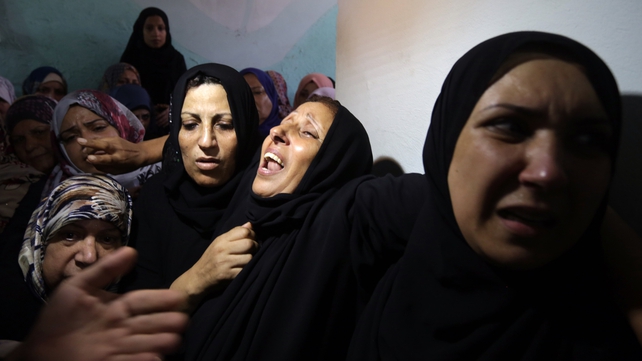
On the 11th October, the text-based news highlights on RTE’s ‘News Now’ channel, featured an image of grief-stricken Arab-Palestinian women, also found on the RTE website, with the accompanying words: “France has said the escalation of violence in the Palestinian territories and Jerusalem was ‘extremely worrying and dangerous’”. The use of such an emotive image, with the accompanying text, places indirect blame on the Israeli authorities for the rise in Arab-Palestinian fatalities. The image inevitably carries with it an inference that those killed were substantively innocent, when many of the fatalities targeted, and sometimes murdered, Jewish civilians.

RTE did not qualify which grouping was initiating violence against the other, even of the past events that led to the 2014 Gaza war, Operation Pillar of Cloud. The November 30th morning ‘News Now’ bulletins reported that Mohammad Abu Khdeir’s “killing was part of a cycle of violence that led to war between Israel and militants in Gaza.” RTE failed to address which group initiated the sequence of events, despite 16 months passing, and misrepresented the character of those events. The brutal murder of Abu Khadir on July 2nd 2014 was likely a reaction to Hamas’ kidnapping and murder of three Jewish teenagers in Judea and Samaria (West Bank), but war in Gaza developed as a consequence of increased rocket attacks. Some believe the attacks from Gaza increased as a result of the mass arrest of Hamas’ operatives in Judea and Samaria, but a programme of mass arrest to save three teenagers does not correspond with a “cycle of violence”. Neither can Abu Khdeir’s death be thought of as a major event leading to eventual war since the particular warring groups were not involved, and the Hamas-sanctioned rocket escalation had already begun before the 2nd July date of murder.

A notable departure

RTE’s television news department first acknowledged that Arab-Palestinians were targeting Jews in a spate of stabbing and other attacks, two weeks after the dramatic intensification, in a brief October 12th Lunchtime News report (“Palestinian man shot dead by security forces in Israel”), which stated:
“A Palestinian man suspected of attempting to stab a police officer in Jerusalem has been shot dead by security forces. It was the latest in a series of knife attacks in the past fortnight, mainly by Palestinians targeting Jews. Police said the officer was unhurt as he had been wearing a protective vest. On Friday, four people – two Israeli-Arabs and two Palestinians were injured in an apparent revenge attack.”
Oddly, the RTE report again referenced the several days-old stabbing of four Arabs, which, according to reports, largely resulted in moderate injuries. By contrast, RTE never displayed an impetus to balance reports of Jewish violence with reference to the Arab-Palestinian equivalent. Instead, it downplayed the latter.

For example, RTE’s Lunchtime, 6.1 and 9 o’clock news broadcasts (11th Oct, 10 mins) solely reported on the deaths of Arab-Palestinians:
“An Israeli airstrike on a Hamas target in the Gaza Strip hit a nearby house, killing a Palestinian woman and her daughter. This marks an escalation in recent violence, which has seen several Israelis killed and a growing number of Palestinian deaths. The increase in violence has increased fears of a new Palestinian uprising.”
There was no mention of the other attacks during the 11th of October, where, for example, an Arab-Israeli man injured four Israelis in a combined car and stabbing assault. RTE also failed to report the attempted suicide bombing by an Arab-Palestinian woman, which was disrupted by Israeli security personnel, despite the fact that the story garnered significant attention due to its circumstance.

Passive voice

RTE reports typically led with descriptions of Israeli security forces shooting dead Arab-Palestinian aggressors, or of Israeli security measures in reaction to the intensification of violence.

At times, a variant of grammatical passive voice was used in the construction of sentences for RTE’s descriptions. Such sentence structure often occurs in mainstream media reportage of the Israeli conflict. Passive voice allows authors more control over narratives, whereby the responsibility of any agent for instigating events can be obfuscated. With passive voice, the instigating group of a conflict situation can be presented as having been subjected to the actions of other parties to that conflict. It is objectionable, for confusing which side is responsible for the broad-spectrum violence, and for directing blame at those attempting to reduce the effects of the destructive acts. For example, news-presenter Brian Finnerty, Lunchtime News, 16th October reported:
“In the past month, the violence has claimed the lives of eight Israelis and more than thirty Palestinians, some of them suspected of carrying out attacks, have been killed by Israeli security forces.”
Undue skepticism

Statements, such as the above, present a double-standard, where murders, or attempted murders, were treated with scepticism, but not the reactions by the authorities. An element of scepticism is appropriate when dealing with claims made by different groupings in a state of conflict, and media reports correctly use the terms ‘alleged’ or ‘suspected’ when addressing criminal acts by individuals/groups that are not yet affirmed through legal process. Nonetheless, journalists commonly make legitimate determinations of fact, based on the security of accessible evidentiary material, and on very high probabilities, where, for example, clear intent can be ascribed to violent/criminal events. It had been firmly ascertained that a significant number of Arab-Palestinians were killed by Israel’s security forces, but it has also been ascertained that a substantive proportion of those killings were in immediate reaction to terror attacks, as the toll of Jewish casualties, and available video material to a number of the attacks, demonstrates.

With further scepticism, Carole Coleman’s October 20th Lunchtime News report describes a house demolition as “Israeli soldiers dismantling a Palestinian home in the West Bank. The army claims it’s the home of a militant who carried out a stabbing a year ago killing a woman.”

The report refers to the demolition of Maher al-Hashlamoun’s house. Al-Hashlamoun is in actual fact is a member of Islamic Jihad who was found guilty of committing several terrorist attacks, one of which led to the murder of a twenty-six year old Israeli woman. By convention, RTE attribute crimes to individuals who have been found guilty of such acts by courts of law. However, Coleman’s report would lead the viewer to suspect that the demolition is undeserved in some way, because al-Hashlamoun is supposedly innocent, or that his crimes have been insufficiently ascertained.

Notable omissions

The attacks during this period were never described as having a terrorist intent. Yet RTE is not adverse to using the term in relation to similar attacks in the West, most recently with the Belgium attacks.

RTE’s 16th November morning and Noon ‘News Now’ bulletins reported on a gun attack against Israeli troops, when the home of terrorist Mohammad abu Shahin (alternatively spelt ‘Shaheen’) was demolished in response to the murder of Danny Gonen, a Jewish hiker, during the month of June. The news-presenter stated:
“Palestinian medical sources have said Israeli troops shot dead at least two Palestinians during a gun battle in the Occupied West Bank. The Israeli military said in a statement that troops had come under attack during the operation to destroy the home of Mohammad abu Shahin… Some twenty other Palestinians were wounded in the incident as troops demolished the home of a militant whom Israel had said had killed an Israeli man in June.”
The report did not note that Shahin (Shaheen) had previously been found guilty of conspiring to commit a terror attack for which he was imprisoned between 2006 and 2008, and had more recently confessed to committing numerous other attacks. He is a member of the Fatah/Tanzim Force 17 elite terror unit. Israel’s Supreme Court issued a stay of demolition in October to evaluate the case, which was subsequently passed, while another demolition application was rejected.

Abbas’ incitement misrepresented

A 14th October 9 O’clock news report by Carole Coleman (“Two Palestinians shot dead in latest spate of attacks in Israel”) led with the deaths of Arab-Palestinians involved in a terror attack, and used material from her earlier reports that day, analysed in part two of this article. Coleman added:
“This evening Palestinian president Mahmoud Abbas held firm, saying that Palestinians would continue to struggle for the project of nation or state-hood. He spoke of the right to self defence but called for non-violent resistance.”
This is an inaccurate representation of Abbas’ speech, which did not in fact call for a de-escalation of violence. The speech endorsed the ongoing Arab-Palestinian violence, which he characterised as a defensive measure, and presented solely as a reaction to supposed Israeli aggression, particularly against the al-Aqsa Mosque. Abbas attempted to present an Arab-Palestinian teen, who engaged in a stabbing attack, as a martyr akin to Mohammad al-Dura, a story that has been utilised as a widespread source of incitement in the Arab world. Coleman’s description may have been based on the inaccurate accounts provided by a number of news-wire services. The article ‘He Said/They Said: Mahmoud Abbas October 14th speech, and the Mainstream Media’ provides a detailed account of the speech.

The speech was in keeping with the Fatah Party’s production of a substantive amount of material encouraging violence, while demonising Israeli soldiers. Coverage of trenchant PA/Fatah incitement, and associated conspiracism involving the Temple Mount/Haram al-Sharif, was entirely absent however.

By contrast, RTE’s coverage of a speech by Israeli prime-minister Benjamin Netanyahu, on October 21st, was very negative. The speech garnered international attention because Netanyahu asserted Grand Mufti Haj Amin al-Husseini had a principle role in encouraging Hitler to wholly adopt a programme of extermination against Europe’s Jewish people but soon clarified that he had no intention of exonerating Hitler. Some of RTE’s reports did include that clarification, whilst other reports did not. The revolving text on the ‘News Now’ channel stated: “Netanyahu provokes holocaust row” — a title also applied to RTE’s syndicated website coverage of the controversy. The article ‘Mufti Haj Amin al-Husseini’s Initiatory Role in the Extermination of European Jewry’ provides a detailed account of the way in which the international media misrepresented history to criticise the PM.

Obfuscation of identity

The 13th of October may be remembered as a peak in the anti-Jewish violence of the period, due to the high number of civilian casualties. The varying identities of attackers, and their victims, is of crucial importance in reports of sectarian strife, but the atypical wording of RTE coverage suggests there may have been attempts to confuse the issue. Morning and Noon news-bulletin reports, on the 13th, stated:
“In Israel at least two passengers have been killed in separate attacks on buses in Jerusalem. The first person died in a gun and knife attack on a bus in the East of the City. Police later shot him [indistinct word]. In the second, a man drove a car into a bus and then started stabbing passengers.”
These reports were peculiar for avoiding the use of identifying words like ‘Jew’. ‘Israeli’, ‘Arab’, and ‘Palestinian’, etc., even though early reports from Israel clearly delineated the identities of the attackers and their victims.

Michelle McCaughren’s October 13th Lunchtime News report differed by expressing notable sympathy for the victims. The victims of the bus attack are described as “terrified passengers who had no means of escape”. However, she continued to use impersonal descriptions like “attackers”, “men”/“man”, and “pedestrians”. She suggested one attack, involving the car-ramming of pedestrians, was indiscriminate, where the assailant got out and supposedly stabbed “anyone” who was nearby. Although McCaughren did mention that the attack took place in an Ultra-Orthodox neighbourhood, she did not clearly address the fact that Jews were targeted, including a Jewish Rabbi, who would be visibly Jewish, and that the assailants were Arab-Palestinians. Attempts to obfuscate certain identities is common in the mainstream media. The appendix has a full transcript of the report.

McCaughren’s report spent almost as much time on one of the Arab-Palestinian attackers as that of the many victims, by featuring police video of a crowd apparently kicking a would-be attacker at a Tel Aviv bus stop. The report included an extract of a speech by the Mayor of Jerusalem, Nir Barkat, telling Israeli citizens to calm down. The selection of such content suggested that the fears of the Jewish citizenry was unjustified, and/or that they were over-reacting. The report did not mention that the mayor explicitly blamed Arab-Palestinian incitement for the murders, earlier that day.

Carole Coleman’s October 19th Lunchtime News report (“Israeli forces impose tighter restrictions in Jerusalem and West Bank”) also focused to a lengthy extent on the fact that some Israelis, who had just witnessed a terrorist incident at a bus station, then attacked another suspected attacker who would later be found to have been uninvolved. While the reprisal is worthy of comment, far greater attention was paid to this incident than the terrorist attack that initiated the subsequent event.

“Palestinian territories”?

RTE (and other media outlets) typically use the terms “occupied Palestinian territories” or “Palestinian territories” for Judea and Samaria/West Bank, and “Palestinian areas of Jerusalem” for East Jerusalem, etc. For example, the RTE ‘News Now’ screen-text (‘News’ section, October 19th), stated “The Israeli government has announced tougher security measures to tackle unrest in Israel and the Palestinian territories”, while Coleman’s October 14th Lunchtime News report referred to “Palestinian areas of East Jerusalem”. It is markedly different to the term “Arab East Jerusalem”, which does not infer an expected or legally/morally justified national identity. The term is prejudicial however much it may be used by the United Nations.

The areas of East Jerusalem, and Judea and Samaria/West Bank, are politically contested territories, which have largely been ruled by empires for millennia. There has been no legitimate prior sovereign in these regions since the defeat of the Jewish Bar Kokhba Revolt against the Roman Empire, in 135 AD. Many do consider the territories to be occupied. However, the British Mandatory text defines all territory West of the Jordan river as necessarily being designated for “the Jewish National Home”, with only territory East of the Jordan river having the option of alternate applications (Article 25), with good reason since the contested territories represent the cultural and religious core of the Jewish homeland, constituting the first and second cities of Judaism (Old (East) Jerusalem and Hebron), along with its holiest of shrines and places of worship.

Some experts effectively treat Jordan as having held legitimate title but the State waged an unprovoked war of aggression against Israel, when the Jewish State first declared independence in 1948. Thus, it is clear that Jordan illegitimately occupied these territories, and so such an act cannot be a basis for valid territorial claims against another so aggressed. Moreover, the entire thrust for peace, with UN Security Council Resolution 242, the final status talks of the Oslo Accords, etc., make it clear that negotiations with the interested parties are to be the basis for a peace settlement. To describe these territories as entirely “Palestinian”, and as “occupied”, without qualification, pre-empts such a process.


Appendix

An example of language usage — transcript of the 13th of October 2015 RTE Lunchtime News report:
John Finnerty: “In Israel at least three people have been killed and thirty others wounded in a series of knife and gun attacks. It comes on a day of rage declared by Palestinian groups. The Israeli prime minister, Benjamin Netanyahu, will convene an emergency session of the security cabinet later today to discuss the recent surge in violence.”
Michelle McCaughren [reporting]: “The attacks took place as early morning commuters made their way to work. The assailants used guns and knives, and in one instance drove a car into a group of pedestrians in an ultra orthodox neighbourhood of East Jerusalem. The driver then got out, and wielding a knife, attempted to stab anyone standing nearby. The most serious incident took place earlier in the capital when two men stormed a bus. One opened fire and the other used a knife on terrified passengers who had no means of escape. It resulted in multiple casualties. One of the attackers was shot dead by police. The other was seriously injured.
In a suburb of Tel Aviv an angry crowd gather around a man suspected of trying to stab another man at a bus stop. A video distributed by the police shows him being kicked and beaten as he lies on the ground. Calling for greater security measures, the mayor of Jerusalem, Nir Barkat, appealed for calm. He said all citizens must know that they cannot take the law into their own hands. The public must calm down and let the security forces do their job.
These types of incidents have increased in frequency in recent weeks and appear to be random and sporadic. The security forces say they are difficult to predict and even more difficult to bring under control.”


Published at Crethi Plethi.

Wednesday, 1 June 2016

He Said-They Said: Mahmoud Abbas October 14th speech, and the Mainstream Media

Palestinian Authority president, Mahmoud Abbas (AP)

Mahmoud Abbas, the Palestinian Authority’s president, delivered an important televised speech to Arab-Palestinian society on October the 14th last year, during the height of a newly resurgent period of violence, which some commentators thought to be the opening salvo of a new Arab-Palestinian intifada or uprising. AFP (Agence-France Presse) described the speech in an article entitled “Abbas says he backs 'peaceful' struggle against Israeli occupation”:
"Palestinian president Mahmud Abbas said Wednesday he favours "peaceful, popular resistance" against Israeli occupation, amid a two-week wave of violence that has killed more than 30 people on both sides.
In a speech broadcast on official Palestinian television, his first since the outbreak of the violence, Abbas spoke of the Palestinian people's 'right to defend ourselves' and 'pursue our national struggle'."
The ‘Abbas favours “peaceful, popular resistance” against Israeli occupation’ sentiment was echoed in other mainstream syndicated news services. Aron Heller, of the Associated Press, wrote:
“In a brief speech Wednesday, Abbas called for a peaceful "national struggle." He also threatened to submit a case to the International Criminal Court against what he called Israel's "extrajudicial killings" of Palestinians.”
That same day RTE’s 9 PM news programme featured a report by Carol Coleman (“Two Palestinians shot dead in latest spate of attacks in Israel”) which presented the speech thusly:
“This evening Palestinian president Mahmoud Abbas held firm, saying that Palestinians would continue to struggle for the project of nation or state-hood. He spoke of the right to self defence but called for non-violent resistance.”
Al Jazeera America stated:
"Addressing Palestinians for the first time since the violence began, Palestinian president Mahmoud Abbas said in a recorded televised speech he supported 'peaceful and popular' struggle against Israel."
The Xinhua News Agency similarly emphasised Abbas’ supposed desire for a meaningful peace, while in an article carrying the headline “Palestinians still extend hand for real peace process: Abbas”, the Indo-Asian News Service (IANS) also described the speech in peaceful terms.

What Abbas really said

The reader would rightly understand such descriptions of the speech as the first seeds of a de-escalation of violence. However, the speech was received very differently in Israel.

Most sectors of Israeli society, including some segments of the more “dovish” left, condemned Abbas’ speech. Indeed, the leader of the liberal secular Yesh Atid party lambasted the speech in the strongest possible terms.

Which perspective on the speech is correct? A full English translation provided by the Jerusalem Post (much of which is reproduced below) amply validates the criticism that emanated from Israel.

In the paragraph below, Abbas does indeed speak of “non-violent popular resistance” but he simultaneously endorses the past violence of the PLO, to which he repeatedly refers:
“We will continue our legitimate national struggle, which is based on our right to defend ourselves and on non-violent popular resistance and political and legal struggle. We will work with needed patience, wisdom and courage to protect our people and our political and national achievements, which we have achieved after decades of hard work and persistence through a long path of martyrs, injured people and prisoners.”
He continues, describing this violence or terrorism as the “price of our freedom” which will soon come:
“It’s true that we paid a big price through the blood of our martyrs, the injured, the tears of our mothers and the pain of our prisoners. However, it’s the price of our freedom, which is around the corner…”
Abbas speaks of tearing up the Oslo Accords, the foundational agreement between the PLO and Israel allowing for Yasser Arafat’s return to Ramallah in 1993 from exile in Tunisia, which facilitates shared security measures (Article II), the transfer of taxes, water resources etc., to the new Palestinian Authority:
“We will together continue with you our national, political and legal struggle. We will not remain hostage to the agreements that are not respected by Israel, and we will continue to join the international organizations and treaties”
Abbas claims that Israel did not respect the Oslo Interim Accord, a view that he has often asserted. However, grave and longstanding breaches by the PLO undermine the notion that the terror group was ever serious about peace. An upsurge in terrorist attacks during the 90s undermined the possibility of final status negotiations. The newly established PA police force did not fulfil their security obligations under Oslo II, the PLO charter was not changed to recognise Israel (Article XXXI, section 9), nor were the undertakings to stop using paramilitary forces (Article XIV, section 3) and incitement to violence (Article XXII) upheld. Abbas also continues to breach the agreement with unilateral moves to achieve statehood without negotiation.

The speech ends with the threat of continued violence and an exhortation of those Arab-Palestinians involved in the violence and terrorist acts:
“Here, I invite you my great people, wherever you are, to, unite and be wary of the occupation schemes designed to abort and terminate our national project. We will never hesitate to defend our people and to protect them this is our right.
A tribute to the martyr’s… greetings to the wounded, greetings to the prisoners.”
In an earlier part of the speech, Abbas describes the conflict in apocalyptic terms, and blames Israel solely for the violence:
“The Israeli aggression against the Palestinian people, land and holy places continues to escalate. The racist barbarism exacerbates the ugliness of the occupation, in a way that threatens peace and stability and the igniting of a religious conflict that would burn everything, not only in the region but perhaps the whole world. […]
We are clearly saying that we will not accept a change in the status quo of al-Aksa Mosque compound, as we will not allow any Israeli schemes aimed at compromising its holiness and Islamic identity to pass. It’s our exclusive right: for the Palestinians and Muslims everywhere in the world.
We are asking for our rights, justice and peace, we do not commit aggression on anyone and we do not accept aggression against our people, our nation and our holy places”
Abbas describes the clashes on the Temple Mount in purely defensive terms. When speaking of self-defence, Abbas is justifying such violence which, paradoxically, is seen in defensive fashion by many of the faithful within the Islamic world. Muslims have claimed that the Jewish people of Israel are attempting to destroy the al-Aqsa Mosque. This trend began in 1929 when the then-Mufti of Jerusalem incited genocide, leading to the mutilation and slaughter of many Jewish civilians, especially in Hebron – the second holiest city within the Jewish faith. Abbas’ audience would not be deaf to the power of his words, which he often reiterated, as for example in an October 8th statement:
"Palestinian leader Mahmoud Abbas says the Palestinians will not be 'dragged' into more violence with Israel, but says his people stand with those 'protecting Al-Aqsa mosque.'
Speaking to business leaders on Thursday in Ramallah Abbas says he is committed to 'peaceful popular resistance,' though he backs rioters who recently barricaded themselves inside Jerusalem’s Al-Aqsa Mosque and clashed with Israeli police on the Temple Mount."
Whilst describing the clashes on the Temple Mount/Haram al Sharif in defensive terms, he nonetheless reiterated in the October 14th speech that Muslims had sole rights over the contested religious site, asserting that “it’s our exclusive right: for the Palestinians and Muslims everywhere in the world.”

Abbas not only repeated the patently false charge that the Israeli State wished to change the status quo of the Temple Mount, a claim originating in the 1920s, which evolved after Israel retook East Jerusalem in the 1967 Six-Day War, an assertion that initiated the Autumn 2015 spate of violence (as well as the Second Intifada), he heightened the political temperature by falsely claiming that Israel was the aggressor of this violence, and that Israel is destroying homes - an action against the financial rewards provided by the Palestinian Authority for encouraging terrorism by providing substantial financial incentives.

Ahmed Manasra’s martyrdom

And yet the baleful quality of such sentiments was nothing new for Abbas – the section of his speech that caused real controversy was the claim that Israel murdered a youth called Ahmed Manasra:
“We will not give up to the logic of brute force, policies of occupation and aggression practiced by the Israeli government and the herd of settlers who are engaged in terrorism against our people, our holy places, our homes, our trees and the execution of our children in cold blood as they did with the child Ahmed Manasra and other children from Jerusalem.”
Ahmed Manasra is a thirteen-year-old Arab-Palestinian, who engaged in an indiscriminate stabbing spree with his fifteen-year-old brother in a Jewish neighbourhood of East Jerusalem called Pisgat Ze'ev, as vividly caught on CCTV footage. Manasrah stabbed a thirteen-year-old Israeli boy multiple times, rendering him clinically dead upon arrival at hospital. Abbas’ claim was easily refuted with the publication of an image of Manasrah recovering in an Israeli hospital after he was injured when struck by a car. Yet Abbas attempted to present the Arab-Palestinian teen who engaged in a particularly savage stabbing attack as a martyr akin to the falsified Mohammad al-Dura case, a hoax that has been used as a widespread source of incitement in the Arab-Islamic world.

A day before Abbas’ television speech, one of Abbas’ spokesmen also claimed Manasrah was executed and compared the youth with al-Dura:
“Presidential Spokesman Nabil Abu Rudeina stated that the execution of child Hassan Manasrah in front of the media, as child Muhammad Al-Dura was executed in the year 2000, is an abominable crime, and the legal, humanitarian and political responsibility for it is on the Israeli government.”
The fabrication seemed to work. Micah Halpern, of the New York Observer, noted the effect caused by this lie:
‘Mr. Abbas used expressions like “Israeli aggression” against the Palestinian people, their holy places and their homes. He spoke of the “executions of children like Ahmed Manasra.” He actually calls terrorists victims and heroes. And the Arabic press backs him up.
Here are two Arabic press news headlines. The first one reads: “Palestinian Child Bleeds to Death While Israeli Police and Civilians Watch, Shouting Insults.” The second reads: “Teen Shot by Israelis Stomped On, Left to Bleed to Death.”’
US news channel MSNBC reinforced Abbas’ account of Ahmed Manasra’s falsified martyrdom whilst Vice News minimised what was a particularly savage stabbing attack, by claiming that it was merely an attempted stabbing. However, controversy over Manasra’s would lead the PA to amend their translation of Abbas’ speech, which was changed to say that Manasra and other children were “shot at in cold blood.”

Words of defence as words of aggression

The very considerable divergence between the international media’s presentation of the October 14th speech, and its interpretation in both Israel and the Arab world, related to basic descriptions of the content of the speech and how Abbas’ claims ought to be understood in view of the ongoing conflict.

Abbas’ speech did not subtly suggest a de-escalation of violence, or express a favouring for non-violent methods. His call to action was starkly framed by images of Israeli aggression and murder, supposedly designed to prevent the basic rights of Arab-Palestinian people to live in their homes, to worship freely, and to achieve political freedom. How could the media justify describing the speech as endorsing non-violent methods to gain statehood? Perhaps because Abbas’ speeches use language that conjures up superficial notions of humanism. To analyse the first of two sentences most indicative peaceful intent:
“We are asking for our rights, justice and peace, we do not commit aggression on anyone and we do not accept aggression against our people, our nation and our holy places”
This sentence uses the noble words “peace” and “justice” but Abbas does not voice any criticism (however feeble) of the then-recent spate of Arab-Palestinian terror attacks against Jewish civilians. Instead Abbas claims that the Arab-Palestinian collective does not “commit aggression,” but rather that Israeli authorities and Jewish people living in Judea and Samaria (AKA the West Bank) are aggressing against them in the renewed violence. By contrast, when a reprisal attack occurred, Israeli Prime Minister Benjamin Netanyahu “strongly condemned the harming of innocent Arabs” and warned those resorting to violence would be brought to justice. The Western ideal of justice, with the iconic image of the scales of balance representing fairness, has no real meaning in Abbas’ world.

Abbas’ notion of “rights” is also problematic because it is politically loaded by decades of conflict-propaganda. The primary longstanding Arab-Palestinian demand is for the so-called “Right of Return”, which is couched in the language of human rights, even though it has no legal basis or moral justification – rather it is an effort to nullify Israel’s existence as a principally Jewish State through demographic means, despite being wholly incompatible with the longstanding "two states for two peoples" approach to the peace process.

The supposedly peaceful stance of sentence two reinforces the difficulties in the first quoted sentence:
“We will continue our legitimate national struggle, which is based on our right to defend ourselves and on non-violent popular resistance and political and legal struggle.”
This sentence talks of “non-violent popular resistance,” which likely refers to the wide-scale riotous violence which is typically described as “protest” by the media. Furthermore, the statement distinguishes between this form of action and the “right to defend ourselves.” Thus, AFP’s claim that Abbas "favours "peaceful, popular resistance" is clearly incorrect. He actually legitimised ongoing sectarian violence, which often targeted Jewish-Israeli civilians, as an inherent right of self-defence.

In a November 16th broadcast on PA television, Abbas explained his intent. He described the attacks as part of a “peaceful uprising” (seemingly because some of the attacks did not use military hardware), and admitted to calling for terror attacks:
“We said to everyone that we want peaceful popular uprising, and that’s what this is. That’s what this is. However, the aggression of firing bullets has come from the Israelis.”
A poll by the Palestinian Center for Policy and Survey Research also found that a majority of Arab-Palestinians believe that Fatah, the ruling party of the Palestinian Authority, supported the terror attacks.

When leaders express such obvious counterfactuals as the claim that the Arab-Palestinian collective “do not commit aggression on anyone,” then their statements must be treated with scepticism and be duly scrutinised. This ought to be deemed a significant ethical issue, particularly during a period of substantive conflict. Where there is a parallel endorsement of ongoing and prior acts of terrorism, it necessarily follows that the use of words like “peace,” “peaceful struggle,” and “defence” can only be legitimately viewed in propagandistic terms.

Lethal results

In keeping with Abbas’ description of Arab-Palestinian violence as defensive, whilst Israel and segments of the regional Jewish populace commit acts of aggression, an incendiary August 1st 2015 speechasserted that “the story of the [Jewish] Temple is… the greatest crime and forgery in history,” and as a means to allow the Jewish People to conquer historic Palestine and “get rid of the al-Aqsa [mosque].” In September Abbas spoke on a PA television channel, heaping blessings on the Murabitin/Murabitat (defenders or guardians of the faith), which the PA and Islamic Movement in Israel hired to harass non-Muslim visitors at the Temple Mount. He added these now-infamous words:
“we bless every drop of blood that has been spilled for Jerusalem, which is clean and pure blood, blood spilled for Allah, Allah willing. Every Martyr (Shahid) will reach Paradise, and everyone wounded will be rewarded by Allah. The Al-Aqsa [Mosque] is ours, the Church of the Holy Sepulchre is ours, and they (the Jews) have no right to defile them with their filthy feet. We will not allow them to, and we will do everything in our power to protect Jerusalem.”
These words were followed all too predictably by an intensified period of violence, with numerous Arab-Palestinian terrorists citing these very reasons for attempting to kill Israeli civilians or security personnel, for example, Muhannad Halabi, a nineteen-year-old university student, who murdered two Israelis and injured a further two, including a two-year-old. He wrote on a Facebook page:
“What is happening to al-Aqsa [mosque] is what is happening to our holy sites, and what is happening to the women of al-Aqsa [the Murabitat] is what is happening to our mothers and women. I don’t believe that our people will succumb to humiliation.”
Halabi decided to kill because he was outraged at the arrest of murabitat for abusing Temple Mount visitors, an act by the Israeli authorities that he characterised as aggressive, and as a “humiliation”. His parents would also praise their “martyred son” for “avenging” those of the Muslim faith on Temple Mount “against the impure enemies.”

Besides constituting one of many examples of the Islamist supremacism so defining this conflict, as forcefully reinforced by the tone of incitement during the period, the terrorist views his act as defensive, which the Arab-Palestinian authorities reinforce in conceptually bizarre ways. Thus, terrorists who attack, injure and/or kill are commonly described as defenceless when they themselves are killed in acts of self-defence, which is used to fuel further violent intent to attack Israeli civilians and/or security personnel.

This peculiar form of reasoning is founded on a century of Arab-Islamic rejectionism, based on the notion that the Jewish people have no right of self-determination in the region, regardless of how small the territory might be that they may possess. For example, the 1964 PLO Charter rejects UN Resolution 181 (Article 17: “The Partitioning of Palestine in 1947 and the establishment of Israel are illegal and false…”). In effect any violent response to Israel is an act of self-defence, while Abbas still refuses to accept the existence of Israel, especially as a Jewish state. This longstanding Arab-Palestinian perspective explains why so many perceive acts of aggression to be acts of defence. Article 15 of the PLO Charter (or ‘Palestinian National Charter’) makes it clear that war, violence and even terrorism against Israel is viewed in purely defensive terms:
“The liberation of Palestine, from an Arab viewpoint, is a national (qawmi) duty and it attempts to repel the Zionist and imperialist aggression against the Arab homeland, and aims at the elimination of Zionism in Palestine. Absolute responsibility for this falls upon the Arab nation––peoples and governments…”
It is quite clear that much of the lexicon of terms utilised by Arab-Palestinian leaders have been highly distorted by conflict-propaganda, and so these terms should be understood differently to that of their commonly understood usage. This fact would not come as a surprise to seasoned journalists familiar with the effects of incitement. However, after the major upsurge in violence, with various Fatah leaders and spokesmen celebrating and endorsing such acts of terror, the regional mainstream media bureaux did not read Abbas’ 14th October speech with any level of scepticism. The PA president is rarely presented as anything other than a moderate politician by the media, a peacemaker who doesn’t have a partner for peace with a supposedly-intransigent Israel.

Over a period of months, the mainstream media would continue to present the surge in Arab-Palestinian violence as a despairing response to failed peace efforts, rather than as a consequence of Islamist supremacism and/or extreme nationalism. Some media experts even believe that religious sectarianism etc. is irrelevant when attempting to explain this violence, contenting themselves by reiterating Arab-Palestinian talking points.

And yet surveys demonstrate that Arab-Palestinian society continues to believe that the al-Aqsa compound is in grave danger, despite the fact that the site has been in Israel’s possession for nearly half a century, and continue to favour the elimination of Israel, which would be replaced by a nation where Jewish people would not share equal rights with Arabs.


Published at the New English Review.

Wednesday, 25 May 2016

Anti-Zionism’s links with anti-Semitism - RTE subscribes to Livingstone Formulation in Labour Party controversy

Ken Livingstone facing camera crews at Westminster (source: Youtube/C4News)

RTE, the public service broadcaster of the Irish Republic, has the capacity to immensely influence the views and moral stances of the Irish nation as seasoned commentator (and one-time senior RTE insider) Eoghan Harris has often pointed out. Due to a virtual broadcasting monopoly, the way in which RTE treats contentious issues of major social concern, such as terrorism, migrant waves, the resurgence of European anti-Semitism, etc., arguably has a greater impact on the thinking of the Irish Nation than equivalent broadcasting institutions in other countries, such as the United Kingdom’s BBC, that compete with a strong private sector.

RTE’s audience reach extends beyond the Irish Republic, with media saturation in Northern Ireland, and its radio and television channels are viewed quite widely abroad, particularly in the UK mainland.

King Newt strikes Jerusalem

The controversy over Ken ‘Newt’ Livingstone’s suspension from the British Labour Party, for defending Naz Shah, an MP accused of anti-Semitism, raged in the UK last month. Livingstone was suspended for an odd apologia of Shah’s actions – he claimed that Hitler supported the Zionist movement until he “went mad” and instituted the programme of mass Jewish extermination. Livingstone has since doubled-down in his attack on the Jewish State by claiming Israel’s creation was a “catastrophe”.

Livingstone’s comments were without any historical basis but he would attempt to back-up his claims with the use of bigoted ahistoric sources cited by neo-NAZI types in the shadier side of the Internet. His assertion that Israel should not have been created “because there had been a Palestinian community there for 2,000 years,” was similarly ahistorical, fitting the PLO’s old propaganda-narrative that Jesus Christ was the first Arab-Palestinian shahid (martyr). He also holds Israel responsible for the military aggression of the Arab-Islamic world, and the creation of ISIS, whilst conflating the risk of a nuclear-Iran with Israel’s arsenal.

Patchy coverage

The fracas has been given little attention to-date on RTE. Their sole article on the topic (‘Livingstone defends Hitler comments in Labour row’, 30th April 2016) was peculiar because it only featured Livingstone’s perspective and that of his defenders. The article also included Livingstone’s obviously fallacious strawman of Benjamin Netanyahu’s comments concerning Haij Amin al Husseini’s role in the Holocaust — the Israeli prime-minister never suggested that Hitler supported Zionism.

Broadcast coverage was similar. The story only featured passing mention on television, in an afternoon ‘RTE News Now’ bulletin on the April 28th, when the news of Livingstone’s suspension first emerged but was not featured in RTE’s lengthier prime news programmes later that same day. By contrast, the election of Labourite Sadiq Khan, the first Muslim mayor of London, received substantive coverage on radio and television throughout the May 6th/7th period, and featured more strongly in online content.

The lack of coverage on RTE is rather peculiar. British political events tend to feature quite prolifically in RTE news schedules due to the close connections between the two States. Moreover, Livingstone is a politician of some renown in Ireland. He was the first senior British political figure to openly engage in talks with Sein Fein-IRA, and one of the very few to have advocated loudly for the Republican group’s cause. While head of the Greater London Council, he talked prolifically with the terror group during an intensive period of its London bombing campaign, for which he earned a considerable degree of notoriority — principally hatred.

Livingstone also earned a lot of affection within the London-Irish community of yore by pandering to an exaggerated and unworthy victimhood. Indeed, Livingstone once charged that “What Britain did in Ireland was worse than what Hitler did to the Jews.” It is worth noting that Livingstone’s views would have also been percieved as extreme in Ireland! While many sympathesised with the very poor treatment of the Catholic populace in Ulster, few would have agreed with his expressions of support for the IRA. Sein Fein only found electoral pre-eminance in Ulster after the Good-Friday Agreement, and only obtained electoral success in the Republic in more recent years.

Labour’s electoral woes matter more?

Perhaps RTE’s most notable input on Livingstone anti-Semitism controversy came when Marian Finucane, a veteran RTE journalist and presenter of repute in Ireland, discussed the issue in the second hour of RTE Radio One’s ‘Marian Finucane Show’ on Sunday the 1st May 2016. Enda Brady, an Irish correspondent with UK broadcaster ‘Sky News’, was invited onto the show to provide some insights into the on-going row. However, the discussion was rather more revealing for its misleading and oddly slanted appraisal of the controversy.

The contributions to the radio slot focused far more on the impact that the controversy would have on the British Labour Party’s electoral ability, than on the actual anti-Semitic content of the remarks that led to the very controversy. This peculiar focus may have led some listeners to wonder if there was any real substance to the criticism of Livingstone’s remarks, beyond that of mere historical inaccuracy.

In a brief commentary to introduce the issue, Brady stated:
“Basically a row over comments Ken Livingstone had made earlier in the week defending a Yorkshire MP called Naz Shah. She had shared something on Facebook. She had shared a post calling for Israel to be relocated to the United States… Ken Livingstone waded in and attempted to defend her, and in doing so kept digging, making the situation just awful for Labour.”

Finucane: “Just coming up to elections?”

Brady: “Yes, local elections here on Thursday, and you know the focus should be on, you would imagine from a Labour perspective, the focus should have been on fighting a Conservative Government, and austerity, and cuts, and what have you to public spending, and yes Labour riven by internal strife and division, and a rather unpleasant nasty row over allegations of anti-Semitism. […]

But yes it’s a mess, and you just think the Conservative Party, David Cameron, everyone else, they must just be watching this with their mouths open”

Finucane: “Manna from heaven.”

Brady: “Yes precisely…”
Finucane and Brady would go on to discuss how the controversy could undermine Sadiq Khan’s prospects in the London mayoral election, with Brady adding:
“Again he’s [Khan] being embroiled in this as well, and just by association, questions being put, you know ‘are you anti-Semitic as well?’ It just looks terrible for Labour. It really, really does, with day after day of headlines, and of course I guess its been a comparatively quiet news cycle, this has just been leading every single bulletin for five six days.”
The questions surrounding Khan related to his own personal associations with extremists, rather than merely his being a member of the Labour Party. Senator Kevin Humphrys, a member of the Irish Labour Party, described the remarks as “wrong”, but similarly focused on the damage it would cause to the British Labour Party vote.

There was a vague reference to a broader concern about anti-Semitism within the Labour Party but there was no mention of the many egregious comments by other Labour members, which would have assisted in framing a discussion to which Irish audiences have limited media exposure.

To cite a few examples of the scale of this problematic behaviour: Gerry Downing’s suggestion that Marxists address what he termed “the Jewish Question”, descriptions of Hitler as the “Zionist God”, charges that Israel uses the Holocaust as “a financial racket in the West”, media reports that Labour secretly suspended fifty Labour members for issues connected with anti-Semitism, and the resignation of a Oxford University Labour Club chairman spurred by the endemic anti-Semitism of its members. To Brady’s credit, he did however note that Labour leader Jeremy Corbyn’s critics point out his poor performance in dealing with the issue.

It should be noted both Brady and Finucane briefly mentioned the hatred exhibited toward Jewish people in France, with Brady describing it as a “massive issue”. Finucane also noted that anti-Semitism is an unacknowledged problem, and disagreed with Livingstone’s view that Hitler supported Zionism. Ultimately however, it was a missed opportunity to discuss an issue that the Western mainstream media often seeks to avoid.

Naz Shah’s unfortunate ‘Facebookery’

Finucane’s radio segment reported that Naz Shah posted a Facebook entry stating that the conflict would be solved if Israel was moved to the US. Later the discussion strayed into flippant territory:
Finucane: “There’s a lot to be said for keeping away from Facebook.”

Sinead O’Carroll (News Editor with Journal.ie): “Absolutely, this started with a politician making a very flippant point on Facebook.”
Such opining infers that Shah did not really mean anything of substance when writing the post. Neither Finucane, nor the other contributors, explained why this particular post is thought by many to be offensive. Shah’s ‘transportation’ Facebook post was not intended to be a constructive idea (however bizarre) — another contributor later suggested that anti-Zionism is not necessarily anti-Semitic. Shah posted a kind of mocking info-graphic that suggested Israel was to blame for all of the troubles of the Middle East (presumably including Islamist terrorism spreading Westward), and that the existence of the Jewish State somehow made the world unhappy. By inference, the post recommends ethnically cleansing the Middle East of its Jewish people, much of whom were forced, by persecution, to flee to Israel from other regions of the Middle East in the first instance.

Finucane and O’Carroll present the post as little more than a ‘blonde moment’ but Shah added a comment that reinforced the message of the infographic, and the contributors also failed to note that she has a record for making other problematic comments in the past.

Shah has also posted critical content about “Jews”, compared Israel’s policies to those of Hitler, and promoted an article that likened Zionism to al Qaeda, which charged that the movement had caused Jews to act in negative ways, akin to neo-Nazi claims of normative Jewish behaviour, with respect to control of politics, the media etc. in European societies, and offered a solution to the “Jewish Question in Europe”. Shah was a relatively senior politician. She is an MP, was private secretary to the Shadow Chancellor, and more remarkably, a member of a committee combating anti-Semitism in Britain, so critics, both within and outside the Labour party, were fully entitled to raise concerns about bigotry.

By the time of the discussion on the Finucane Show, news had also emerged that Shah’s aide, Mohammed Shabbir, had engaged in overtly anti-Semitic messages, inferring that Orthodox Jewish people were engaged in child abuse, prostitution, used the neo-Nazi term “Zio”, suggested Israel created ISIS to serve as a pretext to invade Syria, compared Israel to NAZI Germany, etc. These views echoed some of Shah’s comments, thus raising further questions about her beliefs.

RTE’s Livingstone, I presume

At the end of the discussion, Finucane stated that she had been suprised when she found out that Livingstone was involved in a row over anti-Semitism
“I have to say I was very surprised — I certainly wouldn’t have anticipated that Ken Livingstone would be in any way anti-Semitic.”
Livingstone, who has been a guest on Finucane’s show previously, has intermittently caused a quite substantive level of controversy over many expressions that displayed a strong disregard and dislike of Jewish people. And has expressed strong support for the likes of Yusuf al-Qaradawi, an individual who not only supports Arab-Palestinian terrorism, but has openly expressed genocidal sentiments toward the Jewish people.

After the odd focus on Labour’s election worries, and some expressions of generalised concern about anti-Semitism in Europe today, the discussion strayed into contentious territory when Finucane stated:
“The tricky bit is that just because somebody says that they disagree with Israeli policy in Gaza, it does not mean they are anti-Semitic, and those lines have to be clarified. And they’ve kind of got blurred I think in this debate as well.”

Brady: “Yes I think that’s a fair point but I think in modern politics the speed the reaction of labour to clamp down on all of this, a lot of people here will feel very sore.”
Shah posted the offending infographic during the Gaza war so Finucane appears to be arguing that the comment was not in itself anti-Semitic. However, Shah did not merely criticise Israeli policy in Gaza. Shah took issue with Israel’s very existence. Another guest, Gerard Howlin, a former Fianna Fail Party advisor, agreed but also drew attention to the fact that anti-Zionism often coincides with anti-Semitism:
“There is this thing between anti-Zionism and anti-Semitism. And of course they aren’t always the same. You can be perfectly anti-Zionist without being in any way anti-Semitic, and that should be very much acknowledged. You can be critical of Israel in particular without being in any way anti-Semitic. But of course Zionism is a response to anti-Semitism originally.”
Livingstone reformulated

Finucane advanced the argument that criticism of Israel is not necessarily anti-Semitic, and that the debate confused or conflated anti-Zionism (as inferred by her defence of Shah’s existentially anti-Zionist views) with anti-Semitism, as further indicated by Howlin’s response. By inference, such a position would suggest that the views of the two main players in the controversy — both Shah’s and Livingstone’s — were not necessarily anti-Semitic. Therefore, it seems that Livingstone was quite entitled to defend Naz Shah since the MP did not express views that were inherently anti-Semitic. Such argumentation would lead to the conclusion that if her views are not inherently or necessarily anti-Semitic then, in effect, they should ultimately not to be regarded as anti-Semitic because such accusations are no longer deemed to be fair (in view of the supposed power of the accusation that may be reputationally damaging) or morally legitimate, and so the charge is presented as a vicious ploy.

The stance endorsed on the ‘Marian Finucane show’ constitutes a category error, because it forms a fallacious conflation of two divergent categories of argumentation. There is of course an area where the two categories coincide because anti-Zionism must by definition be critical of the existence of the State of Israel, and efforts to defend its existence. Yet there are circumstances where criticism of Israel does not originate from anti-Zionist positions. Anti-Zionism is a different category of argumentation that is advanced by those possessing trenchant anti-Israel positions. Anti-Zionism is necessarily extremist because anti-Zionists advocate for the dissolution of the sole principally-Jewish State in existence, regardless of its borders and compromises it has attempted to make with Arab-Palestinian society.

Perhaps unwittingly, Finucane may have advanced a strawman’ argument created by anti-Israel advocates, not least by Livingstone himself (for whom David Hirsh coined the term ‘Livingstone Formulation’), who wish to attack those defending Israel in debate. Such advocates present opponents defending Israel (from what is seen as unjustified criticism) as being disingenuous and attempting to silence all criticism of the Jewish State by using the “anti-Semitism card” to trump legitimate debate.

However, it does not appear that anyone has ever argued that all substantive criticism of Israel is inherently anti-Semitic. This cannot be a normative pro-Israel position because it is not uncommon to find criticism of the Jewish State emanating from those who do support Israel in a substantive and meaningful way (in contrast to Peter Beinart, J-Street, et al, who only claim to support Israel but adopt staunchly anti-Israel positions). Rightly or wrongly, many who genuinely support Israel express reservations about Israeli government policy.

Anti-Zionism is necessarily anti-Semitic

There is a strong material link between anti-Zionism and anti-Semitism, both in more traditional and the newer forms, the latter of which manifests most overtly as an intensive and aggressive demonisation of Israel, which is notably singular in its treatment. This reality leads to another question: ‘Is anti-Zionism necessarily anti-Semitic or is it possible to be anti-Zionist without holding anti-Semitic beliefs or being discriminatory by holding the Jewish collective to a different standard to that of other peoples?’

Anti-Zionism is notable for white-washing anti-Semitism. It disregards the oppression that Jewish people experienced in the Christian and Islamic worlds for over a Millennia, which arose with hatreds that continue to exist, albeit in a modified form in the Western World which normatively adopt the language of humanitarianism. It often re-writes the oppression Jews experienced in the Islamic world.

Anti-Zionism disregards the ancient cultural link between Israel and the Jewish People, which may only continue with Jewish self-determination, given the continued rejection of Jewish religious rights within Arab-Islamic societies throughout the Middle East, and the likelihood that a Jewish presence in the region would cease to exist in a would-be Palestinian Nation, as it has ceased throughout almost all of the rest of the Middle East. Trenchant anti-Semitism is normative at all levels in Arab-Palestinian society, of a form that incites violence, terrorism and genocidal sentiment. Rather, anti-Zionists portray wholly improbable results to their advocacy, claiming (in contravention to all available evidence) that peaceful democratic and pluralistic scenarios would result, rather than a further purging of the Middle East.

Anti-Zionists do not accept the two-state solution. They unjustly blame Israel for Arab-Palestinian rejectionism. Ultimately, peace cannot be made with Israel — rather this nation must be compelled to surrender all and effectively abandon the aim of Jewish autonomy, or be cleansed ethnically — the Jewish people should all “go back to Europe”, even if they are Mizrahi purged from Arab nations.

While people can hate a nation for a variety of reasons, hatred that motivates criticism of Israel is typically anti-Semitic, because it directly or indirectly focuses on the Jewish character of the State, which can often be seen in those people who form negative obsessions about a distant nation, which they problematize, often by holding it to absurdist double-standards. They do so while wholly ignoring (or sometimes defending) the manifest wrongdoing of Israel’s regional opponents. Such posturing effectively denies the Jewish State’s right to defend its own citizens.

Indeed, if Israel’s existence is a fundamental wrong visited on another people, then it must necessarily follow that the military defence of Israel’s physical integrity, particularly from attacks by its enemies seeking to remedy supposed wrongs that resulted in the Jewish State’s creation, must also be wrong.

As a consequence, it is difficult not to conclude that anti-Zionism is a form of anti-Semitism that singles out one particular ethnicity of the world’s diverse tapestry, as not deserving of autonomy in its homeland, whilst simultaneously denying the dangers of anti-Semitism that gave rise to Zionism.
These advocates often engage in hysterical demonising language, and sometimes classically anti-Semitic imagery. They project insidious forms of wrongdoing on their opponents, such as arguing that those who disagree are part of a ‘Zionist cabal’ engaging in ‘hasabara’. Anger of an unusual intensity toward other perspectives is common in those advancing anti-Israel stances, whether it be in discussions in the media or on marches, and indeed it is common to see anti-Israel activists disrupting or preventing pro-Israel speakers from expressing themselves, whilst commonly claiming that supporters of Israel silence their own arguments at various levels in political, media and academic domains.

True to form

RTE’s treatment of the Livingstone controversy provides an illustrative example of their failings when dealing with issues that do not sit very easily with the normative political culture found at the Broadcaster. Unlike most of her colleagues at RTE, Marian Finucane does deserve some credit for having the presence of mind to allow space for other perspectives on the Israeli-Jewish/Arab-Islamic conflict, besides the common anti-Israeli stances that pervade the media. Similarly, Brady and her guests were largely sympathetic to the difficulties Jewish society faces in Europe today. However, there are limitations, arguably due to RTE’s staunch political culture, where those on the left always have to be the good guys. Red Ken, and so many others in the anti-Israel movement, professes to care about racism and deny being anti-Semitic so it must be thus! Such a level of trust and faith is not displayed toward the political right.

This bias, a kind of cognitive schtoma, thoroughly taints RTE’s political coverage, where opponents of the recently defeated Fein Gael-Labour government were never meaningfully scrutinised, so leading to an unprecedented degree of political instability, and the grave consequences of the leftistcause celeb of abolishing the new water-charges regime was rarely analysed by the media as a whole despite the longstanding failure to adequately fund Ireland’s ancient water infrastructure, which has led to grave economic and public health issues, and etc., etc.

While it is fair to say that most people in Ireland do not particularly care all that much about the Jewish-Israeli/Islamic-Arab conflict, there is still an unthinking insistence that those loudly lambasting Israel possess only the very best of motives. Such people tend to insist their activism is motivated by humanitarianism but their activism in relation to other conflicts, such as the Assad slaughter in neighbouring Syria, is conspicuously absent, as one well known critic of the movement has noted. Supposed Jewish wrongs matter a lot more.

For a long time RTE has played no small role in advancing and reinforcing such perceptions, which neatly fit the Broadcaster’s reflexively anti-US/pro-Islam posturing. Thus, the recent migrant waves are typically described as “refugees”, and the spate of Islamist attacks on European soil are borne of economic disadvantage and Western Islamophobia and/or racism rather than anything remotely associated with intolerance borne of religious ideology. The absolutist uniformity of RTE’s narratives can be startling — the same on-message NGOs are trotted out for interviews and sound-bites, with nary a murmur of dissent ever afforded the briefest of airtime.

This blindness extends to the levels of coverage afforded to a given topic. RTE audiences are much more likely to hear about the enthusiasm British Labour Party leader Jeremy Corbyn has for Motown’s style of music, than last year’s concerns that he held anti-Semitic views after defending an anti-Semite of some notoriety, giving support to an anti-Israel Holocaust denier, etc., etc.

And when such unfortunate matters come to a head, and so demand to be addressed, we may expect just one perspective. Therefore, we only hear voices in defence of Livingstone’s actions. But even when the ‘right’ or ‘good’ team wins out, it is difficult to find balanced coverage. For example, RTE presented several unopposed voices defending Labour’s newly elected London Mayor, Sadiq Khan, with inferred charges of Islamophobia against competitor Zac Goldsmith and the wider Tory Party, even though it is widely known that Khan repeatedly shared a platform with an ISIS supporter, has assisted other unsavoury characters, and has described moderate Muslims as… “Uncle Toms”!

RTE, like the UK’s BBC, the US’ NPR/PBS programming, Norway’s NRK, et al., are more than conventional media sources. They are institutions constructed to serve the public of a given nation, funded in an enforced manner by the self-same public, with licence fees or a portion of the national tax spend. Thus there is every right to expect the highest of journalistic standards, which in turn can foster fair and informed debate, particularly as such institutions often have an especially powerful role in broadcasting. However, public service broadcasting has almost become a by-word for slanted unduly politicised commentary of a form typically reinforcing left-wing narratives.

If there is truth to the old saying, that “being on the left means never having to say you’re sorry,” then it may be presumed that public service media advocacy of certain political narratives play a significant role in the notable deficits of public scrutiny across their associated segments of the political spectrum.


Published at Crethi Plethi.