Showing posts with label Islamism. Show all posts

Saturday, 16 July 2016

Lebanon, UNIFIL Deaths, and Ireland’s Diplomatic Machinations

Between 1978 and 2001, Ireland contributed significant personnel to the United Nations Interim Force in Lebanon (UNIFIL), which was mandated to assist an orderly withdrawal of Israeli forces, and keep the peace in the border area of Southern Lebanon neighbouring Israel, after the Palestine Liberation Organisation (PLO) repeatedly attacked the Jewish State. Irish troops returned in 2011, to assist with a modified UNIFIL mandate, in the aftermath of the 2006 Lebanon War.


Lebanon’s tragedy


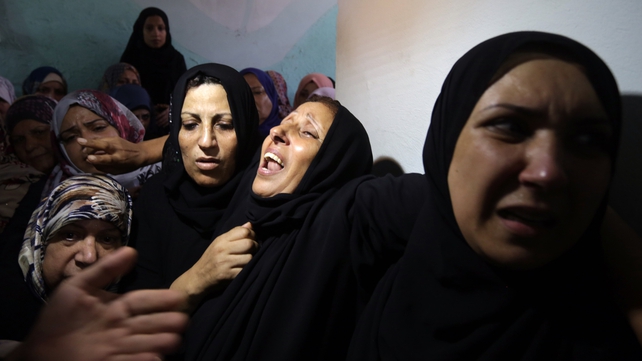
The aftermath of the Damour Massacre,  Lebanon, 1976.

During the 1960s, the PLO used Jordan as a base to attack Israel, whilst attempting to terrorise and destabilise the Arab nation toward the goal of regime change. King Hussein expelled the PLO in 1971. The terrorist group would take up residence in Lebanon, to disastrous effect. The PLO was pivotal in instigating a particularly bloody civil war in the small nation-state, in which it is estimated that approximately 150,000 people would die between 1975 and 1990, although some sources estimate the death toll is a quarter of a million.

The mandate territories in the Middle East included the region of Syria, awarded to France by the League of Nations. Due to a concentrated Christian presence, Lebanon was split from the Greater Syrian region, and was formed as a primarily Christian nation. Lebanon was an unstable factionalised mix, with weak governance and a resentful Islamic minority. War broke out between Muslims and Christians in 1958, after the Islamic populace took issue with Lebanon's pro-Western stance. The Islamic faction was defeated with US intervention. Since an effective PLO invasion, a succession of massacres were committed by the various warring factions (Muslim and Christian). It would result in a substantive amount of the Christian populace fleeing West, such as to the United States, where a great deal of its middle-eastern populace is of Lebanese Christian origin. The continuing instability of Lebanon, and the surging power of Hizbullah, maintained pressure on the largely Maronite Catholic populace, which ceased to represent a majority by the 1990s. Today, Lebanese Christians are thought to only represent 30% of the populace although estimates vary.

Iran became closely involved in Lebanese affairs, circa 1980, giving considerable support to the ‘Amal Movement’, a terrorist Shi’ite group, and especially Hizbullah, which the Shi’ite State helped establish and greatly developed, in the name of resisting an Israeli presence. Islamist Hizbullah is oft seen in the Arab world as a proxy of Iran, rather than authentically Lebanese. Some smaller Sunni factions also received support from several Sunni-Arab nations but they tended to possess a pan-Arab or nationalistic orientation rather than a strong religiously sectarian identity.

Iran, and especially Syria, would maintain influences in the territory, which ultimately broke Lebanese Christian power. Syria would finally withdraw its presence in 2005, only for Hizbullah to tighten its military and political grip on the country.

The Civil War ended with Lebanon becoming a stricter kind of consociational (bi-national) state, where a new constitution dictated a strictly apportioned Islamic-Christian rule but Hizbullah effectively hold the reigns of power. Shia groups weakened rival Sunni militias and built up their forces in Southern Lebanon, pushing the Lebanese army aside. Hizbullah was the sole militia allowed to continue its activities after the end of the Lebanese Civil War. It brought chaos to the region, with continued strikes on Israel, and has effectively created a state within a state, with the capacity to collect taxes locally, whilst fuelling the international drugs trade.

Lebanon can be regarded as a stark precursor of the conflicted Middle East seen today, where Sunni and Shia openly challenge each other, while the ancient Christian communities of the Middle East face extinction in the short to medium term. Lebanon’s history, where Muslim rulers persecuted Christian minorities for more than a millennia, guided one community leader in 1947, Archbishop Ignace Moubarac of Beirut, to illustrate the region’s simmering religious sectarianism for Western leaders, in which he paralleled the fate of Christians and Jewish people in the Middle East, when at the mercy of Islam. It is perhaps a message that many leaders in the West have yet to comprehend, or prefer to ignore.

Enter war and UNIFIL

Israel invaded Southern Lebanon in March 1978, in response to a succession of PLO terrorist attacks from the mid-to-late 1970s. One attack by the PLO, dubbed the ‘Coastal Road Massacre’, resulted in the murder of 38 Israeli citizens, including 13 children, and the wounding of 76 others. Israel made an alliance with Major Saad Haddad’s ‘South Lebanon Army’ (SLA), which developed in Lebanon several years earlier (initially known as the ‘Free Lebanon Army’), to combat the instability caused by the PLO’s actions. The Christian militia was aided by Israel, since both had a mutual interest in opposing the PLO.

Israel achieved a rapid military success, driving the PLO away from the nation’s border. UNIFIL forces stepped in to facilitate an orderly withdrawal, and maintain a peaceable border area. Israel would withdraw in late 1978, and pass control to the quasi-official ‘South Lebanon Army’, which was established by a commander of the Lebanese Army, Major Saad Haddad, after the failure of the national army in the region. Haddad would be dismissed from the Lebanese Army the following year for proclaiming control of South Lebanon.

However, both UNIFIL and the SLA would fail to control South Lebanon. The PLO would reassert a capacity to assault Israel. In 1979 the PLO started shelling Northern Israel indiscriminately. In the summer of 1981, the PLO furthered its indiscriminate artillery barrages, which caused sustained harm to Northern Israel. A ceasefire was agreed but the PLO violated it repeatedly. The PLO also attacked Israel from Jordan, and targeted Israeli diplomats in Europe. This violence would ultimately instigate the 1982 Lebanon War, in which Israel sought to permanently expel the terror group.

Ireland’s UNIFIL troops were harassed by the SLA, which deemed UNIFIL to be interlopers, but would nonetheless co-operate much of the time. Combat fatalities would not occur until April 1980, when relations with Israel declined in a dramatic fashion, after the SLA killed two UNIFIL troops, in the aftermath of a battle that had led to fatalities on both sides.

Brian Lenihan, Snr, (1930-95), Ireland’s Minister for Foreign Affairs
(held the ministerial office in 1973, 1979-81, and 1987-89) 

The Bahrain Declaration

The then president of Ireland, Dr. Patrick Hillery, visited Bahrain in February 1980. Minister for Foreign Affairs, Brian Lenihan, Senior (1930-95) held talks with his Bahraini ministerial equivalent, on February 10th, where they drafted a joint communiqué, which principally dealt with the Arab-Palestinian concern, as well as other diplomatic and economic issues. Lenihan also delivered a speech in Bahrain severely criticising Israel. The two would effectively become known as the ‘Bahrain Declaration’, and would set a sort of precedent in Western politics, with Ireland becoming the first EEC member-state to advocate for the inclusion of the PLO in a peace process toward statehood.

Lenihan called for the establishment of a Palestinian State, and called for Israel’s withdrawal from all territory captured in 1967. The Declaration cited “relevant” Security Council resolutions to support the stance, which misrepresented the substance of territorial issues appertaining to UN Security Council Resolution 242. The Declaration asserted that the PLO are the legitimate representatives of the Arab-Palestinian people toward the formation of a State, but it did not make any reference to terrorism or Israel’s security needs. At the time, this was an unusually hard-line stance for a Western state, which more closely followed the views of the Soviet and Islamic blocks at the United Nations. The Bahrain Declaration was the forerunner of the EEC’s ‘Vienna Declaration’ of 1981, which also reiterated the PLO’s legitimacy, despite its continued belligerence. Shortly before the Venice Conference, Arafat reiterated that PLO/Fatah’s “aim is to liberate Palestine completely and to liquidate the Zionist entity politically, economically, militarily, culturally and ideologically.” The terminology suggested an intent toward ethnic cleansing and perhaps genocide.

Controversially, Lenihan asserted that the PLO was no longer a terrorist organisation, describing Yasser Arafat as a “moderate”, for which the Irish minister saw a “full role” in negotiations. Lenihan’s announcement that the PLO had become a legitimate organisation occurred just with the close of a decade in which a vast number of infamous attacks on Israeli citizens occurred. Lenihan made these prognostications at a time when Irish UNIFIL troops were dealing with the effects of the PLO violence in Lebanon. Yet this notion of a supposed moderation was very much in evidence in Lenihan’s speech.

Lenihan also claimed that the Irish Republican Army had no involvement with the PLO. The proposition is clearly false. At a time when the Northern Irish Troubles was of supreme import to the Irish State, it is extremely improbable that the advance of this denial was anything other than a knowing untruth furthered by the Foreign Affairs Minister. In an era of many IRA terrorist attacks on the Island of Ireland, it may be assumed that the denial had the intent of lessening the PLO’s image, as a terrorist entity, with the FM’s Irish audience.

Lenihan’s assertions were so out of kilter with the observed reality of the time that they came across as an absurdity. The speech caused considerable anger in Israel, and at home in Ireland, where Dr. David Rosen, Ireland’s Chief Rabbi, voiced criticism. Dr. Rosen stated that Ireland’s stance may increase the already volatile tensions in Lebanon, and was critical of what he saw as the motivations of the Irish government, which he believed was driven by a need for oil. This was not an unreasonable assumption in the aftermath of the 1973 OPEC Oil Crisis, which attempted to punish the West, after Arab forces failed to defeat Israel. Frank McClusky, leader of the Labour Party, was of the same belief. However, Senator Noel Mulcahy suggested the Rabbi was threatening Irish UNIFIL troops posted in Lebanon.

When the pro-Palestinianism of Lenihan’s ‘Bahrain Declaration’ was challenged, the minister stated that the PLO would not be recognised by Ireland until they recognised Israel’s right to exist. However, Lenihan had already recognised the PLO as legitimate representatives. In 1993, a consular Fatah (PLO) Arab-Palestinian Delegation would be given permission to establish in Ireland. Yasser Arafat (the PLO chairman) recognised Israel in an official letter to then prime-minister, Yitzhak Rabin, that same year. However, the PLO Charter continues to call for Israel’s destruction through armed struggle. The process of updating the Charter was deliberately fudged by Yasser Arafat during the latter part of the Oslo talks process. It is telling, perhaps, that the Declaration was made in Bahrain, a state that does not recognise Israel’s right to exist.

An extract of the Bahrain Declaration - Palestine & Mid-East Section
(Source: 'Eurabia', a pan-Arab European lobby group, Dublin branch)

Irish support for Palestinianism, including Arafat’s PLO, would remain considerable. Brian Lenihan himself told Arafat, during a visit in 1993, of the “genuine warmth in Ireland for you and your cause” [Ireland-Palestine lecture] which points to Lenihan’s own approach during the fraught UNIFIL years, and rather unashamed support for a particularly virulent terror movement.

By contrast, formal Irish relations with Israel would remain non-existent, for a protracted period of time. Ireland only recognised Israel in 1975, being the last state in the EEC to do so, and was the sole country in the European Union without an Israeli embassy until 1996. Ireland is not only supportive of Palestinianism but has displayed a distinct hostility toward Israel with respect to other matters. A year after Bahrain, Ireland strongly condemned the Israeli bombing of Iraq’s nuclear weapons facilities.

UNIFIL killings

Ironically perhaps, the presence of Irish troops at the Lebanese border caused new and substantive diplomatic tensions. The soldiers were placed in the midst of a civil war, where the pressures from warring sides can lead peace-keepers to pick one side over another, potentially ending in disaster.

Something of a diplomatic crisis would ensue two months after the Declaration. On April 7th, the SLA shot an Irish soldier during a protracted gun battle near At Tiri. The soldier would die from his injuries on the 16th of April. The Irish State would lambast Israel for the death because Israel had an allegiance with the group. The Irish authorities were concerned that their diplomatic machinations had greatly increased tensions with the SLA, and would apply substantive diplomatic pressure upon Israel in the following weeks. The following day, the Israeli government would assert that Ireland’s foreign policy stance on the Arab-Palestinian/PLO issue was distinct to its role in UNIFIL — the former would not prejudice the latter.

However, Major Haddad publicly demanded financial compensation, or the bodies of two Irish soldiers, for the death of an SLA member, the 19 year old brother of one Mahmoud Bazzi, who was killed by UNIFIL during the clash. On the 18th, three Irish soldiers were abducted, two of which were murdered by Bazzi (Privates Thomas Barrett and Derek Smallhorne — John O’Mahoney survived). There was much speculation that the recent killings were a response to the Bahrain Declaration. Menachem Begin, Israel’s prime-minister, condemned the killing of the troops. Sholmo Agrov, Israeli Ambassador to the UK, forcefully denied that the killings had any relation to the Declaration, during an interview on RTE radio, several days afterward. Ireland would also obtain a European Council statement of condemnation, in response to the killings.

There are varying beliefs on whether the Bahrain Declaration was a causal factor in the killing of Irish troops. It has been noted that Haddad’s troops were involved in significant conflict with UNIFIL prior to the Declaration. Before 1980, Ireland had a reputation as a nation unusually sympathetic to the PLO. In 1979, at the UN General Assembly, Michael O’Kennedy, the then Minister for Foreign Affairs, called for a comprehensive solution of the Arab-Palestinian issue, involving the PLO. Yet the violence in April 1980 represented something of an escalation. It is difficult to lay blame for the killings at Israel’s door, because the murder of Barrett and Smallhorne was motivated by a personal grudge, as demonstrated in a confessional interview and Bazzi’s subsequent trial — of note, John O’Mahony, the sole survivor, stated that at one point an Israeli intelligence officer attempted to dissuade Bazzi from either continuing the abduction, or killing the soldiers, before giving up and leaving. However, it is quite likely that the sharp diplomatic impact of the Bahrain Declaration would have had some bearing on Haddad’s harsher treatment of Irish forces. In 1980, the Irish would have more comprehensively resembled enemies, rather than mere impediments.

Dr. Rory Miller, a senior lecturer at King’s College, who authored several books on the Middle East, notes that Irish troops were thought to be prejudicial:
“Throughout the 1980s and 1990s, the Irish regularly called in the Israelis to threaten them and discipline them over the treatment of Irish UNIFIL troops… There was a lot of animosity, as would happen on any tense border. There are two sides to this story. The Irish troops were no less guilty of turning a blind eye to Arab violence than any other UN troops. On the other hand, I have spoken with a number of IDF liaison officers who worked with UNIFIL and they all praise the professionalism of their Irish counterparts.”
The view that some or many Irish UNIFIL troops did not maintain the highest standards of neutrality, which their role would require to minimise tensions, and the potential for clashes with local factions, was a belief also expressed in the Irish media and within the Irish Parliament. It has been claimed that some Irish forces went as far as to assist the PLO in efforts to cross the border into Israel. Whether or not such claims are valid, and while the generalised criticism expressed in some quarters may be an inequitable representation of the conduct of many UNIFIL soldiers, the notable Palestinianism of successive Irish governments, not least with the issuance of the ‘Bahrain Declaration’, would have contributed to the notion that a favouritism for the PLO was prevalent amongst the Irish contingents in Lebanon. Chief Rabbi Dr. David Rosen was perhaps correct in stating that Irish foreign policy manoeuvres placed UNIFIL soldiers at undue risk, in a time of bitter civil war within Lebanon.

Some have asserted that belief in a culture of anti-Israel bias at Ireland’s UNIFIL troop is reinforced by the fact that a notable number of former troops went on to become anti-Israel activists, for example Dr. Ray Murphy, a former army captain and NUI Galway law lecturer at the ‘Irish centre for human rights’ which has presented lectures by PFLP terrorist Shawan Jabarin, who currently leads anti-Israel lawfare NGO al-Haq. Another former UNIFIL officer, journalist Tom Clonan, has repeatedly accused Israel of ‘massacre’ and ‘war crimes’, while being aware of the chaos of war causing harmful effects to civilian populaces, without the necessary cause of intent being present.

Colonel Desmond Travers, one of the four members of the UN Goldstone Commission, displays an attitude toward Israel that disconnects from very basic reality. Travers denied that Israel acted in self-defence, with respect to the 2008-09 Gaza War, stating that Hamas had maintained a ceasefire! He also stated “so many Irish soldiers had been killed by Israelis… a significant number who were taken out deliberately and shot.” He may be referring to the claim that an Israeli intelligence officer was present shortly before Mahmoud Bazzi killed two UNIFIL solders, on April 18th 1980. One of the victims, John O’Mahoney stated (14:11 mins) in the documentary ‘Peacekeepers: The Irish In South Lebanon’ (critiqued in another section below):
“Shouting in Arabic, my brother, my brother, and he [Bazzi] was wearing a black vest. Now Tom Barrett said to me, he said you know, black vests it means death. He [Bazzi] took the three of us out, and he took us up the steps and across the veranda, and an Israeli Intelligence Officer was trying to negotiate with him but next thing he just walked away, he walked away Bazzi opened fire.”
O’Mahoney affirms that the Israeli officer attempted to dissuade Bazzi from the killings, but appears to have possessed no authority to compel the militiaman, in a building housing other members of the SLA. Travers served in Lebanon so must be intimately acquainted with the events of that day. It appears that Israel is only directly implicated in the death of one Irish UNIFIL soldier throughout the entire mission, one Corporal. Dermot McLoughlin, killed in 1987 due to the effects of a tank shell.

Moral culpability

The question of these deaths, and several others in the intervening years, would worsen Ireland’s near non-existent diplomatic relations with Israel. Yet Ireland’s reaction was not remotely as trenchant toward Arab-Palestinian and Islamist groups, when found blameworthy of the killing of Irish UNIFIL forces. In April 1981, the PLO killed two Irish solders. Private Hugh Doherty was killed, and Private Kevin Joyce was taken prisoner, to be murdered subsequently. The Irish State was substantively more reticent in dealing with this situation, even though Arab-Palestinian sources appear to have cynically used Private Joyce’s death as a source of propaganda, perhaps holding onto his corpse to prevent his burial. Joyce’s body was never to be found.

If anything, the attitude that Israel was necessarily responsible for the actions of Major Haddad, and the South Lebanon army, and the intensity of Ireland’s criticism, merely reinforced the view that the Irish authorities possessed a strong bias. Israel and Haddad were allies, operating in a not-dissimilar way to that of Syria which was allied to the PLO, and Iran being allied at the time to Amal. Yet there was no substantive condemnation of Syria for the actions of the PLO at the time, nor subsequently toward Iran.

Whilst a given party can rightly be criticised for its allegiances, it is a step too far to hold them directly responsible for the actions of the aligned party, unless they were complicit in directing such a policy. There may still be some level of indirect responsibility, if the actions of one party to an alliance knows the other party will use their assistance for ill. From a moral perspective, where one party aligns with a more destructive party, blameworthiness toward the former party must ultimately apply if their alliance is intended to mount acts of territorial aggression, or if it is an alliance that is entirely voluntary (not strictly necessary) in nature. Israel needed allies in South Lebanon because UNIFIL were not fulfilling their obligations to bring conditions of peace. Otherwise it would be considerably harder to protect civilians at its border, with the likely resultant increase in civilian casualties in Northern Israel, which the PLO and Hizbullah targeted with some success. Thus, the alliance was justified. By contrast, early Syrian and later Iranian alliances were entirely voluntary, and largely intended to aggress against Israel, regardless of its presence in Lebanon.

The route Ireland took with its diplomatic conduct toward Israel, reduced the idea of the SLA, fighting a civil war against the PLO and other Islamists, to that of mere puppets. The stance was not factually valid. It is possible that Ireland did so to further distance themselves from Israel at a diplomatic level.

Economically informed diplomacy

The weak diplomatic response by successive Irish governments, to the PLO’s numerous attacks on Irish troops serving in Lebanon, during the early to mid 1980s, was especially puzzling because it was widely known that the PLO had interacted substantially with the Provisional IRA since the late 1960s, helping turn the republican terror group into an efficient killing force, which also posed a threat in Southern Ireland. Since the mid-1970s, Irish governments had taken substantive measures to suppress the republican group’s activities, e.g. the formation of a closed criminal court to prevent intimidation.

The answer may have some relation to the fact that the PLO, and its related groups, were sponsored by numerous Arab nations, and it would be diplomatically inopportune to cause upset to a group of notoriously sensitive despots, over a matter so close to the greatest Arabist cause of the era, particularly when attempting to enter their national markets, with agricultural produce (Ireland became a significant supplier of beef), etc. There is some justification in concluding that the Irish State paid little heed in its diplomacy, in the pursuit of narrow economic interests, with regard to the safety of the UNIFIL troops.

Ireland’s trade with the Middle-East multiplied in the 1970’s, and by the early 80’s it was rated at sixty-fold that of Israel, while the security of oil supplies was a major preoccupation (Keatings, Patrick. ‘European foreign policy-making and the Arab-Israeli conflict: Ireland’. 1984. Martinus Hijhoff. Page 20) for the Irish State, in the aftermath of the 1973 OPEC Oil Crisis. Trade issues were detailed when foreign affairs minister, Brian Lenihan visited Bahrain, an issue of particular import when Ireland was going through an economic crisis that would lead to substantive political instability through the early 1980s. There was even an openness to the establishment of an Iranian embassy, in the immediate aftermath of the Iranian hostage crisis. It was also argued at the time that Taoiseach (prime-minister) Charles Haughey had developed a taste for political activism, arguably to improve Ireland’s standing on the international stage.

The more things change, the more they stay the same

The issue of bias, across the UNIFIL contingents, does seem to have been a reality. For example, in 2000, UNIFIL was complicit in Hizbullah’s fatal abduction of three IDF soldiers. UNIFIL obstructed the IDF investigation, by denying the existence of security tapes which could have helped discover the abductors. UNIFIL later acknowledged the existence of the tapes but refused to supply them for several months. The cars are believed to have been turned over to Hizbullah. In 2010, it was reported that the Norwegian contingent actually broke two Lebanese terrorists out of an Israeli jail, and disguised them in UNIFIL uniforms. During the 2006 Israel-Hizbullah conflict, UNIFIL broadcast detailed reports of Israeli troop movements, numbers, and positions on their website, while not reporting similar details concerning Hizbullah.

The 2006 Lebanon War, began in the aftermath of Hizbullah kidnapping Israeli troops, and launched indiscriminate rocket strikes against Israel’s civilian population centres. Approximately 300,000 to 500,000 Israeli civilians fled Northern Israel due to Hizbullah’s attacks. UNIFIL MKII was instituted after the war, to disarm Hizbullah, and form a twenty kilometre buffer zone at Israel’s border. UNIFIL failed to do so on both counts. The Iranian proxy has in fact dramatically enhanced its weapons arsenal, with a reported missile armament estimated to be at least 100,000, which may include chemical and biological weaponry. Senator Francesco Cossiga, a former Italian president, asserted that Italy’s UNIFIL force arranged to ignore Hizbullah’s procurement of weaponry, as long as the terror group desisted from attacking the UN ‘peace-keepers’.

Unfortunately, even in the post-9/11 world, Ireland’s soft approach to Islamo-terrorist groups would remain. Hizbullah has continued to harass UNIFIL troops, but Ireland, and the EU, have not remonstrated with Iran. Some speculate that the increased harassment, directed at particular UNIFIL national groupings, coincides with their respective nation states criticising Iran.

Ireland was a leading force in the diplomatic opposition to Hizbullah being designed a terrorist entity by the European Union, despite terrorist attacks having occurred on European soil, particularly a bus bombing in Bulgaria, which killed five Israeli civilians and one other driver. Hizbullah was involved in the killing of the largest number of US citizens before 9/11, has openly expressed genocidal ambitions toward world Jewry — killing a huge number of Jewish people in Argentina, and finances its activities with international drug trafficking on a rather grand scale. Ireland’s diplomatic move was seen as unusual, given that Germany, France and Spain, which have substantive UNIFIL forces, supported Hizbullah’s terrorist designation.

Irish UNFIL Death tolls, and the media influence

Dr. Rory Miller has noted that Irish media coverage of the UNIFIL (I) troop presence was notably anti-Israel in tone, which tracked and arguably strengthened the resolve of the Irish authorities to find Israel blameworthy. The tone of coverage by elements within the media is illustrated by a Travers interview:
“… because so many Irish soldiers had been killed by Israelis, (some too by Palestinians and/or their Lebanese cohorts), with a significant number who were taken out deliberately and shot (in South Lebanon), slowly but surely, the body-bag phenomenon came into effect, and suddenly Ireland is now perceived as almost entirely pro-Palestinian.”
The views expressed in that statement may be sincerely held, but it tells more of the impressions presented by the Irish mainstream media than of actual fact. 45 to 47 Irish UNIFIL soldiers died between 1978 and 2000. Narratives on the conflict do not note that most soldiers actually died from accidents. The impression given by the media is often otherwise, due to a peculiar focus on Israel’s supposed misdeeds. That most should die from accidents is perhaps unsurprising, in view of the fact that the Ireland had between 45,000 and 50,000 UNIFIL members serving in Lebanon, at varying times, over a 22 year period, serving in rugged terrain, sometimes with aged transit vehicles. Most notably, four soldier would accidentally die on February 14th 2000. Another Irish soldier murdered three of his colleagues in 1982.

Statistics are difficult to obtain but, Robert Fisk’s article (reproduced in Defence Forces Review, 2008) ‘At-Tiri, or Bosnia Avoided: The Irish in UNIFIL 1978 — 95’, notes that:
“an examination of the non-accidental casualties in Irelands thirty five Infantry battalions over the seventeen years of their service in UNIFIL suggest that the Irish have suffered in equal proportions from all parties to the conflict in southern Lebanon. Although the UN does not provide such statistics — nor I think does the Irish army — my own figures show clearly that of the fourteen Irish soldiers killed in action or murdered in cold blood, seven were killed north of the SLA-UNIFIL ridge-line and seven to the south. Six Irish soldiers were killed by Haddad’s militiamen, one by the Israelis — this was Corporal Dermot McLoughlin, killed by Israeli Merkava tank round on 10 January 1987 — five by the Hizballah and two by Palestinians. Of the five who died at the hands of the Hizballah, four were killed by landmines, the fifth Corporal Peter Ward, by a Hizballah militiaman at Al-Jurn on 29 September 1992. These details would suggest that Ireland suffered half its combat/murder casualties at the hand of Israel and its allies and half at the hands of Israel’s Palestinian and Hizballah enemies — grim but persuasive proof, I think, that the Irish battalions did not take sides in the south Lebanon war.”
Fisk attributes 14 of the 38 soldiers killed up to that point, as having died in combat. He appears to over-count fatalities attributed to the SLA by two — in 1999 there was one other fatality attributed by the SLA, Private. William Kedian, making five killed by the SLA in total. Fisk, a journalist noted for his staunch anti-Israel viewpoints, would never do Israel any favours with regard to statistics, so he cannot be said to be minimising fatalities attributed to Israel.

It is rather dubious to argue that the Irish UNIFIL contingent was balanced because the death tolls are roughly equal. Fisk may have adapted a common defense of media organisations, which argue that their news content must essentially be neutral because there are complaints about their coverage from both sides of a given issue. The argument is fallacious, because it ignores the potential validity of complaints. They can be legitimate or illegitimate, with the less moral of pressure groups expecting the media to unduly adopt their narratives. Likewise, UNIFIL’s reputed bias for the PLO/Hizbullah etc., could be enforced with threatening behaviour and killings. Fear is the essential tool of successful terrorist organisations. Hizbullah have a history of intimidating UNIFIL, if they deem them to insufficiently malleable, or for wider political considerations, even though UNIFIL has conducted itself favourably toward the group. 

The broad media’s position is revisited with Robert Fisk’s stance in a retrospective article (UK Independent, March 17th 2001), in which he describes the killers of some Irish troops as “Israel’s murderous little proxy force, the ‘South Lebanon Army’”, while other killers are artfully labelled as “Dissident Palestinians”. Despite the passage of time, the tendency in media coverage, to blame Israel over that of other groups, would continue into the UNIFIL II phase. The 1980 murder of two Irish UNIFIL soldiers in Lebanon, by Mahmoud Bazzi, was given extensive treatment by RTE’s investigative show ‘Prime Time’ (RTE1, December 1st 2015). The report did not note the identity of the group, nor even its well-known name, despite the feature’s length. It merely noted that the organisation was an “Israeli-backed militia”.

Crude propaganda

RTE’s documentary, ‘Peacekeepers: The Irish in South Lebanon’ (produced and directed by John Higgins, and Shane Brennan), was notable for providing such an anti-Israel slant that it would be difficult to distinguish its content from that of the more virulent forms of conflict propaganda. Despite the benefit of hindsight, the documentary forwarded many of the falsities presented by the Irish media through the years, which unduly focus on Israel-related wrongdoing to the near-exclusion of all else.

The programme failed to mention any violent attacks on Ireland’s UNIFIL troops by the PLO, with Dr. Ray Murphy stating that the South Lebanon Army caused virtually all of the conflict issues with Irish UNIFIL troops. The documentary misrepresented the identity of the first UNIFIL casualty, by distorting the timeline. With undue rapidity, it presented UNIFIL forces as battling the SLA near At Tiri, and so effectively presented Stephen Griffin as Irish UNIFIL’s first fatality, having some Israeli-related cause. However, the first UNIFIL fatality was Gerard Moone, who died in a “traffic Accident”. After Moone’s death, Thomas Reynolds would die of another traffic accident that same year, and Private Philip Grogan drowned the following year. The documentary focused on Israeli/SLA actions but failed to mention that more than two-thirds of all the Irish UNIFIL deaths occurred due to non-combat issues, primarily accidents.

The programme discussed in significant detail the killings by the SLA’s Mahmoud Bazzi, and the death of another soldier in 1999 during an SLA attack. It is likely that roughly equal numbers were killed by both sides. Yet, on the opposing side, the documentary would only mention the killing of a single soldier by Amal, even though Amal is associated with an intentional IED hit, which killed three troops in 1989, claimed to be a cover-up: an independent governmental report stated that “deficient assessment” was the cause. There was no mention of the killing of two soldiers by the PLO in 1981, one of which was ‘disappeared’, and could not be found after years of investigation by the Irish Defence Forces.

When recounting events relating to the initiation of war, the documentary repeatedly obsecured which side aggressed against the other. For example, the narrator stated that both the PLO and Israel were engaged in a series of “brutal attacks” during the late 1970s, noting an attack that killed 34 Israelis, which it compared with the death toll from the Israeli invasion of 1978, which conflated civilian and terrorist death tolls, to infer that the invasion was disproportionate. Similarly, the narrator failed to note that Hizbullah aggressed against Northern Israel, with successive missile attacks in 1995/96 on civilian populaces, leading to a substantive military response in 1996, dubbed ‘Operation Grapes of Wrath’ — merely referring to a series of “lethal attacks” after the breach of a three-year cease-fire. The documentary failed to note that Israel apologised for a strike on a building housing civilians, which Tom Clonan described as a “deliberate” attack, an act that he described as a “massacre”, despite recent admissions that there were IDF failures on the ground.

The documentary stated that Israel did not withdraw in 1978. Ray Murphy, Robert Fisk, and others, asserted that Israel did not go along with the UNIFIL mandate. Lara Marlow, a noted anti-Israel journalist, sarcastically asserted that it took Israel 22 years to withdraw. Murphy made a similar claim. However, Israel did withdraw in late 1978, handing over control of the territory it took to the SLA. If Israel had remained in South Lebanon then it could hardly have reinvaded again in 1982.

The narrator also stated that Lebanese groups, Hizbullah and Amal, were established to “resist” the Israeli occupation from 1982. However, Hizbullah is a proxy of Iran, created by Iran’s Revolutionary Guards, to bring conflict to Israel, and has engaged in anti-Jewish terrorism across the world. Amal was founded in 1974, some eight years before the longer term Israeli occupation. The programme also failed to note the continued assaults by the PLO on Israel, which forced the 1982 Israeli invasion.

The programme failed to note the widespread belief that Irish troops favoured the PLO, and would in fact affirm the opposite — that the Irish were an “honest broker”. Ray Murphy stated that the Irish UNIFIL troops felt a natural sympathy for the poor Shia locals, but there was no mention of the fact that Lebanese Sunni and especially Christian groupings have been marginalised by conflict.

Tom Clonan, argued that if it were not for the UNIFIL Irish troops, killing would be on a scale similar to Syria. This was a peculiar observation for the ‘security analyst’ with the Irish Times to make, because Lebanon is a much small nation, with a populace five times smaller in 2011 (4.4 million) than pre-war Syria (22 million), or eight and a half times smaller than 2011 pre-war Syria, at 2.75 million before civil war commenced in 1975. If the populace of the two nations (before conflict commenced) is taken into consideration, the tolls (150,000-250,000 over 15 years, and 400,000 over five years - March 2016 UN estimate) would suggest that the Lebanese Civil War had at least as great a proportional impact upon its people. Yet the Lebanese Civil War would rarely be mentioned in the documentary, despite its importance to the conflict. Clonan, asserted that “the Irish people can be genuinely proud of the troops”, but the documentary’s praise (brave professional individual soldiers notwithstanding) should be tempered by the entirely factual observation that UNIFIL has miserably failed twice in its purported objectives.

The documentary latterly referred to the killing of a Spanish UNIFIL soldier, in a January 2015 Israeli missile strike. The documentary featured footage and narration from an ITN report on the event, detailing the substantive measures employed by Israel, presumably to present it as a disproportionate attack. However, the documentary did not mention the attack was in response to the killing of two Israelis (in the Shabba Farms region), nor the fact that the IDF had come under repeated attack from across the Lebanese border. The documentary spoke of UNIFIL precautions in the aftermath of the attack but did not discuss the quite recent intimidatory efforts by Hizbullah, which nearly led the EU to pull its troops out of Lebanon.


Published at Crethi Plethi.

Tuesday, 14 June 2016

Analysing Trends in Mainstream Media Bias: RTE’s October Coverage of the 2015 Quasi-Intifada – Part One

Introduction

Section 39/1, of Ireland’s 2009 Broadcasting Act, obliges broadcasters to ensure that news reports are “presented in an objective and impartial manner and without any expression of the broadcaster’s own views.” However, RTE (Ireland’s public service broadcaster) was criticised repeatedly by an Irish pro-Israel advocacy group in its online postings, for the quality of its reportage of the onset of intensive violence during the Autumn period, which commentators often described as a prospective ‘Third Intifada’ due to the sharp rise in Arab-Palestinian attacks (stabbings, shootings and car-rammings) against Israeli civilians and security personnel. The period was also noted for an increase in protracted clashes or riotous Arab-Palestinian protests, which typically confronted Israeli forces.

While advocacy groups might be expected to be critical of news coverage that is not compatible with their views of a given issue that they represent, RTE’s news reporting on contentious issues has long been criticised by a variety of independent sources, as inaccurate, misleading, and selective in terms of the stories the Broadcaster chooses to feature. Some commentators have noted an anti-US, anti-Israel, anti-conservative slant in RTE’s coverage, which supports liberal-left stances and political parties, although hard-left political activists have argued that RTE is conservative. A senior member of the Irish Palestinian Solidarity Campaign also criticised RTE’s coverage as being racially prejudiced against Arab-Palestinians. That complaint is addressed in Part Two, in the section “Pro-Israel bias?”

This article discusses a quite large, albeit select, number of problematic examples of RTE’s television news coverage during October 2015, when coverage of the conflict was most prevalent, to attempt to represent the overall tone of coverage. Some brief examples of coverage from the middle of September to the end of November are also included. July-August 2015 coverage is also referenced to note trends in news reporting. With respect to journalistic practice, broad ethical problems concerning the conflict are also addressed. A concluding part of this series focuses in detail on two specific RTE reports, which are not discussed in Part One. RTE Player links of the principle daily television news programmes (Lunchtime News, 6.1 (6 O’clock) News, and 9 O’clock News) are only made available by the broadcaster for a limited period of time.

Background on the quasi-Intifada

While the region continued to experience significant levels of Arab-Palestinian violence, the onset of the Autumn 2015 period of intensified conflict is usually dated to the 13th of September, when Israeli security forces intervened at the al-Aqsa Mosque, to prevent an attack upon nearby Jewish worshippers closely adjacent to the Temple Mount/Haram al-Sharif compound, at the Western/Wailing Wall. Tensions grew during 2014/15 after certain Jewish activists sought changes to improve Jewish access, but Israel’s government refused to change the status quo, due to the fear that it would cause an Intifada.

The planned Arab-Palestinian attack at the Temple Mount coincided with Rosh Hashanah, the Jewish New Year, and was also a likely reaction to a policy move by former Defense Minister of Israel, Moshe Ya’alon, because he outlawed the Mourabitoun and Mourabitat Muslim groups, which were instituted to persistently harass Jewish people visiting the Temple Mount, as well as the Wailing Wall. Israel’s intervention was seen as validating Palestinian Authority President Mahmoud Abbas’ repeated claims that the Mosque was under threat. Alexander Levlovich, was perhaps the first fatality, killed in a stoning attack the following day by an Arab-Palestinian gang, when driving through East Jerusalem.

The quasi-Intifada resulted in approximately fourteen-hundred recorded attacks of Arab-Palestinian origin between the months of September and December 2015. Attacks decreased in January 2016, with 169 recorded attacks, largely matching the rate of August 2015, in which there were 171 recorded attacks. October 2015 saw the peak of this wave of terrorism, with 620 attacks.

Inconsistent news coverage

RTE’s early reportage of the renewed violence in the region was highly partial. When RTE news editors chose to report on the heightened violence, news coverage consistently highlighted Arab-Palestinian victims, albeit with the exception of one news bulletin. Four Israeli civilians were killed, and several others seriously injured, in numerous stabbing attacks, from Thursday the 1st to Friday the 2nd of October. These attacks were newsworthy because their frequency represented a stark indicator of renewed societal conflict. However, RTE’s TV news team only afforded one brief and rather belated mention, in a single Saturday the 3rd morning news bulletin, without an accompanying news report.

RTE’s 9th October Lunchtime television news report similarly failed to mention the high frequency of anti-Jewish violence occurring in Israel during the prior 24 hours. Instead RTE continued a trend of leading reports on Israeli/Jewish violence visited on Arab-Palestinians, with what was a probable revenge attack, which lightly-to-moderately injured four Arab men in Dimona, Southern Israel, although the Israel Security Agency (ISA) later noted that the injury to one victim was severe, with another moderately wounded, and two others injured slightly. The report included footage of grief stricken women, who were identifiably Arab-Palestinian due to their garb. The inclusion of such footage would have led viewers to the impression that the men were battling for their lives.

Whilst it was newsworthy to report on one of the rare instances of violence perpetuated by a Jewish civilian on several Arab men uninvolved in the conflict, the failure to report on anti-Jewish attacks was particularly notable since a numerically similar attack also occurred on October the 8th, which resulted in the injury of four Jewish people.

RTE’s reportage of the violent upsurge is consistent with coverage of the conflict in preceding months.

The last major international news event to come out of Israel, and the disputed territory of Judea and Samaria/West Bank, was perhaps the July 31st Duma arson attack on the Dawabshe family home. RTE’s TV coverage of the Duma attack was substantial and highly problematic. RTE reporter Carol Coleman misrepresented the reasons for Arab-Palestinian violence in the aftermath of the attack, which had a distinctly sectarian-religious (Islamist) dimension associated with the Temple Mount/Haram al Sharif. Coleman also failed to mention the associated incitement by the Palestinian Authority that often motivates such religious-sectarian violence, and presented reasonable security measures by the Israeli authorities as either a reprisal, or inciting a chain of escalating conflict.

The Broadcaster followed up on the Duma attack with reports on the death of the Dawabshe family’s father (8th August), and the death of the mother (7th September), both from burn injuries in the aftermath of the tragic arson attack. However, RTE’s television news department did not report on any of the attacks by Arab-Palestinians upon Israelis during the same period. Besides a failure to report on post-Duma Arab-Palestinian reprisals against Israelis, there was just one report on growing violence at the Temple Mount (13th September), which led with the Israeli intervention at the al-Aqsa Mosque.

RTE-Player screen-grab of revolving news text,
RTE News Now channel, Oct 15, 2015

Conflating aggressors with victims

News-presenter introductory comments for reports, typically described the growing death tolls, with numerical comparison between Arab-Palestinian deaths and Jewish-Israeli fatalities. However, such comparisons usually failed to note the widely divergent circumstances in which these deaths took place, with Arab-Palestinian deaths typically occurring in violent confrontations with army and security personnel, or during terrorist incidents. Sometimes the follow-on reports would clarify the preliminary remarks by the news-presenters but more often they did not. Such conflation is misleading at a most fundamental level because the resurgent violence relates to the matter of who is doing what to whom, e.g. an October 20th 6.1 News report mingled aggressors with victims:
Presenter Sharon Ní Bheoláin: “The UN Secretary General, Ban Ki-moon has said his trip to the Middle-East today reflects the global alarm over the escalation of violence between Israelis and Palestinians.”
Carole Coleman [voice-over of video featuring rioting youths]: “As the frustration felt by Palestinians continues to spill over into the streets, UN Secretary General Ban Ki-moon had this message for the young people…”
RTE-Player screen-grab, RTE 6.1 News, 20-October-2015, Carol Coleman report,
with captioning: "As the frustration felt by Palestinians..."


RTE would continue to lead news stories with the death and injury of Arab-Palestinians individuals, through the latter part of the period of violent escalation in November, and the nature of the fatalities would still be conflated. For example, news-presenter Eileen Dunne stated that “a surge in violence has resulted in the deaths of Israelis and Palestinians”, in the 23rd November 9 O’clock news programme.

RTE described violent riots, which have the explicit intent of clashing with police and soldiers, as “protests”. Protests are commonly understood to be largely peaceful events, which are usually borne of moral concern. The use, by the media, of such a term was especially unjust when there was a growing awareness that this episode could have represented the onset of a new Intifada, which was driven across Arab-Palestinian society by a wave of religious intolerance, with substantively anti-Semitic overtones.

RTE’s 10th October morning news text reported that the “IDF shot dead six Palestinians at the border of the Gaza Strip”. That morning’s news bulletins stated that “Protests have spread across the Israeli-occupied West Bank and Northern Israel after a day where six Palestinians were killed at the border of the Gaza strip…” The segment was short, at no more than 30 seconds, so it is unfair to expect it to be comprehensive, but it nonetheless misled with profound omissions in the description of the violence.

The segment failed to mention that the violence was initiated by Arab-Palestinians, and that further stabbing attacks in Jerusalem were committed against Jewish civilians. RTE also failed to mention that the Arab-Palestinians at the Gaza border were engaged in violence directed at a heavily armed military zone, that they were affiliated with both Hamas and Islamic Jihad, and that this riotous event was linked with Ismail Haniyeh, Hamas’ Gazan leader, who declared a new ‘Intifada’ shortly before the clash.

On the 11th October, the text-based news highlights on RTE’s ‘News Now’ channel, featured an image of grief-stricken Arab-Palestinian women, also found on the RTE website, with the accompanying words: “France has said the escalation of violence in the Palestinian territories and Jerusalem was ‘extremely worrying and dangerous’”. The use of such an emotive image, with the accompanying text, places indirect blame on the Israeli authorities for the rise in Arab-Palestinian fatalities. The image inevitably carries with it an inference that those killed were substantively innocent, when many of the fatalities targeted, and sometimes murdered, Jewish civilians.

RTE did not qualify which grouping was initiating violence against the other, even of the past events that led to the 2014 Gaza war, Operation Pillar of Cloud. The November 30th morning ‘News Now’ bulletins reported that Mohammad Abu Khdeir’s “killing was part of a cycle of violence that led to war between Israel and militants in Gaza.” RTE failed to address which group initiated the sequence of events, despite 16 months passing, and misrepresented the character of those events. The brutal murder of Abu Khadir on July 2nd 2014 was likely a reaction to Hamas’ kidnapping and murder of three Jewish teenagers in Judea and Samaria (West Bank), but war in Gaza developed as a consequence of increased rocket attacks. Some believe the attacks from Gaza increased as a result of the mass arrest of Hamas’ operatives in Judea and Samaria, but a programme of mass arrest to save three teenagers does not correspond with a “cycle of violence”. Neither can Abu Khdeir’s death be thought of as a major event leading to eventual war since the particular warring groups were not involved, and the Hamas-sanctioned rocket escalation had already begun before the 2nd July date of murder.

A notable departure

RTE’s television news department first acknowledged that Arab-Palestinians were targeting Jews in a spate of stabbing and other attacks, two weeks after the dramatic intensification, in a brief October 12th Lunchtime News report (“Palestinian man shot dead by security forces in Israel”), which stated:
“A Palestinian man suspected of attempting to stab a police officer in Jerusalem has been shot dead by security forces. It was the latest in a series of knife attacks in the past fortnight, mainly by Palestinians targeting Jews. Police said the officer was unhurt as he had been wearing a protective vest. On Friday, four people – two Israeli-Arabs and two Palestinians were injured in an apparent revenge attack.”
Oddly, the RTE report again referenced the several days-old stabbing of four Arabs, which, according to reports, largely resulted in moderate injuries. By contrast, RTE never displayed an impetus to balance reports of Jewish violence with reference to the Arab-Palestinian equivalent. Instead, it downplayed the latter.

For example, RTE’s Lunchtime, 6.1 and 9 o’clock news broadcasts (11th Oct, 10 mins) solely reported on the deaths of Arab-Palestinians:
“An Israeli airstrike on a Hamas target in the Gaza Strip hit a nearby house, killing a Palestinian woman and her daughter. This marks an escalation in recent violence, which has seen several Israelis killed and a growing number of Palestinian deaths. The increase in violence has increased fears of a new Palestinian uprising.”
There was no mention of the other attacks during the 11th of October, where, for example, an Arab-Israeli man injured four Israelis in a combined car and stabbing assault. RTE also failed to report the attempted suicide bombing by an Arab-Palestinian woman, which was disrupted by Israeli security personnel, despite the fact that the story garnered significant attention due to its circumstance.

Passive voice

RTE reports typically led with descriptions of Israeli security forces shooting dead Arab-Palestinian aggressors, or of Israeli security measures in reaction to the intensification of violence.

At times, a variant of grammatical passive voice was used in the construction of sentences for RTE’s descriptions. Such sentence structure often occurs in mainstream media reportage of the Israeli conflict. Passive voice allows authors more control over narratives, whereby the responsibility of any agent for instigating events can be obfuscated. With passive voice, the instigating group of a conflict situation can be presented as having been subjected to the actions of other parties to that conflict. It is objectionable, for confusing which side is responsible for the broad-spectrum violence, and for directing blame at those attempting to reduce the effects of the destructive acts. For example, news-presenter Brian Finnerty, Lunchtime News, 16th October reported:
“In the past month, the violence has claimed the lives of eight Israelis and more than thirty Palestinians, some of them suspected of carrying out attacks, have been killed by Israeli security forces.”
Undue skepticism

Statements, such as the above, present a double-standard, where murders, or attempted murders, were treated with scepticism, but not the reactions by the authorities. An element of scepticism is appropriate when dealing with claims made by different groupings in a state of conflict, and media reports correctly use the terms ‘alleged’ or ‘suspected’ when addressing criminal acts by individuals/groups that are not yet affirmed through legal process. Nonetheless, journalists commonly make legitimate determinations of fact, based on the security of accessible evidentiary material, and on very high probabilities, where, for example, clear intent can be ascribed to violent/criminal events. It had been firmly ascertained that a significant number of Arab-Palestinians were killed by Israel’s security forces, but it has also been ascertained that a substantive proportion of those killings were in immediate reaction to terror attacks, as the toll of Jewish casualties, and available video material to a number of the attacks, demonstrates.

With further scepticism, Carole Coleman’s October 20th Lunchtime News report describes a house demolition as “Israeli soldiers dismantling a Palestinian home in the West Bank. The army claims it’s the home of a militant who carried out a stabbing a year ago killing a woman.”

The report refers to the demolition of Maher al-Hashlamoun’s house. Al-Hashlamoun is in actual fact is a member of Islamic Jihad who was found guilty of committing several terrorist attacks, one of which led to the murder of a twenty-six year old Israeli woman. By convention, RTE attribute crimes to individuals who have been found guilty of such acts by courts of law. However, Coleman’s report would lead the viewer to suspect that the demolition is undeserved in some way, because al-Hashlamoun is supposedly innocent, or that his crimes have been insufficiently ascertained.

Notable omissions

The attacks during this period were never described as having a terrorist intent. Yet RTE is not adverse to using the term in relation to similar attacks in the West, most recently with the Belgium attacks.

RTE’s 16th November morning and Noon ‘News Now’ bulletins reported on a gun attack against Israeli troops, when the home of terrorist Mohammad abu Shahin (alternatively spelt ‘Shaheen’) was demolished in response to the murder of Danny Gonen, a Jewish hiker, during the month of June. The news-presenter stated:
“Palestinian medical sources have said Israeli troops shot dead at least two Palestinians during a gun battle in the Occupied West Bank. The Israeli military said in a statement that troops had come under attack during the operation to destroy the home of Mohammad abu Shahin… Some twenty other Palestinians were wounded in the incident as troops demolished the home of a militant whom Israel had said had killed an Israeli man in June.”
The report did not note that Shahin (Shaheen) had previously been found guilty of conspiring to commit a terror attack for which he was imprisoned between 2006 and 2008, and had more recently confessed to committing numerous other attacks. He is a member of the Fatah/Tanzim Force 17 elite terror unit. Israel’s Supreme Court issued a stay of demolition in October to evaluate the case, which was subsequently passed, while another demolition application was rejected.

Abbas’ incitement misrepresented

A 14th October 9 O’clock news report by Carole Coleman (“Two Palestinians shot dead in latest spate of attacks in Israel”) led with the deaths of Arab-Palestinians involved in a terror attack, and used material from her earlier reports that day, analysed in part two of this article. Coleman added:
“This evening Palestinian president Mahmoud Abbas held firm, saying that Palestinians would continue to struggle for the project of nation or state-hood. He spoke of the right to self defence but called for non-violent resistance.”
This is an inaccurate representation of Abbas’ speech, which did not in fact call for a de-escalation of violence. The speech endorsed the ongoing Arab-Palestinian violence, which he characterised as a defensive measure, and presented solely as a reaction to supposed Israeli aggression, particularly against the al-Aqsa Mosque. Abbas attempted to present an Arab-Palestinian teen, who engaged in a stabbing attack, as a martyr akin to Mohammad al-Dura, a story that has been utilised as a widespread source of incitement in the Arab world. Coleman’s description may have been based on the inaccurate accounts provided by a number of news-wire services. The article ‘He Said/They Said: Mahmoud Abbas October 14th speech, and the Mainstream Media’ provides a detailed account of the speech.

The speech was in keeping with the Fatah Party’s production of a substantive amount of material encouraging violence, while demonising Israeli soldiers. Coverage of trenchant PA/Fatah incitement, and associated conspiracism involving the Temple Mount/Haram al-Sharif, was entirely absent however.

By contrast, RTE’s coverage of a speech by Israeli prime-minister Benjamin Netanyahu, on October 21st, was very negative. The speech garnered international attention because Netanyahu asserted Grand Mufti Haj Amin al-Husseini had a principle role in encouraging Hitler to wholly adopt a programme of extermination against Europe’s Jewish people but soon clarified that he had no intention of exonerating Hitler. Some of RTE’s reports did include that clarification, whilst other reports did not. The revolving text on the ‘News Now’ channel stated: “Netanyahu provokes holocaust row” — a title also applied to RTE’s syndicated website coverage of the controversy. The article ‘Mufti Haj Amin al-Husseini’s Initiatory Role in the Extermination of European Jewry’ provides a detailed account of the way in which the international media misrepresented history to criticise the PM.

Obfuscation of identity

The 13th of October may be remembered as a peak in the anti-Jewish violence of the period, due to the high number of civilian casualties. The varying identities of attackers, and their victims, is of crucial importance in reports of sectarian strife, but the atypical wording of RTE coverage suggests there may have been attempts to confuse the issue. Morning and Noon news-bulletin reports, on the 13th, stated:
“In Israel at least two passengers have been killed in separate attacks on buses in Jerusalem. The first person died in a gun and knife attack on a bus in the East of the City. Police later shot him [indistinct word]. In the second, a man drove a car into a bus and then started stabbing passengers.”
These reports were peculiar for avoiding the use of identifying words like ‘Jew’. ‘Israeli’, ‘Arab’, and ‘Palestinian’, etc., even though early reports from Israel clearly delineated the identities of the attackers and their victims.

Michelle McCaughren’s October 13th Lunchtime News report differed by expressing notable sympathy for the victims. The victims of the bus attack are described as “terrified passengers who had no means of escape”. However, she continued to use impersonal descriptions like “attackers”, “men”/“man”, and “pedestrians”. She suggested one attack, involving the car-ramming of pedestrians, was indiscriminate, where the assailant got out and supposedly stabbed “anyone” who was nearby. Although McCaughren did mention that the attack took place in an Ultra-Orthodox neighbourhood, she did not clearly address the fact that Jews were targeted, including a Jewish Rabbi, who would be visibly Jewish, and that the assailants were Arab-Palestinians. Attempts to obfuscate certain identities is common in the mainstream media. The appendix has a full transcript of the report.

McCaughren’s report spent almost as much time on one of the Arab-Palestinian attackers as that of the many victims, by featuring police video of a crowd apparently kicking a would-be attacker at a Tel Aviv bus stop. The report included an extract of a speech by the Mayor of Jerusalem, Nir Barkat, telling Israeli citizens to calm down. The selection of such content suggested that the fears of the Jewish citizenry was unjustified, and/or that they were over-reacting. The report did not mention that the mayor explicitly blamed Arab-Palestinian incitement for the murders, earlier that day.

Carole Coleman’s October 19th Lunchtime News report (“Israeli forces impose tighter restrictions in Jerusalem and West Bank”) also focused to a lengthy extent on the fact that some Israelis, who had just witnessed a terrorist incident at a bus station, then attacked another suspected attacker who would later be found to have been uninvolved. While the reprisal is worthy of comment, far greater attention was paid to this incident than the terrorist attack that initiated the subsequent event.

“Palestinian territories”?

RTE (and other media outlets) typically use the terms “occupied Palestinian territories” or “Palestinian territories” for Judea and Samaria/West Bank, and “Palestinian areas of Jerusalem” for East Jerusalem, etc. For example, the RTE ‘News Now’ screen-text (‘News’ section, October 19th), stated “The Israeli government has announced tougher security measures to tackle unrest in Israel and the Palestinian territories”, while Coleman’s October 14th Lunchtime News report referred to “Palestinian areas of East Jerusalem”. It is markedly different to the term “Arab East Jerusalem”, which does not infer an expected or legally/morally justified national identity. The term is prejudicial however much it may be used by the United Nations.

The areas of East Jerusalem, and Judea and Samaria/West Bank, are politically contested territories, which have largely been ruled by empires for millennia. There has been no legitimate prior sovereign in these regions since the defeat of the Jewish Bar Kokhba Revolt against the Roman Empire, in 135 AD. Many do consider the territories to be occupied. However, the British Mandatory text defines all territory West of the Jordan river as necessarily being designated for “the Jewish National Home”, with only territory East of the Jordan river having the option of alternate applications (Article 25), with good reason since the contested territories represent the cultural and religious core of the Jewish homeland, constituting the first and second cities of Judaism (Old (East) Jerusalem and Hebron), along with its holiest of shrines and places of worship.

Some experts effectively treat Jordan as having held legitimate title but the State waged an unprovoked war of aggression against Israel, when the Jewish State first declared independence in 1948. Thus, it is clear that Jordan illegitimately occupied these territories, and so such an act cannot be a basis for valid territorial claims against another so aggressed. Moreover, the entire thrust for peace, with UN Security Council Resolution 242, the final status talks of the Oslo Accords, etc., make it clear that negotiations with the interested parties are to be the basis for a peace settlement. To describe these territories as entirely “Palestinian”, and as “occupied”, without qualification, pre-empts such a process.


Appendix

An example of language usage — transcript of the 13th of October 2015 RTE Lunchtime News report:
John Finnerty: “In Israel at least three people have been killed and thirty others wounded in a series of knife and gun attacks. It comes on a day of rage declared by Palestinian groups. The Israeli prime minister, Benjamin Netanyahu, will convene an emergency session of the security cabinet later today to discuss the recent surge in violence.”
Michelle McCaughren [reporting]: “The attacks took place as early morning commuters made their way to work. The assailants used guns and knives, and in one instance drove a car into a group of pedestrians in an ultra orthodox neighbourhood of East Jerusalem. The driver then got out, and wielding a knife, attempted to stab anyone standing nearby. The most serious incident took place earlier in the capital when two men stormed a bus. One opened fire and the other used a knife on terrified passengers who had no means of escape. It resulted in multiple casualties. One of the attackers was shot dead by police. The other was seriously injured.
In a suburb of Tel Aviv an angry crowd gather around a man suspected of trying to stab another man at a bus stop. A video distributed by the police shows him being kicked and beaten as he lies on the ground. Calling for greater security measures, the mayor of Jerusalem, Nir Barkat, appealed for calm. He said all citizens must know that they cannot take the law into their own hands. The public must calm down and let the security forces do their job.
These types of incidents have increased in frequency in recent weeks and appear to be random and sporadic. The security forces say they are difficult to predict and even more difficult to bring under control.”


Published at Crethi Plethi.

Saturday, 11 June 2016

The Shapes of Casual Western Anti-Zionism

Defense Minister Moshe Dayan, Chief of staff Yitzhak Rabin, Gen. Rehavam Zeevi (R), Gen. Narkis, in Old Jerusalem
(ILAN BRUNER 7/6/67,
GPO; shared under the CC Attribution-Share Alike 3.0 Unported license.)

Those that criticise Israel particularly harshly over the Jewish State’s handling of the conflict, often argue that ‘Jews should know better’ or words to the same effect. This stance appeals to a protracted history of persecution and genocide in Europe, which reached a peak with the Holocaust.

This seemingly reflexive bias can find expression in some unexpected places. Godfrey Graham, a seasoned cameraman who worked in current-affairs programming at RTE, since the early period of the Broadcaster’s transmission service, described several filming engagements in Israel for his memoir ‘Forty Years Behind the Lens at RTE’, published by Ashfield Press (Dublin).

This relatively detailed article focuses on a number of paragraphs in Graham’s memoir — a book that was clearly not intended to be an exposition of the conflict. There does not appear to be a substantive animus held by the author toward Israel, for he describes his general experiences in quite positive terms. Yet the relevant paragraphs present a clear narrative, which forcefully asserts that the Jewish people of Israel are morally blameworthy, while the Arabs of the region are not. Thus, it represents a good example of the commonplace casually anti-Zionist views often expressed in the West today.

What Israeli-Jews ought to do

Of a visit to Israel in the early 1980s, Graham described (pages 142–144) a pleasant meeting with Chaim Herzog (President of Israel between 1983 and 1993), who was born in Belfast and had strong links with Dublin which were discussed in a convivial atmosphere. However, Graham’s tone darkened when it came to the matter of the conflict:
“We visited refugee camps, where Arabs had been moved to temporary camps in 1944. There is a picture of a very dignified gentleman living in appalling conditions, who made wooden farm instruments and had a philosophical approach to being in the camp but hoped that one day he would have his home and his land back.

The fact that Jerusalem has a strong Arab quarter and that all the great religions are represented there with some important shrines, seems to point to the fact that, ultimately, it must be a capital city that represents all the great religious traditions and not just the city for one dominant tradition. This would seem to me the only fair way forward. Just as the Jewish people longed for a homeland, they should be the first to see the need Palestinians have for a homeland, too.”
In what sense did Graham deem Judaism to be the “dominant” religious tradition of Jerusalem? Clearly he views Judaism’s apparent dominance to have been instituted illegitimately under Israeli rule, rather than being as a consequence of Judaism’s greater ties with the city than that of any other faith, where, for example, the Torah mentions Jerusalem hundreds of times, while it is not named at all in the Koran. Graham’s stance naturally leads to the conclusion that Israel is trying to “Judaise Jerusalem” as many anti-Israel activists allege.

The Jewish populace of East Jerusalem (including the famous Jewish Quarter of the old city) was ethnically cleansed in 1948 by Jordan. The Christian populace of East Jerusalem declined dramatically in the following decades, choosing to emigrate to other parts of Jordan and abroad. We can see that a “dominant” Islamic “tradition” can abuse its power, but, after the Six Day war the Arab populace of Jerusalem has grown at double the percentile rate of the Jewish populace (155% Jewish and 314% Arab) between the years 1967 and 2010. The Christian populace has only grown marginally, and in view of the rapid growth of the Arab-Islamic populace now just represents 2% of Jerusalem, but the dramatic decline under Jordanian rule has been reversed.

While Graham was active in the media, he would have surely been aware that Old (East) Jerusalem was off-limits to the regional Jewish populace because Jordan, which occupied the territory until 1967, prevented Jewish people accessing religious sites (including the Wailing Wall, which is one of the last structural remnants of the Temple Mount compound), in contravention with the Armistice Agreement of 1949 between the two nations. Under Jordanian rule, many Jewish religious sites were repeatedly desecrated and destroyed in violation of Article 8 the agreement, as repeatedly brought to the attention of the United Nations.

After East Jerusalem’s recapture, Levi Eshkol, the Israeli prime-minister of the time, promptly declared that the holy sites of all faiths in Jerusalem would be protected, as would their freedom to worship at such sites. Moshe Dayan famously ceded control of the Temple Mount/Haram al-Sharif to the Islamic Wafq, and established the precedent of giving Muslims exclusive rights of worship on the Temple Mount Compound. This is a matter of the utmost sensitivity to the Islamic faith — hence the rioting when Ariel Sharon visited the site, a visit that was used as an excuse by Arafat for the commencement of the Second Intifada, which was still a major news story at the time of the publication of the memoir.

Therefore, under the rule of the Jewish State there is a seemingly unique situation where the leaders of the “dominant tradition” actually repress their own religious rights to placate another religious grouping, which has a longstanding hostility toward the “dominant tradition”. This Islamo-supremacist denial of the most basic of Jewish religious rights also extends to attempts to claim the Wailing Wall for the Muslim faith, an effort that began in the 1920s to the present. Historically, related Islamic conspiracism surrounding the Temple Mount has led to acts of genocide (1929), and the continued incitement thereof. Yet the accusations that Israel is an “apartheid” nation continue unabated with the anti-Israel movement.

It is difficult to see how Graham can suggest that the Jewish people of Israel have not attempted to facilitate an Arab-Palestinian homeland. This stance would necessitate ignoring such well-established facts as Arafat walking out of the Camp David talks (2000), the Taba talks of 2001, etc., which offered all of Gaza, almost all of Judea and Samaria, and a large swathe of East Jerusalem with substantive control over the Temple Mount. It should be noted that Jordan/Transjordan already constitutes more than three-quarters of what was originally envisaged to be the “Jewish National Home” and as such represents the established nation for the Arabs of the region. When speaking of a “homeland” for Arab-Palestinians, Yasser Arafat’s assertion, when he spoke to reporter Arianna Palazzi in 1970, is relevant:
‘From the Arab standpoint, we mustn’t talk about borders. Palestine is nothing but a drop in an enormous ocean. Our nation is the Arabic nation that stretches from the Atlantic Ocean to the Red Sea and beyond it… The P.L.O. is fighting Israel in the name of Pan-Arabism. What you call “Jordan” is nothing more than Palestine.”’
Criticism of Jewish-Israeli morality

When visiting Israel to film a Gate Theatre production of iconic Irish play ‘Juno and the Paycock’, Graham decided to again focus on supposed Jewish-Israeli immorality in relation to the plight of the Arab-Palestinians (page 226):
“While in Israel, our team got an opportunity to visit the profoundly moving sculpture depicting the Holocaust. That image will remain with me forever. We visited a refugee camp where Arabs had been told way back in 1948 they were going for a temporary period. The tragedy of the displacement of the Arab people is something the Israelis should understand, given the Jewish experience and their long journey to find their homeland. We met one man (his picture is presented on previous page) who had spent most of his life in this ‘temporary’ refugee camp. He had tremendous dignity and lived in just two very small, bear rooms but, despite his horrible experience, retained a gentleness of spirit that inspired all of us who met him. I often wonder whether he is still alive.”
This paragraph begins with a rather detached image evoking the subject of the Holocaust, which is contrasted with another image of an Arab-Palestinian refugee, before expounding on the latter subject. Graham seems to be intentionally reinforcing his point with this juxtaposition — that there is a lacking in the substance in the national morality of the Jewish-Israeli populace, since they, of-all-people, should understand the suffering of another group, given the way in which Jewish people were persecuted.

Graham fails to explain why “Arabs had been told way back in 1948 they were going for a temporary period” to a refugee camp, He appears to refer to the many Arab-Egyptian and Arab-Palestinian people who left a newly independent Israel at the instruction of Arab invaders so the Jewish State could be more easily destroyed, with the promise that they could soon return (within a few weeks) once the deed was done. Others left out of fear of reprisals once the Arab forces began to fail in their objective. This is a crucial point that goes to the very heart of pan-Arab aggression and existential rejectionism. Graham’s assertion may be indicative of perceptive bias, where vital facts are disposed because they do not comply with a certain narrative, or the omission may be more intentional, because it would greatly undermine attempts to hold Israeli-Jews responsible.

Graham described an Arab-Palestinian refugee in understandably sympathetic terms but this man, and his contemporaries, suffered because the Arab-Islamic world refused to accept Israel’s existence, and instead chose to wage a war of aggression. It is their misfortunate that the sole Jewish State in existence was not destroyed, and that the Jewish people did not face genocide — a very real threat made by Azzam Pasha in 1947. The so-called “Nabka” (Catastrophe), where between 472,000 and 650,000 Arab-Palestinians were displaced, could have been avoided if the Arab world recognised the right of Jewish independence with UN Resolution 181, in what constituted just a small portion their ancient ancestral homeland, in a rather small fraction of the original British Palestine Mandate, instead of waging an unofficial sectarian war from 1947 to 1948, and invading one day after Israel declared its independence in 1948, with a coalition of seven armies.

The Arab states refused Arab/Arab-Palestinian refugees citizenship, and curbed their basic rights. Israel feared they would become a fifth column in the absence of peace, but still offered to take back 100,000 at the Lausanne talks of 1949, to which the Arab nations refused. Nevertheless, 50,000 refugees did return under a family reunification programme, as well as a further 75,000 displaced by the Six Day War. Israel also absorbed vast numbers of Jewish people fleeing persecution in Arab lands. Thus, if Graham wants Jewish people to accept the notion of an Arab-Palestinian homeland (which they have), then that request must be justly conditional upon Arab-Palestinian society accepting Jewish self-determination in Israel. Otherwise, strife is merely continued, albeit at a higher intensity a la the defacto nation of Gaza.

Graham only mentions Arab-Palestinian terrorism in passing, when relating Chaim Herzog’s humorous remark that the SAM rockets fired by “Palestinian factions” (pages 143 – 144) were in range of his Tel Aviv home: “He said that a SAM could make a huge mess of your fruit trees if you were not careful.”

Paradoxically, Graham criticises the now-independent Jewish-Israelis who have a homeland, for not understanding the displacement of the Arab-Palestinians from the 1948-49 War of Independence. Yet it has long been a key demand of Yasser Arafat’s PLO to push for a so-called “right of return” to nullify Israel’s existence as a principally Jewish State. The two conditions are mutually exclusive so it seems Graham is indirectly criticising Israeli-Jews for not seeking a loss of their own homeland, their own self-determination, and religious freedom, free of the persecution visited upon them by the Islamic world for over a millennia, which peaked with their oppression, genocide and expulsion from the Arab-Islamic world between the 1920s and 1970.

An authentic homeland?

Graham appears to doubt the strength of the historic links between Israel and the Jewish People, since he describes the re-establishment of Israel as their “long journey to find their homeland”. In an earlier paragraph Graham talks of “the Jewish people” having “longed for a homeland” [emphasis added].

Graham may have in mind Theodore Herzl’s early flirtation with the idea of establishing a Jewish safe-haven in South America, because it was further away from the locus of the imperialist ambitions of the Western powers, which saw opportunities to carve up the territories of the ailing Ottoman Empire, and also avoided Palestine’s geographical proximity to the Russian Empire which had brutally oppressed its quite large Jewish populace. However, the defacto Zionist movement’s return to Palestine preceded Herzl. It seems the secular-minded Herzl may not have fully appreciated the scale of the importance of Palestine to the Jewish people — an importance that led to migration back to the homeland hundreds of years earlier, long before the Zionism movement was devised, and so Herzl’s idea was abandoned.

A passing knowledge of Jewish culture and history demonstrates that the Israeli State is located on part of the ancient homeland of the Jews. They constitute an indigenous people, which numerousobjective genetic studies have demonstrated. It explains the fact that Jerusalem features so strongly in the Torah, in prayer and in sayings, and, as such, are morally entitled to live in a region from which their ancestors were displaced, by successive pagan, Christian and Islamic empires. This is rather more than merely “a” homeland, that the Jewish people journeyed to “find” after fleeing the Christian West.


Published at Crethi Plethi.