Showing posts with label Incitement. Show all posts

Tuesday, 14 June 2016

Analysing Trends in Mainstream Media Bias: RTE’s October Coverage of the 2015 Quasi-Intifada – Part One

Introduction

Section 39/1, of Ireland’s 2009 Broadcasting Act, obliges broadcasters to ensure that news reports are “presented in an objective and impartial manner and without any expression of the broadcaster’s own views.” However, RTE (Ireland’s public service broadcaster) was criticised repeatedly by an Irish pro-Israel advocacy group in its online postings, for the quality of its reportage of the onset of intensive violence during the Autumn period, which commentators often described as a prospective ‘Third Intifada’ due to the sharp rise in Arab-Palestinian attacks (stabbings, shootings and car-rammings) against Israeli civilians and security personnel. The period was also noted for an increase in protracted clashes or riotous Arab-Palestinian protests, which typically confronted Israeli forces.

While advocacy groups might be expected to be critical of news coverage that is not compatible with their views of a given issue that they represent, RTE’s news reporting on contentious issues has long been criticised by a variety of independent sources, as inaccurate, misleading, and selective in terms of the stories the Broadcaster chooses to feature. Some commentators have noted an anti-US, anti-Israel, anti-conservative slant in RTE’s coverage, which supports liberal-left stances and political parties, although hard-left political activists have argued that RTE is conservative. A senior member of the Irish Palestinian Solidarity Campaign also criticised RTE’s coverage as being racially prejudiced against Arab-Palestinians. That complaint is addressed in Part Two, in the section “Pro-Israel bias?”

This article discusses a quite large, albeit select, number of problematic examples of RTE’s television news coverage during October 2015, when coverage of the conflict was most prevalent, to attempt to represent the overall tone of coverage. Some brief examples of coverage from the middle of September to the end of November are also included. July-August 2015 coverage is also referenced to note trends in news reporting. With respect to journalistic practice, broad ethical problems concerning the conflict are also addressed. A concluding part of this series focuses in detail on two specific RTE reports, which are not discussed in Part One. RTE Player links of the principle daily television news programmes (Lunchtime News, 6.1 (6 O’clock) News, and 9 O’clock News) are only made available by the broadcaster for a limited period of time.

Background on the quasi-Intifada

While the region continued to experience significant levels of Arab-Palestinian violence, the onset of the Autumn 2015 period of intensified conflict is usually dated to the 13th of September, when Israeli security forces intervened at the al-Aqsa Mosque, to prevent an attack upon nearby Jewish worshippers closely adjacent to the Temple Mount/Haram al-Sharif compound, at the Western/Wailing Wall. Tensions grew during 2014/15 after certain Jewish activists sought changes to improve Jewish access, but Israel’s government refused to change the status quo, due to the fear that it would cause an Intifada.

The planned Arab-Palestinian attack at the Temple Mount coincided with Rosh Hashanah, the Jewish New Year, and was also a likely reaction to a policy move by former Defense Minister of Israel, Moshe Ya’alon, because he outlawed the Mourabitoun and Mourabitat Muslim groups, which were instituted to persistently harass Jewish people visiting the Temple Mount, as well as the Wailing Wall. Israel’s intervention was seen as validating Palestinian Authority President Mahmoud Abbas’ repeated claims that the Mosque was under threat. Alexander Levlovich, was perhaps the first fatality, killed in a stoning attack the following day by an Arab-Palestinian gang, when driving through East Jerusalem.

The quasi-Intifada resulted in approximately fourteen-hundred recorded attacks of Arab-Palestinian origin between the months of September and December 2015. Attacks decreased in January 2016, with 169 recorded attacks, largely matching the rate of August 2015, in which there were 171 recorded attacks. October 2015 saw the peak of this wave of terrorism, with 620 attacks.

Inconsistent news coverage

RTE’s early reportage of the renewed violence in the region was highly partial. When RTE news editors chose to report on the heightened violence, news coverage consistently highlighted Arab-Palestinian victims, albeit with the exception of one news bulletin. Four Israeli civilians were killed, and several others seriously injured, in numerous stabbing attacks, from Thursday the 1st to Friday the 2nd of October. These attacks were newsworthy because their frequency represented a stark indicator of renewed societal conflict. However, RTE’s TV news team only afforded one brief and rather belated mention, in a single Saturday the 3rd morning news bulletin, without an accompanying news report.

RTE’s 9th October Lunchtime television news report similarly failed to mention the high frequency of anti-Jewish violence occurring in Israel during the prior 24 hours. Instead RTE continued a trend of leading reports on Israeli/Jewish violence visited on Arab-Palestinians, with what was a probable revenge attack, which lightly-to-moderately injured four Arab men in Dimona, Southern Israel, although the Israel Security Agency (ISA) later noted that the injury to one victim was severe, with another moderately wounded, and two others injured slightly. The report included footage of grief stricken women, who were identifiably Arab-Palestinian due to their garb. The inclusion of such footage would have led viewers to the impression that the men were battling for their lives.

Whilst it was newsworthy to report on one of the rare instances of violence perpetuated by a Jewish civilian on several Arab men uninvolved in the conflict, the failure to report on anti-Jewish attacks was particularly notable since a numerically similar attack also occurred on October the 8th, which resulted in the injury of four Jewish people.

RTE’s reportage of the violent upsurge is consistent with coverage of the conflict in preceding months.

The last major international news event to come out of Israel, and the disputed territory of Judea and Samaria/West Bank, was perhaps the July 31st Duma arson attack on the Dawabshe family home. RTE’s TV coverage of the Duma attack was substantial and highly problematic. RTE reporter Carol Coleman misrepresented the reasons for Arab-Palestinian violence in the aftermath of the attack, which had a distinctly sectarian-religious (Islamist) dimension associated with the Temple Mount/Haram al Sharif. Coleman also failed to mention the associated incitement by the Palestinian Authority that often motivates such religious-sectarian violence, and presented reasonable security measures by the Israeli authorities as either a reprisal, or inciting a chain of escalating conflict.

The Broadcaster followed up on the Duma attack with reports on the death of the Dawabshe family’s father (8th August), and the death of the mother (7th September), both from burn injuries in the aftermath of the tragic arson attack. However, RTE’s television news department did not report on any of the attacks by Arab-Palestinians upon Israelis during the same period. Besides a failure to report on post-Duma Arab-Palestinian reprisals against Israelis, there was just one report on growing violence at the Temple Mount (13th September), which led with the Israeli intervention at the al-Aqsa Mosque.

RTE-Player screen-grab of revolving news text,
RTE News Now channel, Oct 15, 2015

Conflating aggressors with victims

News-presenter introductory comments for reports, typically described the growing death tolls, with numerical comparison between Arab-Palestinian deaths and Jewish-Israeli fatalities. However, such comparisons usually failed to note the widely divergent circumstances in which these deaths took place, with Arab-Palestinian deaths typically occurring in violent confrontations with army and security personnel, or during terrorist incidents. Sometimes the follow-on reports would clarify the preliminary remarks by the news-presenters but more often they did not. Such conflation is misleading at a most fundamental level because the resurgent violence relates to the matter of who is doing what to whom, e.g. an October 20th 6.1 News report mingled aggressors with victims:
Presenter Sharon Ní Bheoláin: “The UN Secretary General, Ban Ki-moon has said his trip to the Middle-East today reflects the global alarm over the escalation of violence between Israelis and Palestinians.”
Carole Coleman [voice-over of video featuring rioting youths]: “As the frustration felt by Palestinians continues to spill over into the streets, UN Secretary General Ban Ki-moon had this message for the young people…”
RTE-Player screen-grab, RTE 6.1 News, 20-October-2015, Carol Coleman report,
with captioning: "As the frustration felt by Palestinians..."


RTE would continue to lead news stories with the death and injury of Arab-Palestinians individuals, through the latter part of the period of violent escalation in November, and the nature of the fatalities would still be conflated. For example, news-presenter Eileen Dunne stated that “a surge in violence has resulted in the deaths of Israelis and Palestinians”, in the 23rd November 9 O’clock news programme.

RTE described violent riots, which have the explicit intent of clashing with police and soldiers, as “protests”. Protests are commonly understood to be largely peaceful events, which are usually borne of moral concern. The use, by the media, of such a term was especially unjust when there was a growing awareness that this episode could have represented the onset of a new Intifada, which was driven across Arab-Palestinian society by a wave of religious intolerance, with substantively anti-Semitic overtones.

RTE’s 10th October morning news text reported that the “IDF shot dead six Palestinians at the border of the Gaza Strip”. That morning’s news bulletins stated that “Protests have spread across the Israeli-occupied West Bank and Northern Israel after a day where six Palestinians were killed at the border of the Gaza strip…” The segment was short, at no more than 30 seconds, so it is unfair to expect it to be comprehensive, but it nonetheless misled with profound omissions in the description of the violence.

The segment failed to mention that the violence was initiated by Arab-Palestinians, and that further stabbing attacks in Jerusalem were committed against Jewish civilians. RTE also failed to mention that the Arab-Palestinians at the Gaza border were engaged in violence directed at a heavily armed military zone, that they were affiliated with both Hamas and Islamic Jihad, and that this riotous event was linked with Ismail Haniyeh, Hamas’ Gazan leader, who declared a new ‘Intifada’ shortly before the clash.

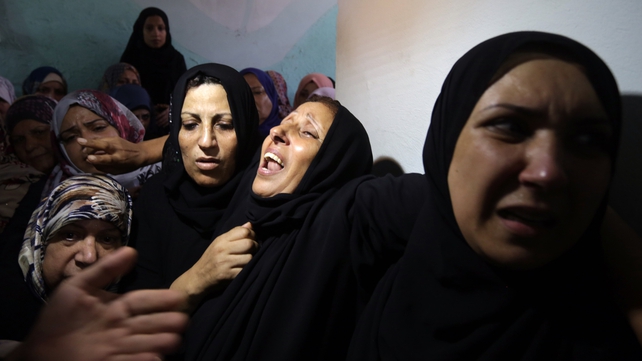
On the 11th October, the text-based news highlights on RTE’s ‘News Now’ channel, featured an image of grief-stricken Arab-Palestinian women, also found on the RTE website, with the accompanying words: “France has said the escalation of violence in the Palestinian territories and Jerusalem was ‘extremely worrying and dangerous’”. The use of such an emotive image, with the accompanying text, places indirect blame on the Israeli authorities for the rise in Arab-Palestinian fatalities. The image inevitably carries with it an inference that those killed were substantively innocent, when many of the fatalities targeted, and sometimes murdered, Jewish civilians.

RTE did not qualify which grouping was initiating violence against the other, even of the past events that led to the 2014 Gaza war, Operation Pillar of Cloud. The November 30th morning ‘News Now’ bulletins reported that Mohammad Abu Khdeir’s “killing was part of a cycle of violence that led to war between Israel and militants in Gaza.” RTE failed to address which group initiated the sequence of events, despite 16 months passing, and misrepresented the character of those events. The brutal murder of Abu Khadir on July 2nd 2014 was likely a reaction to Hamas’ kidnapping and murder of three Jewish teenagers in Judea and Samaria (West Bank), but war in Gaza developed as a consequence of increased rocket attacks. Some believe the attacks from Gaza increased as a result of the mass arrest of Hamas’ operatives in Judea and Samaria, but a programme of mass arrest to save three teenagers does not correspond with a “cycle of violence”. Neither can Abu Khdeir’s death be thought of as a major event leading to eventual war since the particular warring groups were not involved, and the Hamas-sanctioned rocket escalation had already begun before the 2nd July date of murder.

A notable departure

RTE’s television news department first acknowledged that Arab-Palestinians were targeting Jews in a spate of stabbing and other attacks, two weeks after the dramatic intensification, in a brief October 12th Lunchtime News report (“Palestinian man shot dead by security forces in Israel”), which stated:
“A Palestinian man suspected of attempting to stab a police officer in Jerusalem has been shot dead by security forces. It was the latest in a series of knife attacks in the past fortnight, mainly by Palestinians targeting Jews. Police said the officer was unhurt as he had been wearing a protective vest. On Friday, four people – two Israeli-Arabs and two Palestinians were injured in an apparent revenge attack.”
Oddly, the RTE report again referenced the several days-old stabbing of four Arabs, which, according to reports, largely resulted in moderate injuries. By contrast, RTE never displayed an impetus to balance reports of Jewish violence with reference to the Arab-Palestinian equivalent. Instead, it downplayed the latter.

For example, RTE’s Lunchtime, 6.1 and 9 o’clock news broadcasts (11th Oct, 10 mins) solely reported on the deaths of Arab-Palestinians:
“An Israeli airstrike on a Hamas target in the Gaza Strip hit a nearby house, killing a Palestinian woman and her daughter. This marks an escalation in recent violence, which has seen several Israelis killed and a growing number of Palestinian deaths. The increase in violence has increased fears of a new Palestinian uprising.”
There was no mention of the other attacks during the 11th of October, where, for example, an Arab-Israeli man injured four Israelis in a combined car and stabbing assault. RTE also failed to report the attempted suicide bombing by an Arab-Palestinian woman, which was disrupted by Israeli security personnel, despite the fact that the story garnered significant attention due to its circumstance.

Passive voice

RTE reports typically led with descriptions of Israeli security forces shooting dead Arab-Palestinian aggressors, or of Israeli security measures in reaction to the intensification of violence.

At times, a variant of grammatical passive voice was used in the construction of sentences for RTE’s descriptions. Such sentence structure often occurs in mainstream media reportage of the Israeli conflict. Passive voice allows authors more control over narratives, whereby the responsibility of any agent for instigating events can be obfuscated. With passive voice, the instigating group of a conflict situation can be presented as having been subjected to the actions of other parties to that conflict. It is objectionable, for confusing which side is responsible for the broad-spectrum violence, and for directing blame at those attempting to reduce the effects of the destructive acts. For example, news-presenter Brian Finnerty, Lunchtime News, 16th October reported:
“In the past month, the violence has claimed the lives of eight Israelis and more than thirty Palestinians, some of them suspected of carrying out attacks, have been killed by Israeli security forces.”
Undue skepticism

Statements, such as the above, present a double-standard, where murders, or attempted murders, were treated with scepticism, but not the reactions by the authorities. An element of scepticism is appropriate when dealing with claims made by different groupings in a state of conflict, and media reports correctly use the terms ‘alleged’ or ‘suspected’ when addressing criminal acts by individuals/groups that are not yet affirmed through legal process. Nonetheless, journalists commonly make legitimate determinations of fact, based on the security of accessible evidentiary material, and on very high probabilities, where, for example, clear intent can be ascribed to violent/criminal events. It had been firmly ascertained that a significant number of Arab-Palestinians were killed by Israel’s security forces, but it has also been ascertained that a substantive proportion of those killings were in immediate reaction to terror attacks, as the toll of Jewish casualties, and available video material to a number of the attacks, demonstrates.

With further scepticism, Carole Coleman’s October 20th Lunchtime News report describes a house demolition as “Israeli soldiers dismantling a Palestinian home in the West Bank. The army claims it’s the home of a militant who carried out a stabbing a year ago killing a woman.”

The report refers to the demolition of Maher al-Hashlamoun’s house. Al-Hashlamoun is in actual fact is a member of Islamic Jihad who was found guilty of committing several terrorist attacks, one of which led to the murder of a twenty-six year old Israeli woman. By convention, RTE attribute crimes to individuals who have been found guilty of such acts by courts of law. However, Coleman’s report would lead the viewer to suspect that the demolition is undeserved in some way, because al-Hashlamoun is supposedly innocent, or that his crimes have been insufficiently ascertained.

Notable omissions

The attacks during this period were never described as having a terrorist intent. Yet RTE is not adverse to using the term in relation to similar attacks in the West, most recently with the Belgium attacks.

RTE’s 16th November morning and Noon ‘News Now’ bulletins reported on a gun attack against Israeli troops, when the home of terrorist Mohammad abu Shahin (alternatively spelt ‘Shaheen’) was demolished in response to the murder of Danny Gonen, a Jewish hiker, during the month of June. The news-presenter stated:
“Palestinian medical sources have said Israeli troops shot dead at least two Palestinians during a gun battle in the Occupied West Bank. The Israeli military said in a statement that troops had come under attack during the operation to destroy the home of Mohammad abu Shahin… Some twenty other Palestinians were wounded in the incident as troops demolished the home of a militant whom Israel had said had killed an Israeli man in June.”
The report did not note that Shahin (Shaheen) had previously been found guilty of conspiring to commit a terror attack for which he was imprisoned between 2006 and 2008, and had more recently confessed to committing numerous other attacks. He is a member of the Fatah/Tanzim Force 17 elite terror unit. Israel’s Supreme Court issued a stay of demolition in October to evaluate the case, which was subsequently passed, while another demolition application was rejected.

Abbas’ incitement misrepresented

A 14th October 9 O’clock news report by Carole Coleman (“Two Palestinians shot dead in latest spate of attacks in Israel”) led with the deaths of Arab-Palestinians involved in a terror attack, and used material from her earlier reports that day, analysed in part two of this article. Coleman added:
“This evening Palestinian president Mahmoud Abbas held firm, saying that Palestinians would continue to struggle for the project of nation or state-hood. He spoke of the right to self defence but called for non-violent resistance.”
This is an inaccurate representation of Abbas’ speech, which did not in fact call for a de-escalation of violence. The speech endorsed the ongoing Arab-Palestinian violence, which he characterised as a defensive measure, and presented solely as a reaction to supposed Israeli aggression, particularly against the al-Aqsa Mosque. Abbas attempted to present an Arab-Palestinian teen, who engaged in a stabbing attack, as a martyr akin to Mohammad al-Dura, a story that has been utilised as a widespread source of incitement in the Arab world. Coleman’s description may have been based on the inaccurate accounts provided by a number of news-wire services. The article ‘He Said/They Said: Mahmoud Abbas October 14th speech, and the Mainstream Media’ provides a detailed account of the speech.

The speech was in keeping with the Fatah Party’s production of a substantive amount of material encouraging violence, while demonising Israeli soldiers. Coverage of trenchant PA/Fatah incitement, and associated conspiracism involving the Temple Mount/Haram al-Sharif, was entirely absent however.

By contrast, RTE’s coverage of a speech by Israeli prime-minister Benjamin Netanyahu, on October 21st, was very negative. The speech garnered international attention because Netanyahu asserted Grand Mufti Haj Amin al-Husseini had a principle role in encouraging Hitler to wholly adopt a programme of extermination against Europe’s Jewish people but soon clarified that he had no intention of exonerating Hitler. Some of RTE’s reports did include that clarification, whilst other reports did not. The revolving text on the ‘News Now’ channel stated: “Netanyahu provokes holocaust row” — a title also applied to RTE’s syndicated website coverage of the controversy. The article ‘Mufti Haj Amin al-Husseini’s Initiatory Role in the Extermination of European Jewry’ provides a detailed account of the way in which the international media misrepresented history to criticise the PM.

Obfuscation of identity

The 13th of October may be remembered as a peak in the anti-Jewish violence of the period, due to the high number of civilian casualties. The varying identities of attackers, and their victims, is of crucial importance in reports of sectarian strife, but the atypical wording of RTE coverage suggests there may have been attempts to confuse the issue. Morning and Noon news-bulletin reports, on the 13th, stated:
“In Israel at least two passengers have been killed in separate attacks on buses in Jerusalem. The first person died in a gun and knife attack on a bus in the East of the City. Police later shot him [indistinct word]. In the second, a man drove a car into a bus and then started stabbing passengers.”
These reports were peculiar for avoiding the use of identifying words like ‘Jew’. ‘Israeli’, ‘Arab’, and ‘Palestinian’, etc., even though early reports from Israel clearly delineated the identities of the attackers and their victims.

Michelle McCaughren’s October 13th Lunchtime News report differed by expressing notable sympathy for the victims. The victims of the bus attack are described as “terrified passengers who had no means of escape”. However, she continued to use impersonal descriptions like “attackers”, “men”/“man”, and “pedestrians”. She suggested one attack, involving the car-ramming of pedestrians, was indiscriminate, where the assailant got out and supposedly stabbed “anyone” who was nearby. Although McCaughren did mention that the attack took place in an Ultra-Orthodox neighbourhood, she did not clearly address the fact that Jews were targeted, including a Jewish Rabbi, who would be visibly Jewish, and that the assailants were Arab-Palestinians. Attempts to obfuscate certain identities is common in the mainstream media. The appendix has a full transcript of the report.

McCaughren’s report spent almost as much time on one of the Arab-Palestinian attackers as that of the many victims, by featuring police video of a crowd apparently kicking a would-be attacker at a Tel Aviv bus stop. The report included an extract of a speech by the Mayor of Jerusalem, Nir Barkat, telling Israeli citizens to calm down. The selection of such content suggested that the fears of the Jewish citizenry was unjustified, and/or that they were over-reacting. The report did not mention that the mayor explicitly blamed Arab-Palestinian incitement for the murders, earlier that day.

Carole Coleman’s October 19th Lunchtime News report (“Israeli forces impose tighter restrictions in Jerusalem and West Bank”) also focused to a lengthy extent on the fact that some Israelis, who had just witnessed a terrorist incident at a bus station, then attacked another suspected attacker who would later be found to have been uninvolved. While the reprisal is worthy of comment, far greater attention was paid to this incident than the terrorist attack that initiated the subsequent event.

“Palestinian territories”?

RTE (and other media outlets) typically use the terms “occupied Palestinian territories” or “Palestinian territories” for Judea and Samaria/West Bank, and “Palestinian areas of Jerusalem” for East Jerusalem, etc. For example, the RTE ‘News Now’ screen-text (‘News’ section, October 19th), stated “The Israeli government has announced tougher security measures to tackle unrest in Israel and the Palestinian territories”, while Coleman’s October 14th Lunchtime News report referred to “Palestinian areas of East Jerusalem”. It is markedly different to the term “Arab East Jerusalem”, which does not infer an expected or legally/morally justified national identity. The term is prejudicial however much it may be used by the United Nations.

The areas of East Jerusalem, and Judea and Samaria/West Bank, are politically contested territories, which have largely been ruled by empires for millennia. There has been no legitimate prior sovereign in these regions since the defeat of the Jewish Bar Kokhba Revolt against the Roman Empire, in 135 AD. Many do consider the territories to be occupied. However, the British Mandatory text defines all territory West of the Jordan river as necessarily being designated for “the Jewish National Home”, with only territory East of the Jordan river having the option of alternate applications (Article 25), with good reason since the contested territories represent the cultural and religious core of the Jewish homeland, constituting the first and second cities of Judaism (Old (East) Jerusalem and Hebron), along with its holiest of shrines and places of worship.

Some experts effectively treat Jordan as having held legitimate title but the State waged an unprovoked war of aggression against Israel, when the Jewish State first declared independence in 1948. Thus, it is clear that Jordan illegitimately occupied these territories, and so such an act cannot be a basis for valid territorial claims against another so aggressed. Moreover, the entire thrust for peace, with UN Security Council Resolution 242, the final status talks of the Oslo Accords, etc., make it clear that negotiations with the interested parties are to be the basis for a peace settlement. To describe these territories as entirely “Palestinian”, and as “occupied”, without qualification, pre-empts such a process.


Appendix

An example of language usage — transcript of the 13th of October 2015 RTE Lunchtime News report:
John Finnerty: “In Israel at least three people have been killed and thirty others wounded in a series of knife and gun attacks. It comes on a day of rage declared by Palestinian groups. The Israeli prime minister, Benjamin Netanyahu, will convene an emergency session of the security cabinet later today to discuss the recent surge in violence.”
Michelle McCaughren [reporting]: “The attacks took place as early morning commuters made their way to work. The assailants used guns and knives, and in one instance drove a car into a group of pedestrians in an ultra orthodox neighbourhood of East Jerusalem. The driver then got out, and wielding a knife, attempted to stab anyone standing nearby. The most serious incident took place earlier in the capital when two men stormed a bus. One opened fire and the other used a knife on terrified passengers who had no means of escape. It resulted in multiple casualties. One of the attackers was shot dead by police. The other was seriously injured.
In a suburb of Tel Aviv an angry crowd gather around a man suspected of trying to stab another man at a bus stop. A video distributed by the police shows him being kicked and beaten as he lies on the ground. Calling for greater security measures, the mayor of Jerusalem, Nir Barkat, appealed for calm. He said all citizens must know that they cannot take the law into their own hands. The public must calm down and let the security forces do their job.
These types of incidents have increased in frequency in recent weeks and appear to be random and sporadic. The security forces say they are difficult to predict and even more difficult to bring under control.”


Published at Crethi Plethi.

Analysing Trends in Mainstream Media Bias: RTE’s Coverage of the 2015 Quasi-Intifada – Part Two

This article provides an analysis of two RTE television news reports, during the Autumn 2015 period, when a sharp rise in Arab-Palestinian attacks against Israeli civilians, and security personnel, occurred. Broad issues of normative journalistic practice are also discussed. The preceding part of this series analyses, more broadly, a relatively large number of other RTE reports broadcast during the same period. RTE Player links of the principle daily television news programmes (Lunchtime News, 6.1 (6 O’clock) News, and 9 O’clock News) are only made available by the broadcaster for a limited period of time.

Carole Coleman reports

An 14th October Lunchtime News report by Carole Coleman, appears to have partly or indirectly justified the Intifada-esque conditions in Israel and the disputed territories of the Judea and Samaria/West Bank, as well as the Gaza Strip, by laying undue blame with the authorities opposing the then-resurgent bout of violence. Appendix One features an excerpted transcript of the news-report.

RTE-Player screen-grab, revolving news text,
RTE News Now channel, 14-October-2015

Israel’s security measures are described prejudicially in the report. In the introduction, the news presenter claims the security measures will “seal off” Arab neighbourhoods, while Coleman describes the measures as “blockades”, which misleadingly evokes the actions applied to Gaza. The revolving screen-text on the RTE ‘News Now’ channel also stated: “Israeli police to seal off Arab parts of Jerusalem”. However, the security measures were not remotely as draconian. Roadblocks and ‘stop and search’ measures were put into place. Residents were not being prevented from travelling outside of their communities, nor were people being prevented from travelling into the relevant neighbourhoods.

Coleman’s report features quotes from two individuals: an Arab resident who was hostile to Israel, and a representative of an anti-Israel NGO. Coleman did not quote an alternate perspective for the report.

An Arab man, identified as ‘Khader Ishkirat’, a resident of Jabel Mukaber, provided his views on the new security restrictions. He described these measures as “collective punishment”, and presented the restrictions as somehow contravening the pursuit of a two-state peace solution. However, Coleman’s report failed to note that the Jabel Mukaber neighbourhood is an Arab-Palestinian village in the environs of Jerusalem, which has earned notoriety, both as a flashpoint of violence, and due to a number of its residents having engaged in particularly vicious acts of terrorism, which include what was the then-current violent upsurge. Jewish residents have experienced substantive violence, due to their proximity to the village.

RTE-Player screen-grab, RTE Lunchtime News, 14-October-2015, Carol Coleman
 report, featuring Sari Bashi, of the NGOs Gisha & Human Rights Watch

Sari Bashi, identified as a representative of Human Rights Watch, also offered highly critical views on the security measures. Bashi however is better known as the co-founder and Executive Director of anti-Israel NGO Gisha.

Bashi does not have a reputation for presenting balanced critiques on the Israeli-Jewish/Arab-Islamic conflict. She defended the reputation of notorious terrorist Shawan Jabarin. Moreover, Gisha’s critiques erased the context of Israeli military actions as constituting reactions to Hamas’ rocket bombardments from Gaza. The NGO also baselessly charged that Israel was violating the rights of students from Gaza.

Misrepresenting the root causes of the conflict

The most problematic aspect of Carole Coleman’s report is the overt attempt to lead its audience into a simplified understanding of a protracted conflict, which stands in contravention with basic established fact, when choosing to blame the current spate of violence principally on settlements and the failure of peace talks, whilst ignoring the most pernicious religious sectarianism that has pervaded this conflict, which existed long before Israel became a reality. The report finds Israel blameworthy, despite the attacks being aimed indiscriminately at Jewish civilians, as well as soldiers and the security services.

This quasi-Intifada erupted following Palestinian Authority (PA) President Mahmoud Abbas’ intensive incitement, featuring false claims of an intent by the Israeli authorities to change the status-quo of the Temple Mount, and harm the al-Aqsa Mosque. The claims were echoed by the PA itself, for example, to quote a near-concurrent PA broadcast:
“The story of the Temple is nothing but a collection of legends and myths for political reasons. They [Jews] have set Palestine and Jerusalem as their goal, and have used the myths in the service of their declared goals of occupation and imperialism. In the spirit of the delusions and legends, they try to get rid of the Al-Aqsa [Mosque] and establish their so-called ‘Temple’ — the greatest crime and forgery in history.”
Mahmoud Abbas set the stage for the violence in his speeches, which were notably supportive of the increasing violence at the Mount. To cite a speech from the 16th of September:
‘His honor [Abbas] saluted the Murabitin (those carrying out Ribat, religious conflict/war to protect land claimed to be Islamic) and stated: ‘Every drop of blood that has been spilled in Jerusalem is holy blood as long as it was for Allah. Every Martyr (Shahid) will reach Paradise, and everyone wounded will be rewarded, Allah willing.’ … and stated: ‘The Al-Aqsa [Mosque] is ours, and they have no right to defile it with their filthy feet.”’
Furthermore, the modus-operandi of stabbing terror attacks had been widely linked to several speeches by leading Muslim-Arabs.

Arab members of the Israeli Knesset also led incitement drives, claiming Jewish people have no right of worship on the Temple Mount.

Likewise, a survey of concurrent Arab-Palestinian opinion demonstrated that most oppose the two-state solution, based on the principle of two-states-for-two-peoples. Only 30% supported a one-state solution where Arabs and Israelis possess equal rights. No less than 58% were against the recognition of Israel as a nation for Jewish people, that carried a mutual recognition of Palestine as a nation for Arab-Palestinian people.

Palestinian leaders rejected a two-state solution, and peace with Israel, in 2000, 2001 and 2008, the latter of which afforded near 100% of all Palestinian Authority territorial demands with mutually agreed land-swaps. If Arab-Palestinians were truly despairing due to a lost quest for their independence, they would instead punish their own leaders for repeatedly undermining that process.

The report ignores a phenomenon that led to a century of anti-Jewish Arab-Palestinian incitement at all levels of society. It led to pogromic episodes that began circa 1920 in Jerusalem, some 47 years before the Six-Day war. Likewise, the Second Intifada erupted following PA incitement over false claims of Jewish designs on the al-Aqsa Mosque. At the time Arafat believed a bizarre conspiracy, where Israel would engineer an earthquake to destroy the Mosque.

RTE-Player screen-grab, RTE Lunchtime News, 14-October-2015, Carol Coleman report,
captioned: "Palestinians also cite increased encroachment on the al-Aqsa..."

Reiterating sectarian propaganda

Most surprisingly, Coleman appears to endorse the Arab-Palestinian conspiracy that Jews are somehow undermining the Temple Mount/Haram al-Sharif, when she stated “Palestinians also cite increased encroachment on the al-Aqsa Mosque compound in Jerusalem’s Old City…” She did not state that this is a disputed claim. Netanyahu has repeatedly asserted that there is no attempt to change the ‘status quo’, nor does there appear to have been any notable increase of visits to the Temple Mount. The prior year’s figures show only a marginal number of Jewish people being allowed access to the Temple Mount. Israel has done nothing to provoke such fears. The conspiracy is also supremely unlikely, since prior fears over the site were unfounded.

Coleman claims the al-Aqsa Mosque, and its environs on the Temple Mount, is holy to both Muslims and Jews. The Temple Mount is an extremely large site, which is of course holy to the Jewish faith, but the actual structure of the Mosque, and its environs (the al-Aqsa compound), is no more holy to the Jewish faith than that of any other holy structure to an unaffiliated religion. The al-Aqsa Mosque sits on the Mount to the far-south. It is of less relevance to the Jewish faith than the Dome of the Rock, (located in the middle of the Mount), since it was built in the area where the Jewish Temple once stood.

Orla Guerin, a former RTE journalist, also inaccurately claimed, at the BBC, that the Mosque itself is also holy to Jews. Such assertions may be borne of a lack of knowledge, but both journalists are noted for possessing strong anti-Israel viewpoints. This stance reinforces one aspect of the Arab-Palestinian conspiratorial narrative, namely that Jewish people supposedly desire to take over the al-Aqsa Mosque.

The Arab-Palestinian narrative on the issue is wholly implausible, with for example the BBC’s Nawal Assad fancifully asserting that the al-Aqsa Mosque effectively sits on the whole of the Temple Mount, and so the supposed desire to rebuild the Temple necessitates the destruction of the al-Aqsa Mosque.

Despite often invoking the notion of the Temple Mount ‘status quo’, RTE has failed to explain to its audiences what the term meaningfully constitutes. The ‘status quo’ is the denial of religious rights for the Jewish faithful on their holiest site, whilst ceding control of the Mount to the Islamic Waqf. To explain the conflict as substantively constituting one religious groupings resistance to another religious grouping’s assertion of their most basic of religious freedoms, would greatly undermine the claims of Coleman, Guerin, and so many others in the mainstream media, that the upsurge in violence was stoked by a desire for independence. This choice can be understood as an intentional manoeuvre, because it neatly fits RTE’s complete failure to report that the upsurge coincided with wide-ranging Islamic conspiracism, stoked by Abbas and other leaders.

Opposition to basic rights infers that the violence is motivated by Israel’s existence as a predominately Jewish nation situated in the historic House of Islam (Dar al-Islam). Such violence was a feature of Israel’s existence before it took possession of Judea and Samaria, in a defensive war against Jordan and other neighbouring Arab-Islamic states. The violence that concurrently emanated from Gaza cannot justifiably be deemed to be a direct consequence of living under a claimed occupation.

Pro-Israel bias?

Raymond Deane, a leading founder-member of the Irish Palestinian Solidarity Campaign, publicly stated on his Facebook page that he complained to RTÉ about the radio-equivalent of the same programme. He accuses Coleman of having a pro-Israel bias, and asserts that the report presented a racist attitude toward Arab-Palestinians:
“On today’s News at One on RTÉ Radio 1 (14th October), your reporter Carole Coleman asserted that while “7 Israelis have been brutally murdered,” 30 Palestinians merely “died in the ensuing violence.”
This is not merely an unprofessional formulation, but a formulation so outrageously biased as to border on racism. To begin with, it omits context: the ongoing, daily violence of the Israeli state against the illegally occupied, colonised and besieged Palestinian people. Secondly, it decontextualises “the ensuing violence”, as though it just happened out of the blue without anybody being responsible. Thirdly, it fails to itemise the acts of “ensuing violence”, most of which constituted “brutal murder” by the Israeli security forces and by armed colonial settlers, whose presence in the West Bank and occupied/annexed East Jerusalem is illegal under international humanitarian law.
It is clear that Carole Coleman views the deaths of Israelis (which I do not condone) as a matter of far greater significance than the deaths of those oppressed, persecuted, dispossessed and colonised by the Israeli state – hence my sense that her formulation is inherently racist.”
However, Coleman’s formulation was largely accurate. The Israelis murdered were civilians who were going peaceably about their business. They were murdered solely for having an identity that their attackers disapproved of. As Associated Press reported on the 16th of October:
“Over the past month, eight Israelis were killed in Palestinian attacks, most of them stabbings. In that time, 31 Palestinians were killed by Israeli fire, including 14 labeled by Israel as attackers, and the rest in clashes with Israeli troops.”
These clashes are often described in the mainstream media as ‘protests’. However, such events are in fact violent confrontations with troops and security personnel.

It would be prejudicial to conflate the unprovoked murder of one grouping, with the fatalities of another grouping that voluntarily chose to aggress, and by extension the associated deaths of the latter grouping, typically leading from protracted episodes of violent confrontation and riot. Interestingly, Coleman’s description strayed from the norm at RTE, for example, an October 20th Lunchtime News report features the sort of conflationist language that may meet with Deane’s approval:
“UN Secrteary General, Ban Ki-moon, is meeting Israeli prime minister Benjamin Netanyahu and Palestinian President Mahmoud Abbas today, in an effort to calm tensions which have seen at least 42 Palestinians and 8 Israelis killed.”
Deane charged that the description of Israeli and Arab-Palestinian deaths ‘decontextualises “the ensuing violence”’, before making the charge of occupation, whilst invalidly claiming that Jewish settlements in Judea and Samaria, contravene International Law. However, Deane takes the remarks on the death toll out of context. Coleman’s report does cite those very issues as causal factors, when she stated that the quasi-Intifada has been enacted: “…by Arabs upset by Israeli occupation”, adding that “The causes of the turmoil include settlements and the failure to achieve a Palestinian state.”

Deane claimed that he is not justifying the death of Jewish civilians, but his efforts to explain Arab-Palestinian violence as a result of the very worst of supposed Israeli actions, namely as reactions by the “oppressed, persecuted, dispossessed and colonised”, is a distinct apologia for terrorism, as might be expected given the extremism of many of his prior expressions of support for the Arab-Palestinian cause.

Deane’s criticism is without foundation. A significant amount of criticism of the media from anti-Israel voices, originates with a desire to see the Jewish State demonised to a greater intensity in the media, since such criticism is often directed at media sources that are explicitly pro-Palestinian, for example, the Guardian, and the New York Times, with activists creating fake bias apology editorials.

November’s peaks and troughs

RTE’s TV coverage of the conflict became more infrequent during the month of November. The rate of the ongoing attacks had declined significantly, but still occurred at an atypically elevated level, with 326 recorded attacks, of which 249 utilised firebombs. Reports were brief other than that of the 12th of November. Israeli undercover agents raided the Al Ahli Hospital Hebron, in the PA administered zone of the city, to retrieve Azzam Shalaldeh, a Hamas operative who had stabbed a Jewish resident two weeks earlier.

The event was the second featured story in morning bulletins. Revolving screen text for the ‘News Now’ channel stated: “Israeli agents shoot man in hospital”. The raid became the headlining story for the Lunchtime News show, and subsequent afternoon news bulletins, which featured a report by Brian O’Donovan. News-presenter Aengus McGreanna stated “Undercover Israeli soldiers raid a hospital in the West Bank and kill a Palestinian man” in the opening headline for the Lunchtime show. The 6.1 News also highlighted a very similar report.

The report included numerous comments, and fact-based claims, by Arab-Palestinian individuals, but did not feature speakers presenting an alternate Israeli position. Despite a detailed report of the event itself, O’Donovan merely stated “There’s been a wave of violence in Israel, Jerusalem, and the West Bank, since the start of last month” as context for the concurrent wave of terrorist attacks and rioting.

O’Donovan’s report features footage of the detained Arab-Palestinian man’s brother, claiming that his relative, Abdullah, was shot dead for merely looking at the Israeli agents, after having been told to stay in his part of Azzam Shalaldeh’s hospital room. This assertion diverges with the claim by the Israeli authorities, that the relative was shot dead for attacking the operatives. The viewer is presumably supposed to believe the former claim, since similar reports on the 9 o’clock News programme, and the 11 PM news bulletin, excluded all mention of the Israeli assertion, whilst affording the brother’s account absolute credibility. O’Donovan stated:
“During today’s operation, the suspect’s cousin was shot dead, and his brother witnessed it all.”
The late exclusion of one perspective was made despite available reports that the Shalaldeh family had partially retracted the claim that Abdullah had not attacked the Israeli agents.

The report featured the director of the hospital, Dr. Jihad Shawar, stating (by translation) “This is a clear breach of international laws and ethics. It is well known that hospitals are a safe place for everyone.” The claim that it is against international law to detain any individual while at a hospital is an unusual assertion, but the claim was not challenged. The Third Geneva Convention ‘relative to the Treatment of Prisoners of War’, is the most widely cited international statute on the matter of the fair treatment of prisoner combatants. However, the Convention, does not apply to illegitimate combatants, principally defined as individuals who do not follow the normative rules of engagement. It does not apply to those who engage in terrorist attacks, such as the intentional targeting of civilians uninvolved in a conflict. Moreover, Azzam Shalaldeh was not being held in custody by the Israeli authorities while in hospital.

The story was newsworthy, but it is difficult to account for such intensive media focus on what was otherwise a busy day for domestic news stories, when the same news editors had largely ignored the insurgent Arab-Palestinian violence for several weeks. The video footage of disguised Israeli agents might be newsworthy, and indeed O’Donovan introduces the report with the words: “A dramatic armed raid captured on CCTV”. Yet visually dramatic Arab-Palestinian attacks on Israeli security personnel were also caught on video during the same period, but they did not garner attention at RTE. The broadcaster’s interest in the hospital-raid story was so significant that two suicide bombings in Beiruit, which at the time were known to have killed in excess of 37 people, and wounded hundreds more, played second-fiddle in the later news programmes.

The BAI ‘Code of Fairness, Objectivity and Impartiality in News and Current Affairs — Guidance Notes’, July 2013 (pages 8 – 9), note that news material should be accurate, unbiased, and lack prejudgement. Unfortunately, both RTE reports featured have breached these principles to a very substantive extent.


Appendix

An excerpted transcript of the 14th October Lunchtime News report by Carole Coleman:
Presenter Sharon Toban [RTE studio]: “Israel’s cabinet has authorised police to seal off Palestinian areas of East Jerusalem and soldiers have been deployed in response to a worsening spate of violence. Seven Israelis and thirty Palestinians have been killed in the past two weeks.”
Carole Coleman [narration and associated video footage]: “Israeli border police erecting road blocks in Arab East Jerusalem. They are stopping Palestinians for inspection — checking cars for anything that might be used to cause mayhem. The blockades sanctioned by Israel’s cabinet have been prompted by a wave of violence, stabbings and car rammings carried out by Arabs upset by Israeli occupation.”
“Many residents disagree with sealing off Palestinian areas.”
Khader Ishkirat, a resident Jabel Mukaber: “The collective punishment will not achieve the goals of the Israeli government. The only way to achieve the goals of a peaceful way of living between the Israelis and the Palestinians is to establish the two-state solution.”
Coleman continues: “Human Rights Watch fears the blockade will make things worse.”
Sari Bashi, Human Rights Watch: “Given the history of abuse and neglect by Israeli authorities in East Jerusalem, it’s only going to exacerbate tensions between residents and police. It’s exactly what we don’t need.”
Coleman continues: “Seven Israelis have been brutally murdered in the past two weeks. Thirty Palestinians have died in the ensuing violence.”
“The causes of the turmoil include settlements and the failure to achieve a Palestinian state. But Palestinians also cite increased encroachment on the al Aqsa Mosque compound in Jerusalem’s Old City, an area holy to both Muslims and Jews.” […]


Published at Crethi Plethi.

Saturday, 23 April 2016

Rafeef Ziadah‏ - a rather objectionable “poet”

'International Literature Festival Dublin’ - source: ark.ie


Next month’s ‘International Literature Festival Dublin’, will feature numerous speakers of a certain political persuasion – the likes of Naomi Klein, Yanis “evilly grinning the IMF/EU into submission” Varoufakis, and so-called “peace activist” Margaretta D'Arcy.

The oddity of art events universally promoting hard-left politics, with a revolutionary slant, in festival after festival, is worthy of comment. Indeed, such events do not seem to be complete without an Arab-Palestinian or two completing the bill. In this instance, one of the two stages of the Abbey Theatre will be graced by Rafeef Ziadah on the 22nd of May. To quote the International Literature Festival’s promotional literature:
‘“Rafeef’s poetry demands to be heard” ~ Ken Loach

Rafeef Ziadah is an acclaimed Palestinian refugee poet and activist. Her poem ‘We Teach Life, Sir’ – an impassioned attack on media misrepresentation of the Palestinian cause – went viral within days of its release, clocking up millions of views, and since then she has toured the world, representing Palestine at the Poets Olympiad in London in 2012 and releasing We Teach Life, an acclaimed new album of poetry and songs. This live show offers an exciting blend of poetry and music, which she brings to the stage with Australian guitarist and We Teach Life producer Phil Monsour.’
It is standard in the promotion of such events for the contentious and often objectionable character of such guests to be completely ignored. Thus, Rafeef Ziadah is presented merely as a “Palestinian refugee poet and activist”. Whilst it might be unfair to expect promotional material to afford full voice to her critics, it is nonetheless quite a white-wash, given her close association with a number of highly objectionable organisations. Perhaps indication of such would raise question (in the mind of the reader) about the legitimacy of her invite.

Ziadah claims to be a Lebanese-Palestinian refugee but uses her family history to promote a victim narrative that is out of step with the historical record of the era.

Ziadah is first and foremost a leading and widely publicised BDS campaigner. She is as a member of the Palestinian BDS National Committee (BNC), which is “the Palestinian coordinating body for the BDS campaignworldwide.” She is also a member of PACBI (Palestinian Academic and Cultural Boycott Initiative) – a group that became notorious for its dishonesty, stances opposed to reconciliation, and inflammatory pseudo rights-based rhetoric, and claims on her website to have been a founding member of "Israel Apartheid Week", a movement which is noted for its anti-Semitism, which has increasingly made campuses a hostile space for Jewish students,

Ziadah is also a leading member of controversial UK charity ‘War on Want’, which has engaged in particularly egregious activity designed to inflame extreme hatred, leading the UK government to cease affording the organisation the financial benefits of a charity.

Ziadah is a lecturer at SOAS, University of London (the School of Oriental and African Studies), doubtlessly teaching her brand of hatred at the university’s ‘London Middle East Institute (LMEI)’ and ‘Centre for Palestine Studies (CPS)’. In her role she has presided over events that forwarded discredited, demonising, and decidedly anti-Semitic theories, such as the claim that Israel harvests the organs of Arab-Palestinians, and engages in the systematic rape of Arab prisoners.

Ziadah opposes the Oslo Accords and effectively calls for the destruction of Israel. Much like her boss at PACBI, Omar Barghouti, She has made it clear that the boycott movement is an effort to destroy Israel, regardless of any future placement of its borders:
“Rafeef concluded the forum with an open invitation to all to her house in Haifa, once Palestine is free. Once she can return home. And the campaign to boycott the products of Carmel Agrexco is a step along the way.”
Ziadah makes much of her claim that those who collectively make up Arab-Palestinian society “teach life”. This is of course a response to criticism concerning normative Arab-Palestinian incitement, which teaches a particularly violent form of hatred towards both Israeli citizens, and Jewish people more generally. Such sentiments are inculcated in a systemic form from childhood, through education, familial bonding and popular entertainment. And yet Ziadah has praised figures like Khader Adnan, who is a leading member of Islamic Jihad, noted for his encouragement of suicide-terrorism. However, she believes it is to engage in a racist discourse to actually discuss this abiding threat to Israel's existence.

Ziadah’s hypocritical posturing does not make her “We teach life” meme any more sincere than rather ambitious mass-invites to her future home. However, her message will continue to be presented uncritically at festivals in the coming months where she will promote her new album.


Also published at Crethi Plethi.


Thursday, 22 October 2015

Mufti Haj Amin al-Husseini’s Initiatory Role in the Extermination of European Jewry

(Updated - 23rd October)

Israeli Prime Minister, Benjamin Netanyahu, has been harshly criticised in recent days for highlighting what he believes to be the role of Haj Amin al-Husseini, the Grand Mufti of Jerusalem during the British Mandate era, in encouraging the initiation of the most destructive phase of the Holocaust. The position of Grand Mufti affords the highest authority on religious law in Sunni Muslim nations.

During a speech at the 37th World Zionist Congress in Jerusalem this week, Netanyahu claimed that Hitler originally intended to expel European Jews but changed his mind due to the influence of al-Husseini. The Mufti argued that the expulsion of the Jews would lead to their migration to Mandatory Palestine, which he had a leading role in violently opposing. Netanyahu stated that Hitler was persuaded to exterminate Europe’s Jewry at a meeting between the two men on the 28th November 1941.

The Mufti of Jerusalem, Haj Amin al-Husaini, meets with Adolf Hitler,
 November 28th, 1941

The claim has been widely criticised. Some elements in the media presented Netanyahu as somehow making trouble, for example RTE titled its article on the controversy: “Netanyahu provokes Holocaust row” when in fact the Mufti’s relationship with Hitler was only referred to briefly in the speech. The thrust of criticism concerned Arab-Palestinian incitement from the Mufti’s era to the present, which media outlets ignore.

Fatah-PLO lambasted Netanyahu's comments, unsurprisingly perhaps, given al Husseini's heroic status in Arab-Palestinian society. Carlos Latuff, an illustrator who deals in anti-Israel propaganda, mocked Netanyahu over the episode. Latuff makes near-continual use of Holocaust imagery to demonise the Jewish State’s role in the Israeli-Arab conflict.

Moshe Zimmermann, of Jerusalem’s Hebrew University, went as far as to argue that Netanyahu is a Holocaust denier:
“Any attempt to deflect the burden from Hitler to others is a form of Holocaust denial”
Such a charge is a nonsense since Netanyahu didn’t deny Hitler’s responsibility for the Holocaust. Holocaust Deniers deny that the Holocaust occurred, suggest there was no intent to exterminate European Jews, or minimise or relativise the dimension of the episode by presenting it as a fairly typical genocide for the period. The term is not used for those who argue that Hitler may have been influenced by other allied elements.

Associated Press failed to note that Moshe Zimmermann has a record for applying offensive Holocaust terminology to Jewish political opponents. He described Hebron’s Jewish children as ‘Hitlerjugend’ (Hitler Youth). Such behaviour is often deemed to be objectionable since it trivialises the scale and cruelty of the Holocaust. Thus, it is most peculiar for Associated Press to claim that Zimmermann is a prominent expert on anti-Semitism. His expertise in fact focuses on German history, and is regarded as one of the most extreme anti-Israel propagandists in Israeli academia.

Netanyahu later clarified that he had no intention of absolving Hitler of his responsibility for the extermination programme but wished to highlight “the role played by the Mufti, Haj Amin al-Husseini, a war criminal, in encouraging and goading Hitler, Ribbentrop, Himmler and others to exterminate European Jewry.”

Associated Press wrote that unnamed historians disagreed with Netanyahu’s claim of the Mufti’s role:
“Historians quickly noted that the Nazi Final Solution was already well underway at this point, with several concentration camps up and running. Hitler had previously repeatedly declared his lethal intentions for the Jews.”
Such claims are not in keeping with the known timeline of the Holocaust, and also conflates the nature of concentration camps. There were concentration camps in NAZI Germany going back to the middle 1930s but they were not extermination camps. Camps with the principle purpose of committing mass murder are known to have only been built after the Wannasee Conference of January 1942, which marked a major turning point in the Holocaust.

Hitler had indeed declared a lethal intent towards the Jewish race, such as in a January 1941 speech but it was clearly a threat of extermination should war spread internationally. Hitler’s private speech to Nazi Leaders 20 days after his meeting with al-Husseini attests to his wish for extermination to finalise the ‘Jewish Question’. It is important to note that this was after war had spread to the United States and the USSR. Hitler appeared to believe that powerful international Jewish financiers were out to destroy the Reich and the Germanic people. His stance may have been propagandistic but the NAZIs projected many of their own character defects upon a notional Jewish collective which was described as genocidal in intent.

There is no consensus among historians as to when NAZI Germany decided upon extermination rather than a mix of expulsion, starvation and genocide. Arguments tend to vary, favouring the middle of 1941 or closer to the end of 1941 as the turning point in this horrific episode. Critics might argue that Netanyahu pointed to a specific meeting as turning Hitler’s opinion toward extermination rather than expulsion. However, it appears to be incorrect to point to the existence of genocidal methodologies prior to al-Husseini’s visit, as a refutation of Netanyahu’s stance.

It is worth noting that an expulsion strategy was adopted at the time as a solution to the ‘Jewish Question’. Mass genocide was systematic in the newly NAZI-occupied areas of Eastern Europe which had an immensely destructive impact on the regional Jewish populaces but this strategy does not appear to have been envisaged as the primary solution for ending European Jewry's presence. Professor Peter Longerich, a scholar of the Holocaust, argues that it is difficult to place the exact date of transition toward a programme of pure extermination:
“In mid-1941, Hitler ordered the deportation of Jews from the Greater German ‘Reich’ to Eastern European ghettos. Ten thousand German Jews were sent to Lodz, Minsk and Riga between October 1941 and February 1942. From March 1942 they were deported to ghettos in the Lublin district. Hitler was thus putting into practice his plan, developed at the start of 1941, to deport the Jews to occupied Soviet territories. But he did not wait for his original precondition to be fulfilled — military victory over the Soviet Union’s Red Army.
In autumn 1941, the Nazi regime extended the policy of mass murder to areas outside the Soviet Union. In so doing they drew on experience gained from the defunct T4 ‘euthanasia’ programme. From this point, fixed and mobile gas chambers were to be used to murder Jews. At Chelmno, from December 1941, specially adapted buses (Gaswagen) were used for this purpose. In March 1942, Belzec extermination camp went into operation, killing Jews from Lublin and Galicia.
The exact date on which the leadership of the Nazi regime decided to convert the as-yet-unplanned intention to exterminate all European Jews into a concrete programme is not documented and is still the subject of controversy among historians. It is likely that it was not the consequence of a single decision, but of a longer process.”
A multifaceted strategy for resolving the “Jewish Question” was not novel. Konstantin Pobedonostsev, a leading Russian political figure of the late 19th Century, famously remarked on what he saw as the desired fate of the then three-million Jews living in Imperial Russia: “one-third will die, one third will leave the country, and the last third will be completely assimilated within the Russian people.”

Al-Husseini was in contact with the Third Reich since 1933, and testimony, such as that of Eichmann’s assistant, Dieter Wisliceny establishes that he had a role in encouraging a Holocaust extermination programme, rather than expulsion as a means for Hitler to be rid of the Jewish people:
"Adolf Eichmann’s deputy, , stated at his Nuremberg trial that the mufti’s importance “must not be disregarded[.] … [T]he Mufti had repeatedly suggested to … Hitler, Ribbentrop and Himmler, the extermination of European Jewry"
Andre Steiner also relayed a conversation with Wisliceny in Bratislava, June 1944:
"When acting as adviser on Jewish affairs to the Slovakian government, Wisliceny is believed to have said that “the Mufti was one of the instigators of the systematic extermination of European Jewry and was a partner and adviser to Eichmann and Hitler for carrying out this plan.” (citation from the book “Israel: The Will to Prevail,” by Danny Danon, 2012).
Some prominent historians have cast doubt on the accuracy of Wisliceny’s statement however, arguing that the timelines suggest the Mufti’s meeting with Hitler came too late, although Wisliceny suggests that al-Husseini influenced other members of the Third Reich as well.


Bernard Wasserstein’s book ‘Britain and the Jews of Europe, 1939-1945’, asserts that the Third Reich precluded Jews being allowed to emigrate to British-Mandatory Palestine due to the NAZI alliance with the Mufti — in March 1941, Hitler agreed to this condition, and a few months later the Nazis ended the legal emigration of Jews from areas under German control, for which they often extorted substantial sums of money.

During 1941, leading NAZI members were advocating the deportation of Jews to the USSR, to free up space for German citizens. Hitler finally agreed to the proposal at the end of September 1941. At some point between October and December, NAZI policy would crystallise into an approach solely constituting extermination. Little wonder that some historians believe that the Mufti’s visit was a pivotal moment in the Holocaust.

The book ‘Nazis, Islamists, and the Making of the Modern Middle East’, authored by Wolfgang G. Schwanitz and Barry Rubin, points to Hitler being open to emigration as a solution to the “Jewish Question” in 1941. The book vividly illustrates (see pages 20–22) the influence that the Mufti brought to bear in helping initiate a mass extermination programme, albeit a contention that is controversial amongst other historians:
“Hitler had to decide precisely how “the very last” of the Jews were to leave Germany. As late as 1941, Hitler thought this could happen, in the words of Hermann Göring in July, by “emigration or evacuation.” Yet since other countries refused to take many or any Jewish refugees, Palestine was the only possible refuge, as designated by the League of Nations in 1922. If that last safe haven was closed, mass murder would be Hitler’s only alternative.
The importance of the Arab-Muslim alliance for Berlin, along with the grand mufti’s urging, ensured that outcome"
The question is one of intentionality. Holocaust deniers would like to believe that Hitler and the Third Reich did not possess the most murderous ambitions toward the Jewish people, and would not have preferred to murder world Jewry rather than merely expel such people. The intensity of Hitler's hatred led him to see Jews as an international threat, and believed that such a concentration in Palestine might cause further trouble, as asserted during his meeting with al Husseini. Yet the scale of murderous ambition would have an impact on the number of Jewish people ultimately killed in the Holocaust.

The issue is one of intent to destroy the entire Jewish populace in Europe, and perhaps the Middle East and elsewhere. The NAZIs murdered a large number of Jews up until 1941 but also entertained expelling them to other parts of the world. The Holocaust is often deemed to have begun in 1941 when death squads murdered Jews en masse in Eastern Europe. A report by a senior member of the Einsatzgruppen states that the death squad killed 137,346 people in Lithuania between the start of July 1941 and the end of November that same year. Thus, the Reich was using ever more lethal efforts to handle Jewish populaces.

Material evidence is somewhat contradictory. Construction in October 1941 of the Second phase of the Auschwitz-Birkenau camp, which would be used for mass extermination the following year, was first intended to ease the prison population, but on the other hand, the first mass killings at Auschwitz took place in September 1941, when prisoners were murdered by gas in the basement of one building.

Rudolf Hoess, the commander of Auschwitz, asserted under questioning 1946, that he was summoned to Berlin to speak to Heinrich Himmler in the summer of 1941. He claimed that Himmler told him that Hitler had given the order for the extermination of the Jewish people, and Auschwitz was chosen for that purpose.

This meeting likely came after Hermann Goering's July 31st order to the more senior figure of Reinhard Heydrich, to prepare plans “for the implementation of the aspired final solution of the Jewish question” in all German-occupied areas of Europe. Such a plan would not necessarily conflict with a plan to deport Jews to Russia, although Adolf Eichmann would later relay (presumably the same order) that Heydrich had told him the following month that "the Führer has ordered the physical extermination of the Jews." However, Gord McFee argues that Hitler was likely indecisive, given the delay in the plans. Hitler’s delayed decision to agree to the mass deportation of Jews to Russia in September suggests that he considered different options to resolve the ‘Jewish Question’.

An active policy of expulsion paralleled murderous policy. As Holocaust specialist Professor David Cesarani noted:
“The autumn of 1941 is one of the strangest and most difficult periods to get a hold of… In the Soviet Union you have got the most radical conceivable kind of ethnic cleansing which is the mass shooting of populations, particularly the Jewish population. You have the crystallization of an idea in Berlin that during the war itself the Jews are going to be removed from the sphere of influence of the Third Reich, which I think at that point means after the defeat of the Soviet Union, which is imminent, dumping them in Siberia, not actually killing them… Tens of thousands of Jews are being massacred, but people are thinking of sending Jews alive to somewhere else where they may die, but they may not.” 
A diary entry by Joseph Goebbels, of the 12th of December, affirms a substantive change in Hitler’s thought: "Führer has decided to make a clean sweep. He prophesied to the Jews that if they again brought about a world war, they would live to see their annihilation in it." This position was echoed in an article published in 1943.

The closest to an outright order for extermination is a note that Heinrich Himmler made in his appointment diary, in the aftermath of the December 18th meeting with Hitler. Himmler wrote: "Jewish Question—to be exterminated as partisans" seemingly in response to Hitler’s belief that “New York Jews” were waging war against the Third Reich, and must now collectively suffer the consequences.

While it is correct to suggest that Netanyahu exaggerated the likely role of al-Husseini in Hitler’s decision to extend the Holocaust programme’s reach, and to claim that other factors would have likely had a substantive impact on Hitler’s decision-making, especially the spread of war to the US, it nonetheless appears to be correct to assert that the Mufti had a significant influence on the Reich when it came to migration policy, including a direct complicity in the deaths of many thousands of Jewish children.

Al Husseini's influence would extend to the establishment of a Bosnian-Muslim Waffen SS division in 1943, and planning to institute a Jewish extermination programme in Palestine, which was prevented by Rommel’s defeat by the British at El Alamein, as attested in the book ‘Nazi Palestine: The Plans for the Extermination of the Jews of Palestine’, by Klaus-Michael Mallmann and Martin Cüppers.
“Arise. O sons of Arabia, fight for your sacred rights. Kill the Jews wherever you find them. Their spilled blood pleases Allah, our history and religion. That will save our honor.” — Haj Amin al-Husseini, radio broadcast, May 1942.
Al-Husseini may not have merely encouraged an extermination programme - there is less historical debate in the fact that he collaborated in efforts to implement such policy, and systematically promoted the NAZI cause in the Arab world. Although the media has presented a white-wash of the Mufti's behaviour, perhaps this week’s argument will encourage some renewed interest in this issue, which has been all too often ignored.
“…The sole German objective in the region will be to liquidate all Jews who live in Arab countries under the patronage of Great Britain.” — Adolf Hitler to Hajj Amin al-Husseini, November 28, 1941.


Also published at Crethi Plethi